




TIMES FOR CONSTRUCTION:
art works and infrastructure at the Living Schools
05 May 2026
In the last few months, the Living Schools have carried out projects that intertwine care, education and creation to remain within their own communities and to reach out to others. At the Huni Kuin Living School, a new communal kitchen has been built to strengthen daily life and community work, and at the Baniwa Living School, the Madzerokai Ways of Knowing House is almost done. At the same time, workshops for the new “Long Live the Living Schools” exhibition at Tomie Ohtake Institute in São Paulo have given shape to other projects in the field of art, such as the mîmãnãm masts, a traditional Maxakali ritual creation that will also be featured in the exhibition. The workshops are part of a movement that still have many new developments in store for the coming months, including paintings, sculptures, and much more.
At the Guarani Living School, the exchange trip to the Rizoma Village in Paraty (Rio de Janeiro) with young people and children carried on deepening the collective process of creating the book “Tekoypy rã – A origem de nós” [Tekoypy rã – The origin of us], which delves into the narratives of Carlos Papá about what we call the world, and Papá explains to be Yvy rupa. Meanwhile, at the Bahserikowi Center for Indigenous Medicine at the Tukano-Dessano-Tuyuka Living School, new initiatives such as the “Transmasc Amazon” and the “Gathering of Knowledges” event have been building further connections between bodies, territories, and social movements.

Maxakali mîmãnãm masts that will be on display at the Living Schools exhibition.

“Gathering of Knowledges” event at the Bahserikowi.
Through initiatives focused on community empowerment, infrastructure maintenance, and the promotion of traditional practices, the Flor da Floresta Institute of the Huni Kuin Living School carried out maintenance on the water collection cistern, the electrical grid, and the solar panels, as well as the purchase of a new inverter for the water collection system, but the highlight was the construction of a communal kitchen in Coração da Floresta village throughout the month of April. The structure included the installation of sinks and a piped water system, a laundry area, showers, and a small dry toilet. The community was committed and actively participated in the construction alongside the team from the Flor da Floresta Institute, which was responsible for planning, acquiring materials, and coordinating the building workers, including a sawyer, carpenter, and electrician, as well as managing material planning, budgeting, and logistics.


Construction of the communal kitchen at Coração da Floresta village.


Shaman Dua Busë next to Netë in the new communal kitchen.
The kitchen is more than a physical space: it’s a place for gathering, care, and well-being, providing better conditions for hygiene, organization, and food preparation. As a shared space, the facility not only improves daily life in practical ways but also fosters practices of coexistence, autonomy, and cooperation within the community. Built by many hands, it is a celebration of an achievement made possible by commitment and affection.
The Huni Kuin Living School has also organized agroforestry activities and planted medicinal and fruit tree seedlings in recent months, and has distributed food and supplies to the Coração da Floresta village, prioritizing purchases from local producers, thereby contributing both to food security and to the preservation of traditional knowledge related to agroforestry management.
In the cultural sphere, two “bales” of natural cotton yarn were delivered, supporting the continuity of weaving and encouraging workshops that keep this ancestral tradition alive, while preparations for the exhibition at the Tomie Ohtake Institute keeps on going.


Pintura de placa na Aldeia Coração da Floresta
The Baniwa Madzerokai Living School is also celebrating the final stages of construction of the Madzerokai Ways of Knowing House, built in record time thanks to the collective dedication of the community. The space was designed to preserve the culture of the Baniwa and Koripako peoples of the Içana River through gatherings, knowledge-sharing, and various activities. Completed in less than a year, the Ways of Knowing House is more than a building: it is a meeting point for generations, where traditional knowledge and youth leadership come together. To learn more about this process, we invite you to read the article “The Madzerokai Ways of Knowing House: a new navel of the world”, which provides details of the journey toward this achievement through testimonials from community leaders.


Etapas de finalização da Casa de Formação Madzerokai.
The ancestral expression “navel of the world” is the title of the book by Francy Baniwa, an artist, anthropologist, and coordinator of the Baniwa Madzerokai Living School. Released in 2023 at the Assunção do Içana community and published by Dantes Editora. The book portrays the mythology of the Baniwa people through Francy’s dialogue with her father, Francisco Fontes Baniwa, considered a maadzero (“wise man,” in the Baniwa language) by the community. The center of all Baniwa life, connecting times immemorial with the present and intertwining worlds and generations, the “navel of the world” also lends its name to one of the installations that's being prepared for the Living Schools exhibition at the Tomie Ohtake Institute. Bringing the power of the Baniwa’s knowledge, culture, and legacy to the public, the work is being created collectively and features raw materials from their territory, ancestral crafting techniques, and a collective reflection on the cosmology and continuity of the Baniwa people.


Etapas de construção da obra “Umbigo do mundo”.
The Guarani Living School visited Aldeia Rizoma, in Paraty, for an immersion with young people and children delving into another stage of creation for the book “Tekoypy rã – A origem de nós” scheduled to be released in June. The book is based on narratives by Carlos Papá and is dedicated to the knowledge and stories of Nhe’ery, which is how the Guarani name the territory that is usually called the Atlantic Forest, a place sustained by water, Y, inhabited by ijás, owners of the beings and responsible for trees, animals and all the elements of nature.
During the immersive process, the Living School participants produced illustrations, recordings, edited, and transcribed stories in a careful and collaborative process. Anna Dantes, the book’s editor, was present for the occasion, listening, observing, and contributing to this process.


Work and other experiences at Aldeia Rizoma, in Paraty.
With the new Living Schools exhibition coming up, the Guarani Living School has also completed the canvases that will be on display in São Paulo at Tomie Ohtake Institute, paving new paths for memories and territories to keep on flourishing.
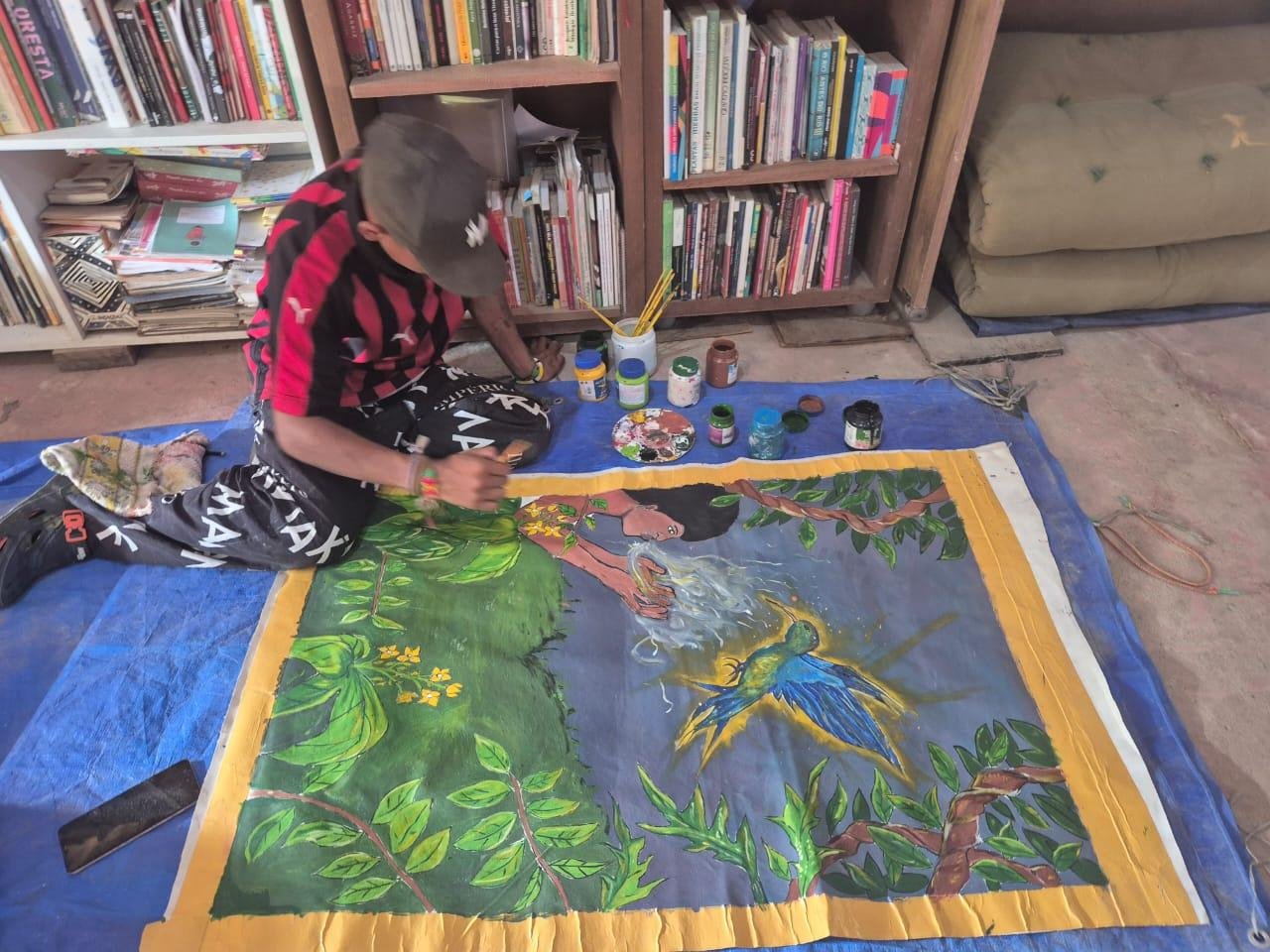
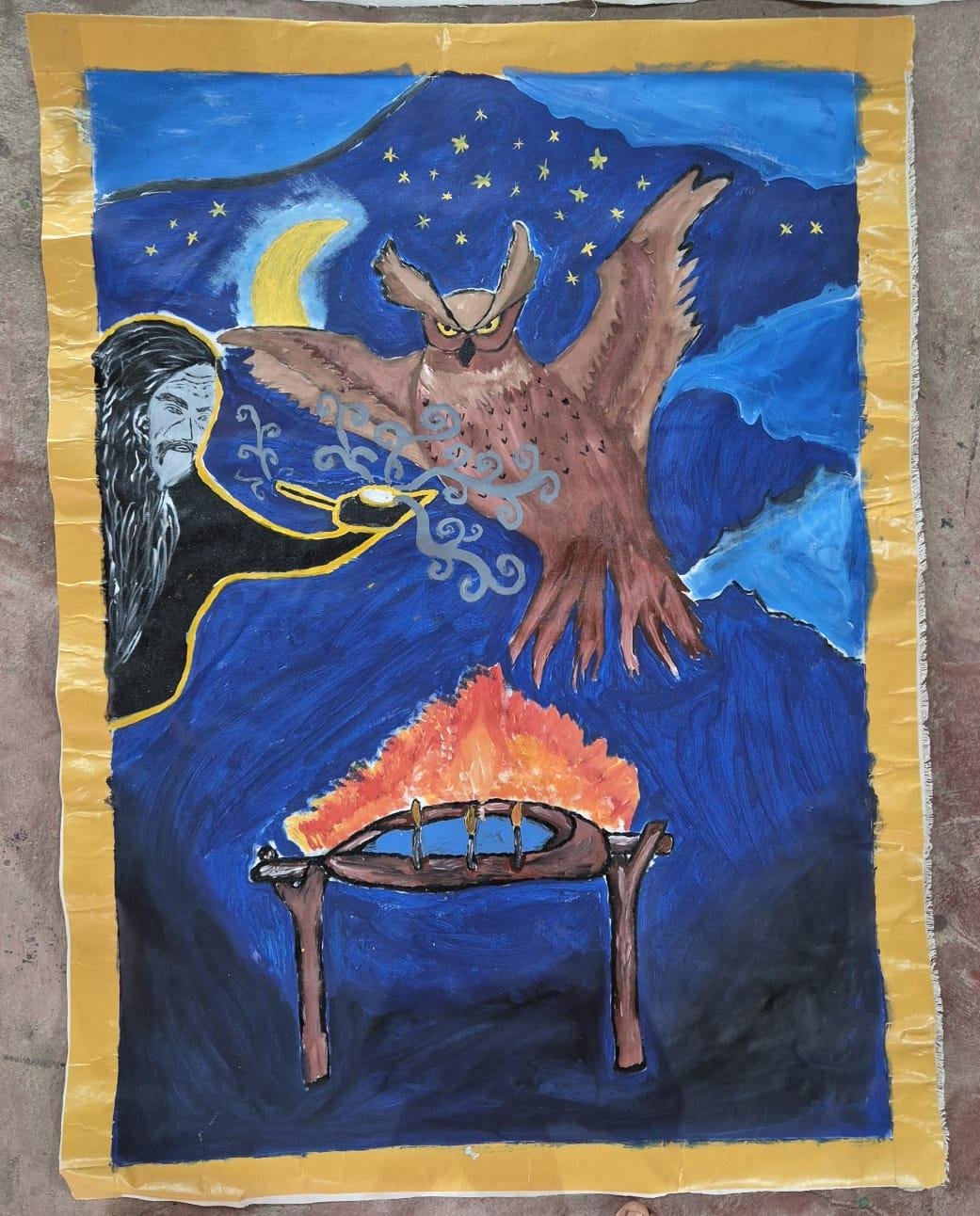
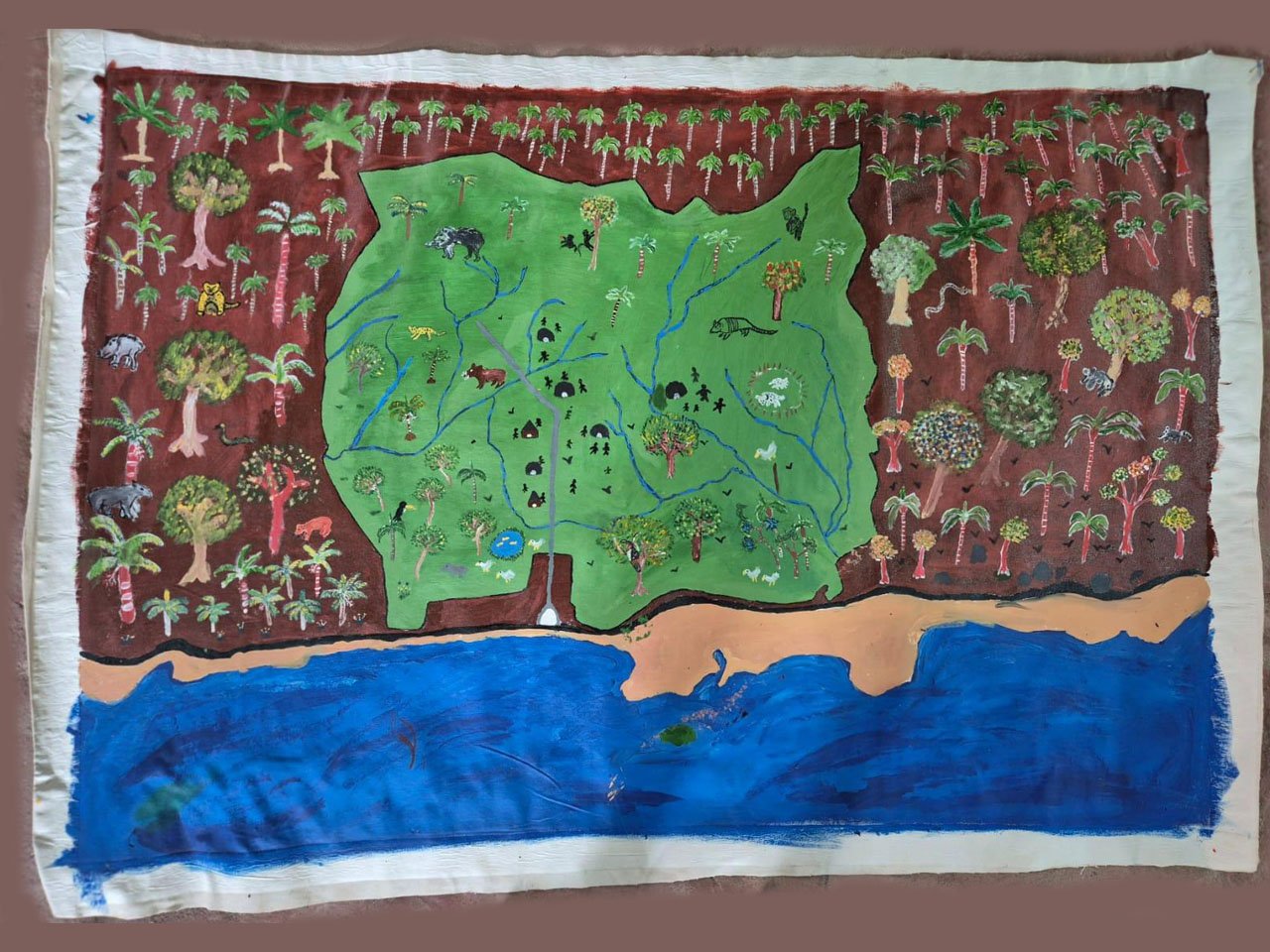
Guarani paintings for the new "Long Live the Living School" exhibition.
Throughout the month of March, a community cleanup effort was held on the community site, bringing together children and young people to take care of the land. Cleaning is not just a preparatory step, but part of the effort to improve the cultivation of certain crops through an agroforestry system. Even though the soil faces challenges—it is still very sandy and highly acidic—the cultivation of bananas, cassava, pineapple, and medicinal plants continues. The plan is to keep clearing the fields to make way for the cultivation of sweet potatoes and other vegetables.


Between playing and taking care, the collective effort of cleaning up and planting a vagetable garden, also becomes a way of knowing shared by different generations.
The Guarani Living School has also expanded its activities and reach beyond its territory through an invitation to participate in the International Symposium “Atlântico Indígena: Conhecimentos e relações de povos indígenas com o mar”, held at USP, UNIFESP, and Tekoa Mirim. On the occasion, Indigenous thinkers and leaders joined forces with Indigenous and non-Indigenous researchers to reflect on territorialities, meanings, and relationships that connect peoples to the sea along the extensive Atlantic coast. The presence of the xeramõi and xejaryi—elders and guardians of the word—brought to light the living force of Guarani thought, bringing the academic field closer to the territorialities that persist and are recreated along the Atlantic Forest coastline.
Meanwhile, at the Bahserikowi Center for Indigenous Medicine at the Tukano-Dessano-Tuyuka Living School, the month of March also fostered new dialogues by hosting events that broaden the exchange between knowledge and social struggles, such as “Transmasc Amazon” and the “Gathering of Knowledges” in addition to providing healthcare services and promoting its regular cultural activities.
Organized by the LGBTQIAPN+ collective, the “Transmasc Amazon” event brought together Indigenous and non-Indigenous people—including researchers, activists, and the general public—for discussions on diversity, rights, and inclusion. The participation of leaders such as Carla Wisu and Ivan Tukano reinforced Bahserikowi's role as a space for listening and coordination among different movements and perspectives, a meeting ground for collective building toward shared and plural futures.

The “Transmasc Amazon” event, held at Bahserikowi.
The Living School was also connected to the Federal University of Amazonas (UFAM) through the “Gathering of Knowledges” event, an educational and research project linked to the Social Sciences program and the Graduate Program in Social Anthropology. Kumu Durvalino Kiibe participated in the discussions offering reflections on the theme “Land through the eyes of Indigenous peoples,” and the closing ceremony took place at the Indigenous Medicine Center itself, bringing together approximately 70 participants, including researchers, Indigenous experts, people from terreiro and quilombolas communities, with debates and dance performances organized by Bahserikowi.


“Gathering of Knowledges” event
In the field of health, only in March approximately 80 people were treated at the Indigenous Medicine Centre, most of them women between the ages of 40 and 80 seeking treatment, protection, and prevention through the use of medicinal plants, integrating various aspects of traditional knowledge. Furthermore, collaborators continue with the ongoing activity of making earrings, necklaces, bracelets, and other objects, as well as painting fabrics with designs that materialize ancestral knowledge of the peoples of the Upper Rio Negro connected to healing systems used by the kumuã. Thus, the paintings of fabrics are more than an artistic practice; they are a way to strengthen and express cultural identity.


Despite celebrating the success of so many activities, the Tukano-Dessano-Tuyuka Living School faces a persistent challenge: the limitations of its physical space, which remains insufficient to meet the growing demand. Even so, the collective preserves its purpose of securing a larger facility capable of strengthening and expanding its initiatives, and continues to forge paths where health, culture, and politics go hand in hand.
At the Maxakali Living School, the community has been experiencing a period of great creativity and transformation. Between March 30 and April 4, an art workshop was held in the territory, co-organized by Selvagem and the Tomie Ohtake Institute, with the participation of Cristine Takuá, coordinator of the Living Schools movement, and Veronica Pinheiro, from the Selvagem team, in addition to the coordination by Isael Maxakali and Sueli Maxakali. The workshop took place in preparation for the new Living Schools exhibition which will be inaugurated in June at the institute, and is also an extension of Maxakali Living School participation at the Living School House artistic residency.

Oficina de pintura no território maxakali
These were days of sharing dreams, art, and collective creation, with the entire community engaged in painting canvases, drawings, and other works, such as the mîmãnãm masts — a traditional Maxakali ritual object that will also be featured in the exhibition. Mîmãnãm means “pole of religion” and represents the connection between the Maxakali and their spirits, the yãmîyxop. Painted and decorated, it is planted in front of the kuxex (house of religion) to honor the yãmîy.
Other important developments are also taking place in Maxakali territory. Following the acquisition of new land for the village, in the name of the shaman Mamei Maxakali, which took place in early March, the community is organizing the relocation of a family unit to the new land, thereby strengthening their living and farming areas. April was also a month in which the Maxakali of the Forest School Village harvested many foods that had been planted in recent months, as part of the community’s ongoing reforestation and subsistence farming efforts. For example, many bananas and other fruits were harvested, and dozens of new fruit tree seedlings were planted on the territory to feed the community.

Bananas at the Maxakali territory
The Living Schools are a movement supporting five projects dedicated to strengthening and passing on traditional knowledge. If you’d like to contribute, you can financially support the movement through our website.
Selvagem and the Living Schools are thankful!