




ARROWS AND “TECHNOLOGICAL DANCES”:
a Selvagem conversation with Alice Anderson
17 April 2026
Alice Anderson is a French multidisciplinary artist who has been talking to, drawing inspiration from, and creating alongside non-human beings for over 20 years. Her connection with Selvagem emerged from her personal journey marked by the close listening to animals, plants, and even the most diverse types of matter—affinities that, according to Alice, have found an echo in Selvagem’s content, practices, and publications. Among the many crossings and confluences that have emerged from this relationship, the artist has been presenting "SELVAGEM ARROWS” in many exhibitions she participates in, expanding the dialogues and reverberations of this conceptual, political, and affective encounter.
In her first exhibition in Brazil, “CORPOS HUMANOS-NÃO HUMANOS” [HUMANS NON-HUMANS BODIES] which ran from September to November 2025 at the Hélio Oiticica Municipal Arts Center in Rio de Janeiro, Alice exhibited “Arrow 5 – An Invisible arrow” and “Arrow 6 - Time and love” alongside her paintings and performances. In 2026, this movement continued with the incorporation of the Arrows into her solo exhibition “TECHNOLOGICAL DANCES,” curated by Marc Pottier at the Oscar Niemeyer Museum in Curitiba, which remains on view through the end of May.
“Ever since I saw the first "ARROWS" thanks to the generosity of Madeleine Deschamps, I knew I wanted to share the exceptional work that Selvagem accomplishes through the sharing and support of Indigenous knowledge, the extraordinary editions that bind Art to Science, the Living Schools coordinated by Cristine Takuá - who by the way - came to sing a magnificent poem at my exhibition at the Centro Hélio Oiticica in Rio last September” said the artist during a conversation with our team.

Over the past few years, Alice has been weaving a deep and thoughtful connection with Selvagem, a journey that began with her reading of Ailton Krenak books, the narrator of “Selvagem Arrows”, and which unfolded through her encounter with Anna Dantes, who is responsible for the direction, text, and image research of these materials. Alice's research on the intersections between indigenous knowledge and quantum physics regarding matter as something alive found resonance and inspiration in the Arrows, which also emerge from the invisible world of the microcosm toward affective and ancestral worlds and now reaching an ever-growing audience through the exhibitions. Today, her work is an amplifier of this Selvagem web, circulating in multiple contexts ways of perceiving the world that restore the connection between all forms of life.
Below, you can read the full conversation with Alice Anderson, in which she delves into her relationship with Selvagem and the evolution of her work, as well as sharing important reflections on how it will be through dance and nature, and not by algorithms, that we will learn to live in connection.
And if you’d also like to share about an activity or exhibition you’ve experienced or organized using Selvagem materials, we invite you to tell us about it through this form. Beyond being a great joy, this feedback is very important to us to follow the impact of Selvagem materials around the world.
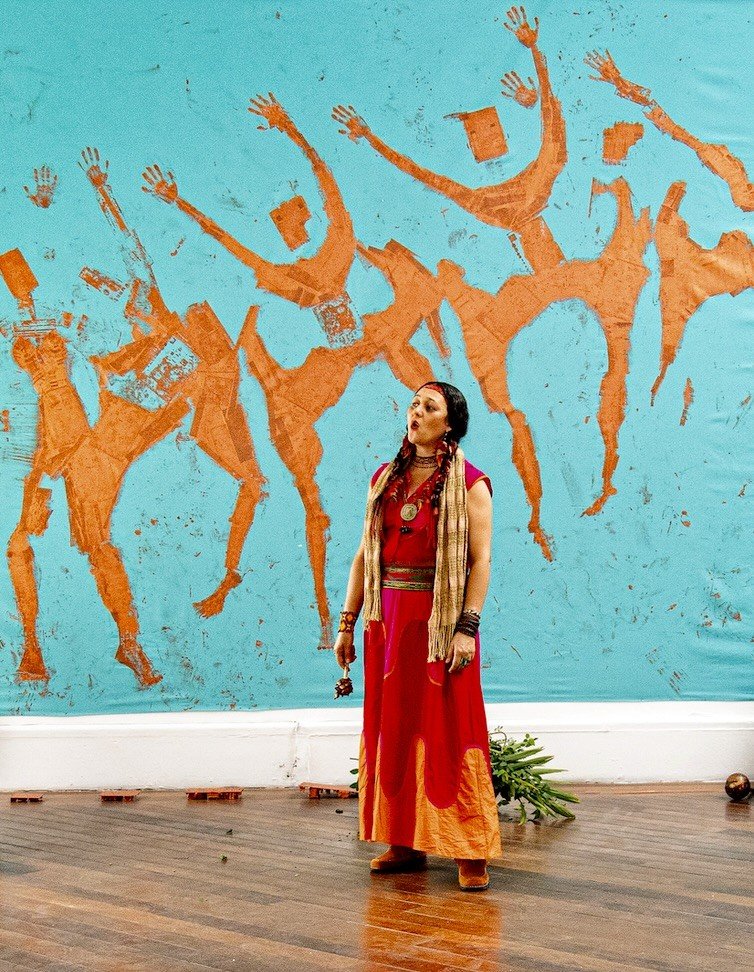
Cristine Takuá performing at the exhibition “HUMAN NON-HUMAN BODIES” in 2025, in Rio de Janeiro.
How did your relationship with Selvagem begin?
“As a child I was deeply connected to a nail, an oak, a stone and a stream I encountered in the forest of Charnes in Berry (a place that Madeleine Deschamps, the first person I had the chance to meet, must know well).
I have always had a very strong relationship with nature. In fact my entire environment speaks to me constantly. Instinctively it is as if I knew that the matter composing all things was endowed with an existence, a point of view.
I was marginalised in my time because in the West very few people understood me. Over time, I was able to discover other cultures far more powerful and which corresponded entirely with my vision : where humans, animals, plants, stones, objects - have their own way of being and of perceiving the world, and where our actions are part of a fabric of relations with them.
For many years, I built bridges between indigenous knowledge systems and quantum physics, recognising matter as an active and vibrant field that is never inert, through works such as those of physicist Karen Barad, philosopher Jane Bennett, or environmentalist Glen Albrecht.
Later, reading Ailton Krenak's "ANCESTRAL FUTURE" and "IDEAS TO POSTPONE THE END OF THE WORLD", I heard his call. Sharing deeply his commitment to the Earth, I wanted to go and meet him to question him about AI, that tool which is transforming the Earth, society and the body at an exponential speed.
Then I was able to meet Anna Dantes, a radiant being, and her "SELVAGEM ARROWS" which are poetic films of immense power. In short, all these encounters contributed to deepening my conviction that life is a fabric of interconnections.”
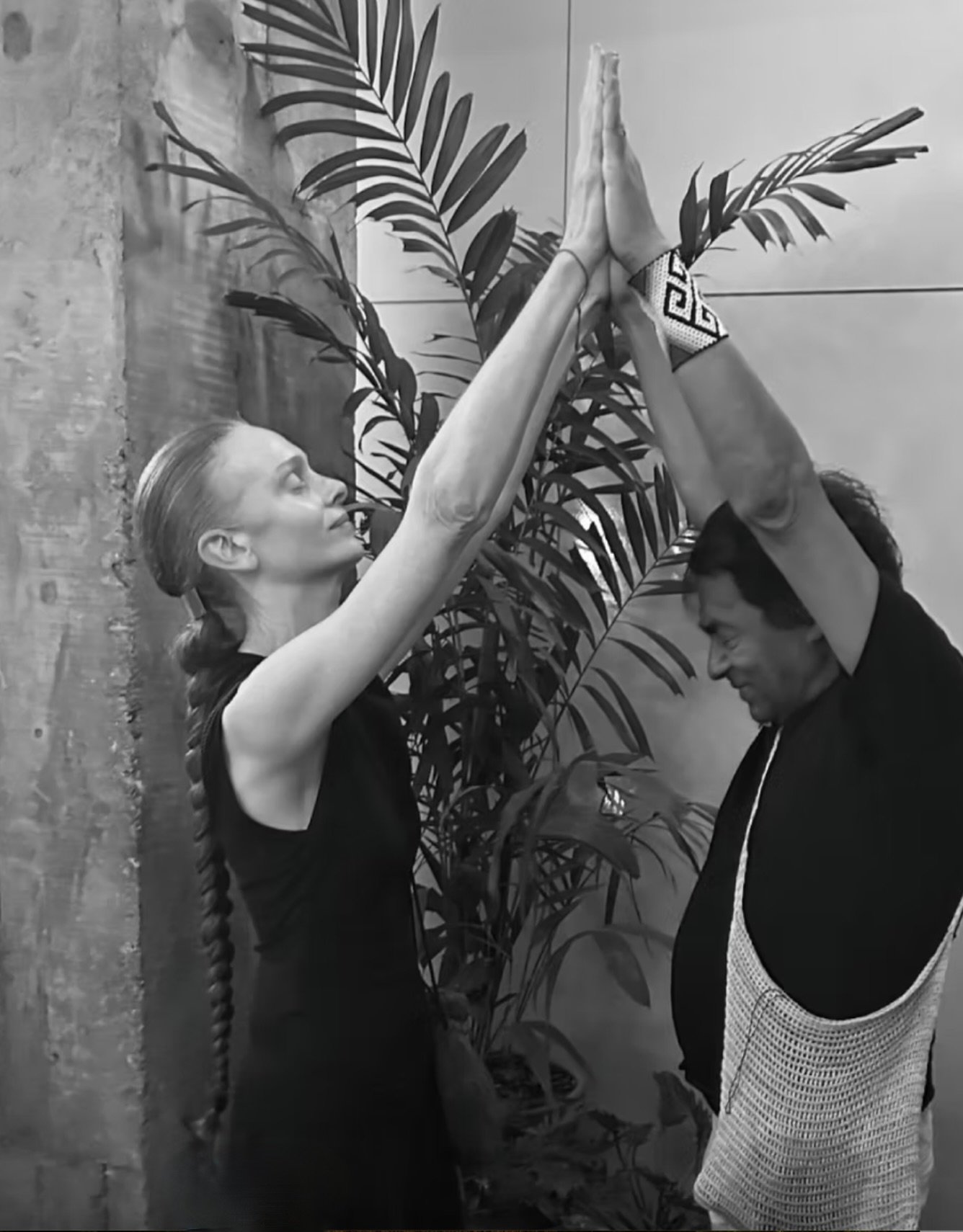
Alice Anderson and Ailton Krenak in 2024
How do the Arrows connect with your work?
“I create "TECHNOLOGICAL DANCES" by dancing with ancient tools, modern machines, electronic circuits, architectural elements, or meteorites, in order to reconnect with their animated materiality and to repair our relations with the more-than-human world.
I begin my dialogues with non-human beings through long observation sessions; after spoken to them, I apply liquid paint to these 'objects' to free them from their primary functionality.
These entities are transformed during the "TECHNOLOGICAL DANCES" and become "AWAKENED OBJECTS". The imprints created on the canvas record these communications, beyond the visible world, during states of trance.
These "TECHNOLOGICAL DANCES" bear witness to another possible intelligence in the age of AI: the one that inhabits matter.
As for the "AWAKENED OBJECTS", they function as sites of resistance and memory. In the age of AI, where objects are increasingly optimised, the "AWAKENED OBJECTS" act as witnesses rather than as tools. They anticipate a near future shaped by AGI, in which intelligence becomes abundant; attention rare; presence political and memory sacred.”
How do you perceive the reception of your work in the exhibition?
“This is a shared work and reflection. I would say: OUR work. The majority of the beings I know are all ‘working’ for the Earth. The exhibition at the MON shows other poetic paths that awaken consciousness.
Visitors linger at length before the works; some confide in me that they feel something they struggle to name. This confirms to me that we are at a pivotal moment:
When AI becomes general, all values will shift. The capacity to be: 'there' bodily, emotionally, without mediation. Sincere attention to what surrounds us, to non-humans. The quality of listening, of looking, of shared silence will become rare, therefore precious.
In a world saturated with intelligences, conscious presence will probably be a privilege. In fact, everything that engages the body in real time will hold an immense sensory value. Everything made with a 'non-optimised', imperfect gesture will become sacred.
That is why, 20 years ago, I developed gestures that 'memorise' through painting and sculpture the passage towards this new era - as if to say: let us remember Nature, its power and what we make of it.
AI can produce and reproduce, but it does not know the existential stakes. It has forgotten Nature and does not know death.
What will matter will be the "why" behind the act. Why reconnect with Nature? Why create? Why choose this rather than that? Why now?
Generalist AI tends towards the global. Value will lie in what is local, minority, non-reproducible at scale. Perhaps in singular stories, atypical trajectories, dissonant voices and above all embodied memories.
It is our entire relationship with the living and with what surrounds us that must be rethought. To rethink the bond with what does not speak in language: for example with plants, animals, cycles, landscapes, architectures, objects.
We must value the intelligence of Nature. We will have to learn to think by dancing, and not through algorithms.”
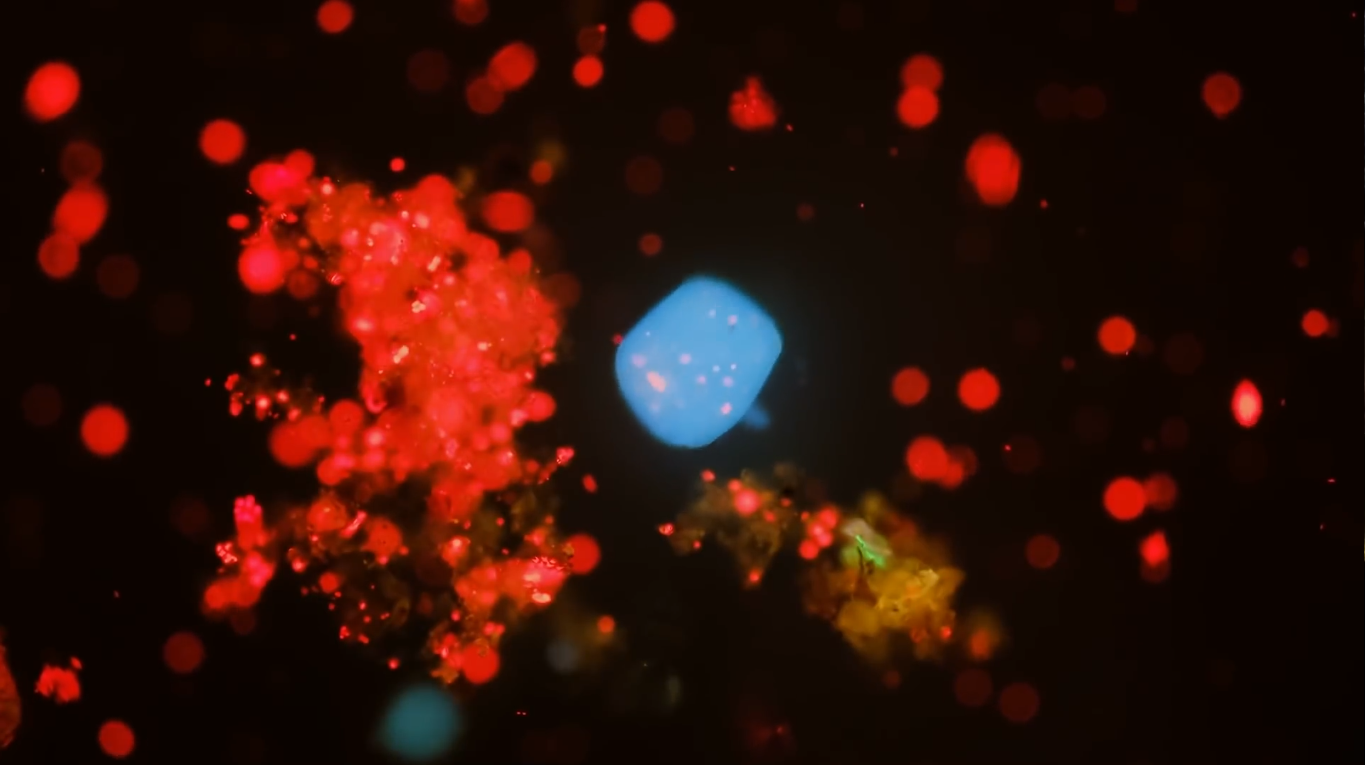
Still Group of the Arrow 5 – An Invisible arrow
Why do Microbes explode under UV Light?
JAMES WEISS (@JAM_AND_GERMS)