




MADZEROKAI STORIES AND STARS ARRIVE IN GENEVA
18 may 2026
This month, a part of Madzerokai, the Baniwa Living School, arrived at the Geneva Museum of Ethnography (Musée d’Ethnographie de Genève) in Switzerland. The “Hiwirhi Ipaattoni” installation, which translates to “Box of Stars”, was created by the Baniwa Living School during the Waphia Warapaka artist residency in July 2025 and evolved into a commissioned work that is now part of the exhibition “The Future, what’s that?” (“Le futur, c’est quoi?”), which opened on May 7 and runs through January 10, 2027.
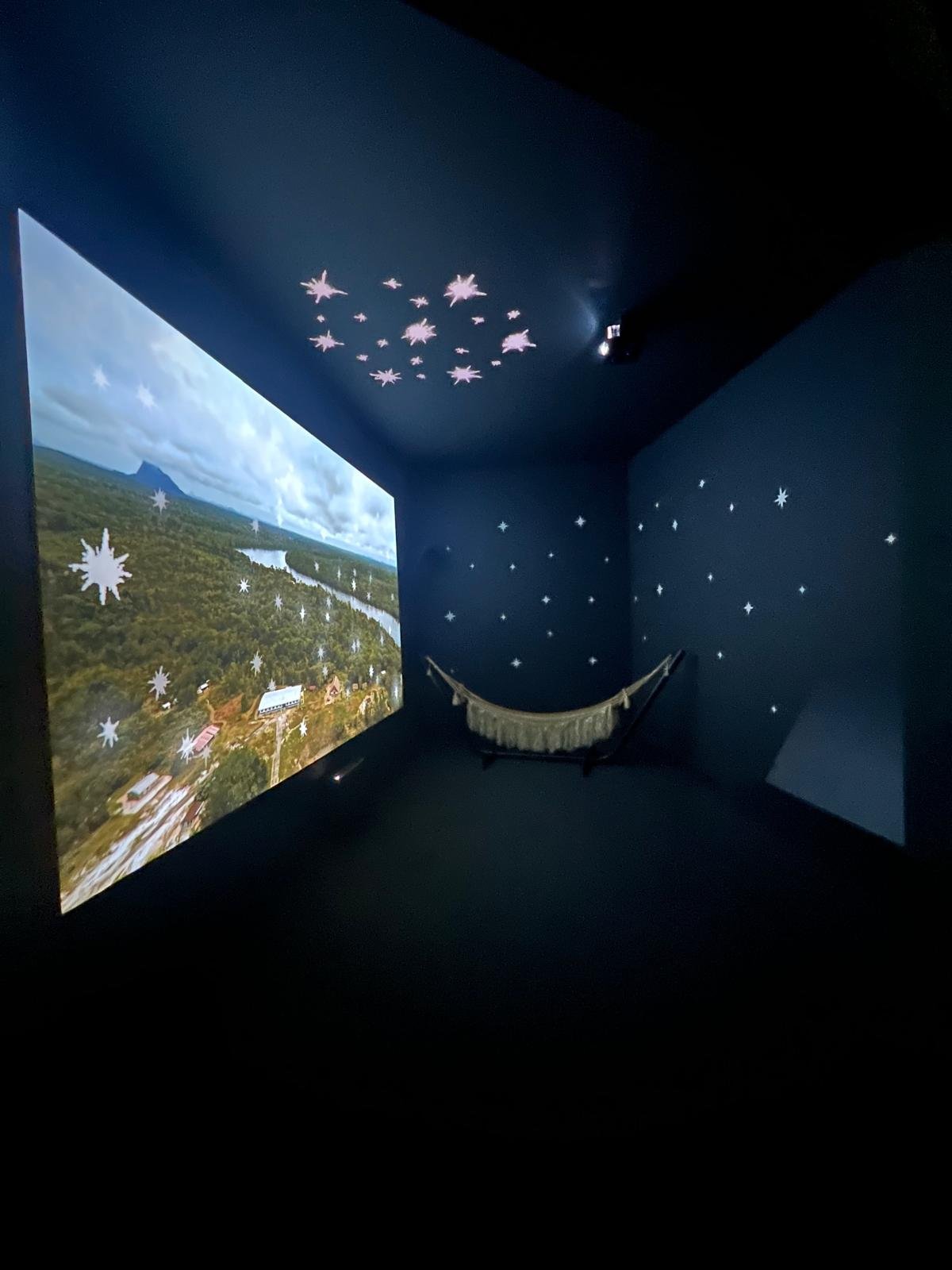
“Hiwirhi Ipaattoni”/“Box of Stars” installation at “The Future, what’s that?” exhibition in Geneva.
“Hiwirhi Ipaattoni”/“Box of Stars” is a video installation and one of the four works in the exhibition focused on the dialogue between ancestry and the museum’s archives. “Box of Stars” is located in the “Ancestral Future” section and features two projections, one on the wall and the other on the ceiling. While the first displays a film featuring Baniwa origin stories performed by the Assunção community, produced during the residency last July, the ceiling features Frank Baniwa’s drawings of the constellations present in the stories. Narrated by Francisco Fontes Baniwa, considered a maadzero (“wise man” in the Baniwa language), the film tells about three origin stories of the constellations Buya Wasu (great snake), Tatu (armadillo), and Siusi (no translation into English), where the maloca [large communal house] served as a set and children and young people participated by filming, recording sound, and playing the characters of the stories.

Excerpt from the Baniwa Living School film during the Waphia Warapaka residency in July 2025.
In the film, Mr. Franciso Fontes draws a correlation between ancestral knowledge of the constellations and the climate crisis, explaining how, in the past, the stars guided the cycles of life – from fishing to farming – linking the movements of the sky to the seasons, the presence of certain fish, and even the natural control of saúva ants. Today, many of these rhythms no longer correspond to the position of the stars in the sky, which shows how environmental impacts affect the balance between nature, time, and ways of life.
The residency that gave rise to the work was a partnership between the Baniwa Living School, located in the community of Assunção do Içana in the Upper Rio Negro region, the Mi Mawai collective, a transmedia and interdisciplinary artistic music label that, since 2022, has been jointly developing a Baniwa music archive project called “Waphia Warapaka” about the community’s musical traditions, and L’Abri Genève, an artistic and cultural space in Geneva.
The film screened at “Hiwirhi Ipaattoni”/“Box of Stars” brings to life the musical and linguistic heritage of the Baniwa people by featuring songs in the Baniwa language, such as the benobeno – a traditional Baniwa musical – as well as songs from other indigenous groups in the region. Furthermore, the audio and visual recording of instruments such as the japurutu and kariçu flutes ensures that this knowledge, these sounds, and these practices remain alive through the film.
The installation also features a sculpture of the Buya Wasu done by Frank, the “great snake”, created over a three-week period in Geneva in March 2026, during which time he also produced the animations included in the film. The “Box of Stars” also features a hammock for the audience to watch the projections, created by Nathalia Martins, another artist from the Assunção community.


Sculpture of Buya Wasu, the great snake, by Frank Baniwa.
For Lucas Canavarro, involved with the project from the start, there is a sense of fulfillment in realizing that, thanks to the partnerships forged with the Baniwa Living School, these songs, drawings, and traditions now resonate within a museum on the banks of another river, crossing new geographies and imaginations. Speaking about the presence of the wisdom of the great Francisco Fontes in the exhibition, Lucas says: “We are bringing a Baniwa elder to share the stories of his people, which creates a capacity for connection that goes beyond the mere object. It’s a possibility for spiritual connection.”
The exhibition, aimed specifically for children and teenagers, takes a playful approach, but also highlights the tensions in the relationship with European ethnographic museums—institutions that often function as banks safeguarding treasures, adhering to a logic of preservation that is detached from the living relationships that constitute this knowledge.
Incorporating Indigenous narratives into the museum – with the Indigenous peoples themselves taking center stage – opens up important fissures in these systems, bringing people and ideas into dialogue through art. The invitation to participate in the Geneva Ethnographic Museum is the result of three years of exchange between the Baniwa Living School, Mi Mawai, and L’Abri—a collaboration that also led to the opportunity for Frank to bring together Swiss artists and very different creative works during the residency in Geneva that preceded the exhibition.
In the cosmologies of the Upper Rio Negro, the great serpent charts the paths that shaped the world and the stars appear as guides capable of maintaining the balance of time and the universe. Together these presences become a way to traverse the cosmos from within the museum, where a journey through the universe begins within each viewer.

“Hiwirhi Ipaattoni”/“Box of Stars” installation.
In June, the Baniwa Living School will participate in another exhibition focused on the Living Schools movement. Opening on June 9 and running through August 9, the new exhibition “Long Live the Living School” arrives at the Tomie Ohtake Institute in São Paulo, featuring more artists and works that see art, life, and education as one. Read more at: https://selvagemciclo.org.br/en/viva-viva-escola-viva-sp/
Frank Baniwa is a Baniwa Indigenous artist, from the Waliperidakenai clan. He was born in the community of Assunção do Içana and is the son of Francisco Luis Fontes (Francisco Baniwa) and Lúcia Bitencourt, both farmers and artisans. Since childhood, he has always enjoyed drawing and painting, and he says that much of his talent comes from his parents.
Lucas Canavarro é doutorando em Artes Visuais pela UFBA e atualmente mora em Salvador. Nascido no Rio de Janeiro, é cineasta, editor e curador, atuando com Mi Mawai há 10 anos e trabalhando na coordenação do projeto Guanabara Pyranga há 3 anos.
If you’d also like to share information about an activity or exhibition you’ve attended or organized using Selvagem’s materials or initiatives, we invite you to tell us about it using this form. Not only does this bring us great joy, but this feedback is also very important to track Selvagem’s impact around the world.