




SCHOOL IS EVERYWHERE
Cristine Takuá
25 September 2025
Among the blow of the Wind, the native Bees and the Terrapin.
The ways of knowing
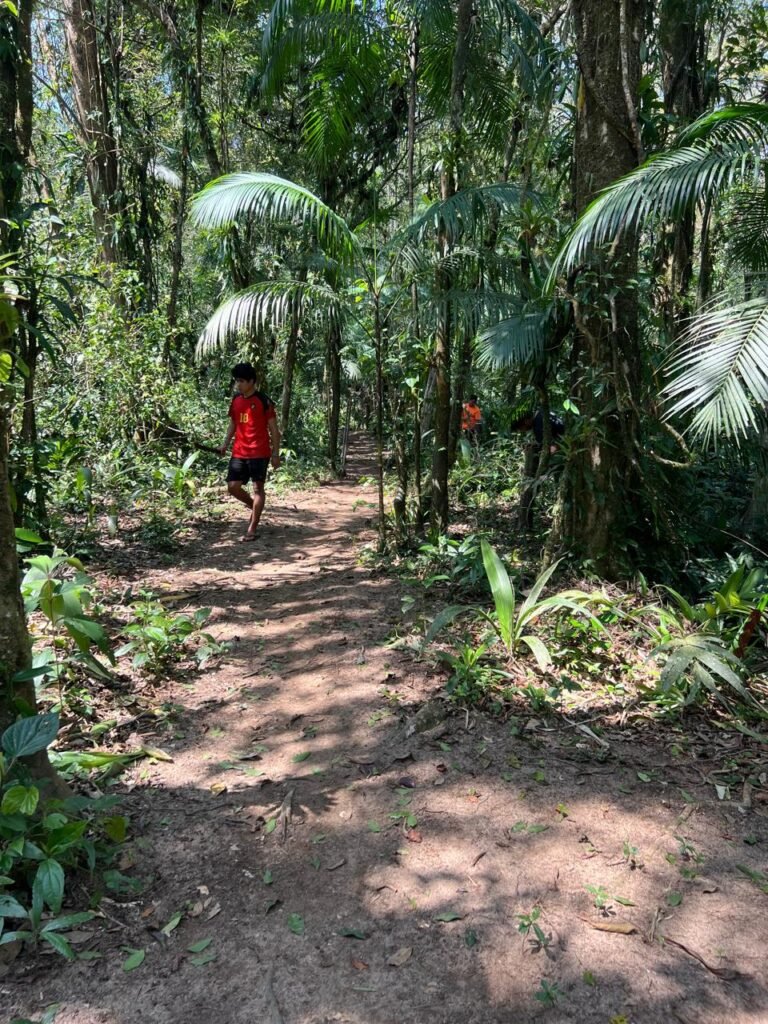
Photo: Cristine Takuá
Nhembo’ea
“Nhane nhembo’ea na yvyra, há’e vyae py yvyra Guy rupi nhande kuai nhanhembo’e vy. Nhandereko mbo’ea ma yvyra tajy, yvyra gui hae jaikuaa nhande kuery, yvyra haema nhane arandu rapyta.”
“Our way of knowing is the tree, that's why we learn under the tree. Our teacher is Ipê tree. From this tree, we acquire knowledge. The tree is the beginning of our knowledge.”
Xamoi José Verá
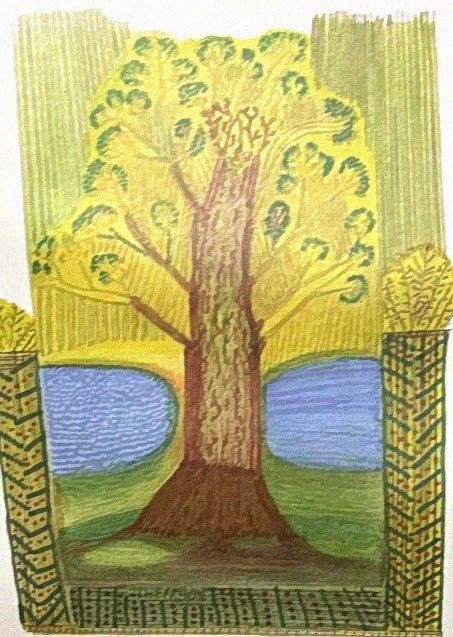
Yellow Ipê, drawing by José Vera
Reflecting on the teachings of José Verá, a xamoi from the Tekoa Campo Molhado in Rio Grande do Sul, I began to connect with the thoughts of Isael Maxakali, who came to visit me here at my home with his family. He came saying that he wanted to bring his grandchildren to sleep in the forest, as he always says that all places are spaces for learning. Under the tree, by the river, in the house of chants and prayers, on the pathways of the trails, all places are classrooms, so all is school!
As we walk this path, we learn to put ourselves in our place, subtly understand the codes that surround us, and acquire the sensitive wisdom to dialogue with the elements that appear. A few weeks ago, we were visited by an extremely strong wind, whose gusts were so intense that they knocked down trees, shook the earth, and made us think about its strength and power. We spent days and days tidying up all the upheaval the wind caused on the paths, in the yard, and in our house.
The north-west wind, say some caiçaras, was a very naughty boy. Whenever he went out to play, he made a lot of mess. Until one day his mother climbed to the top of a mountain and went to talk to Mother Nature to ask for guidance, because she could no longer stand the mess made by the north-west boy. Mother Nature then advised the boy's mother to take a cloth nappy and tie it tightly to the top of a tree branch so that when he went out to cause trouble, he would be tied up and unable to run around knocking over buckets and messing up the yard. That is why it was very common for older women to keep a cloth nappy so that when the north-west wind blew, they could tie it to the tree and prevent the wind from causing so much damage. These are ancient teachings that few people practise today. Behind this knowledge, which may seem simple, there is a deeper understanding that teaches us to protect ourselves and tread carefully.
A few nights ago, we were gathered in the middle of the forest with a group of young people and children to spend the night studying moã’i medicine. When we were already in the power of the vine, a distant and strong wind began to blow at the top of the mountain. I was worried that it might be too intense, so I went outside with my pipe, blowing tobacco into the wind and talking to him. I invoked Yvytu xeramoi and Yvytu Xejary, the grandpa wind and the grandma wind, asking them to walk slowly and gently. I did this invocation for a while, blowing tobacco, until I returned to the opy'i, the house of prayer, and chanted to the wind. Surprisingly, it gradually became less intense until it blew away in other directions, and so we continued the night with chanting, meditating and focusing on the teachings of the medicine.
This event moved me deeply and made me think about how incredible it is when we allow ourselves to greet and communicate with spirit beings, with all that is around us. It all makes more sense in life.
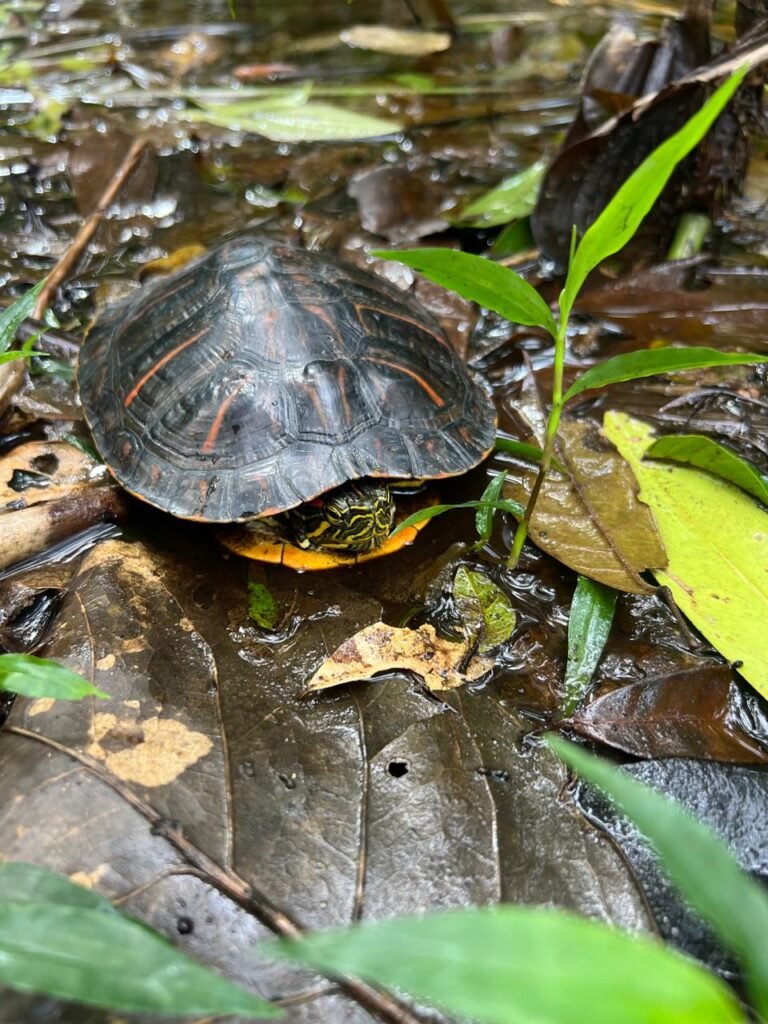
Photo: Cristine Takuá
A few days ago, we found a terrapin, Carumbé, near our house. The children picked the terrapin up and brought home. When I saw the terrapin, I remembered the xamoi José Verá, who says:
“Nhanderu created the turtle as if it were medicine. They live three hundred to five hundred years, which means they are almost immortal. Nhanderu created them so that the water would not dry up and we, the Guarani, would not lack water. That is why we must not kill turtles. If we find one on the path, on the road, we must take it back to the water... Children need to learn this at school.”
In the book Nhemombaraete Reko Ra’i – strengthening the wisdom, xamoi José Verá reflects on the importance of the turtle and draws a picture of it, so that everyone learns that it is medicine and that it is sacred, which is why Nhanderu sent it here to Earth.
After talking to the children about these teachings, we took the terrapin to a small river on the ‘farm’, where we built a prayer house, the classroom for the Guarani Living School. Now the terrapin lives there, in the middle of the forest.
Photos: Cristine Takuá
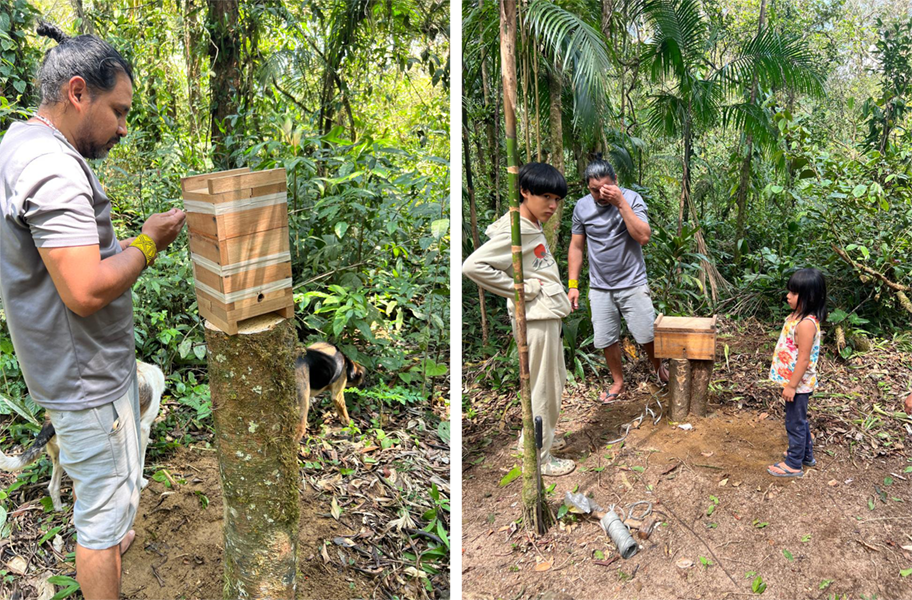
In this dream of strengthening transmission practices and activating ancient knowledge and skills among young people and children, a few days ago we organised an exchange meeting with a Guarani family who came from Jaraguá to share their knowledge about the native stingless bees of Nhe'ery. They brought Jataí, Uruçu, Mandaçaia and Mirim’i bees. It was a very exciting meeting where we were able to talk about the importance of bees for our lives, for performing rituals to name children and for maintaining the forest. We organised the bee boxes along the forest trail so that children and young people walking there can get to know and learn from them. Bees are great teachers and very collectively organised workers who allow us to learn to be strong and have the courage to keep going every new day.
Thus, the ways of learning are woven together in dialogue with the breath of the wind, the enchantment of terrapins, and the strength of bees. And we come to understand that all that surrounds us is a school. Each opportunity to learn opens doors to a broader perception, one that is conscious and respectful of all forms of life.
Long Live the Living Schools!
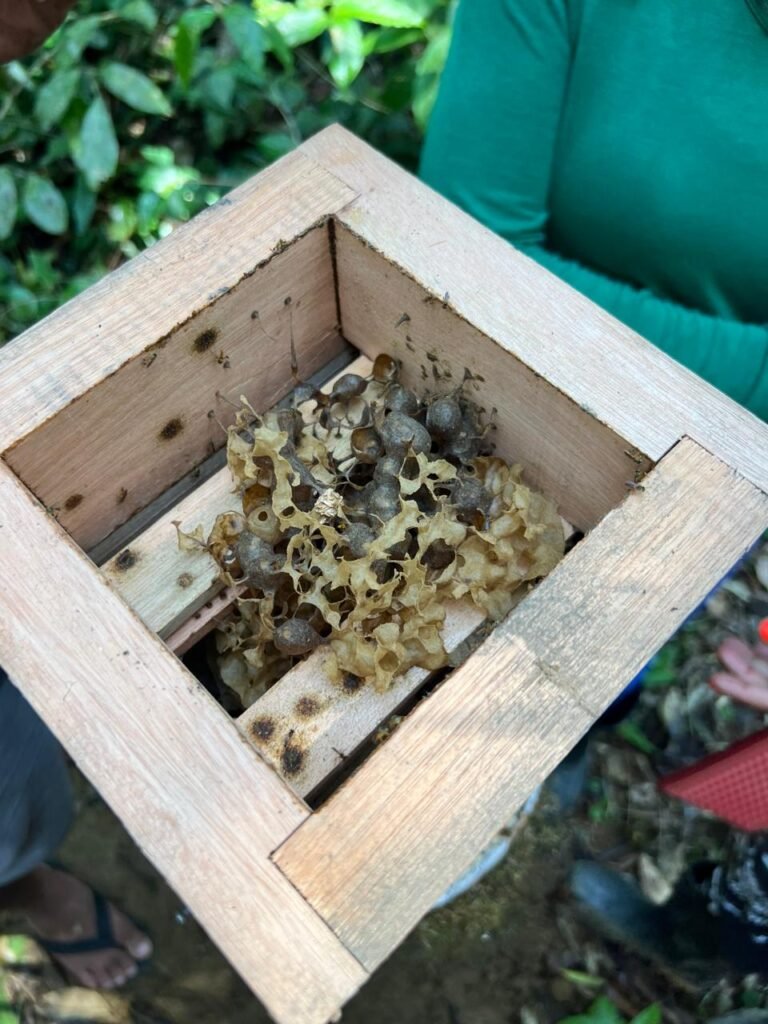
Photo: Cristine Takuá