




I DIDN’T KNOW IT WAS SO BEAUTIFUL
Veronica Pinheiro
11 de junho de 2024

"WE NEED TO LEARN TO GET INVOLVED WITH THE EARTH, WITH OUR RIVERS, FORESTS AND MOUNTAINS.
Involvement doesn't mean private interest in owning that river."
Ailton Krenak¹
It rained so much on the afternoon and evening of June 4 in the city of Rio de Janeiro that I lost count of the people who sent messages asking if the visit to Sugarloaf Mountain on June 5 would be cancelled. We got to the second immersion of the Ways of Knowing Journey: the children's encounter with the waters of Guanabara Bay. When the gathering was confirmed, there was no rain forecast for the day of the tour. The forecast changed, but I chose to trust the waters and the Sun. The gathering was not cancelled. I left home under heavy rain. We arrived at the school to find the children under heavy rain. However, I chose to trust the water and the Sun.
Tania and Ericka, Sun and dream companions, went straight to the visitation site. "Veronica, it's not raining here. Lots of clouds." "Tell Sun we're counting on him, and the children will be out of school soon." After breakfast was served at the school, it was time to board the pink bus and meet our kind driver again.
An unspoken agreement was made in Favela da Pedreira: If the pink bus is there, the children are going for a walk; therefore they must leave and return to the favela peacefully. The roads leading to the school are cleared so that our bus can pass, and we are watched from the moment we board the bus until we leave the complex. The children don't notice that the community also changes its routine somehow so they can experience joyful days. It was touching to see that the community and the parallel power are concerned about the well-being of children and teachers.
We left the school. It was no longer raining. "Let's go up and see the clouds; in cloudy weather we won't be able to see anything." I listened, but I didn't answer, because I trusted the waters and the Sun. On the way to the Sugarloaf Mountain, we crossed the Acari River. Our beloved river, who cuts through the entire school area. A wide river that listens to us. A river that bears witness to life and the terror imposed on the region. A river that still holds its charms, caymans and capybaras. The Acari River is one of the largest watercourses in Rio de Janeiro, and the reason for our walk². Acari is so strong that macrobiologically it has resisted until recently. We said goodbye to the river and continued our journey. We travelled 40 km to Sugarloaf Mountain. We climbed Urca Hill and Sugarloaf Mountain so we could see the waters of Guanabara Bay from above.

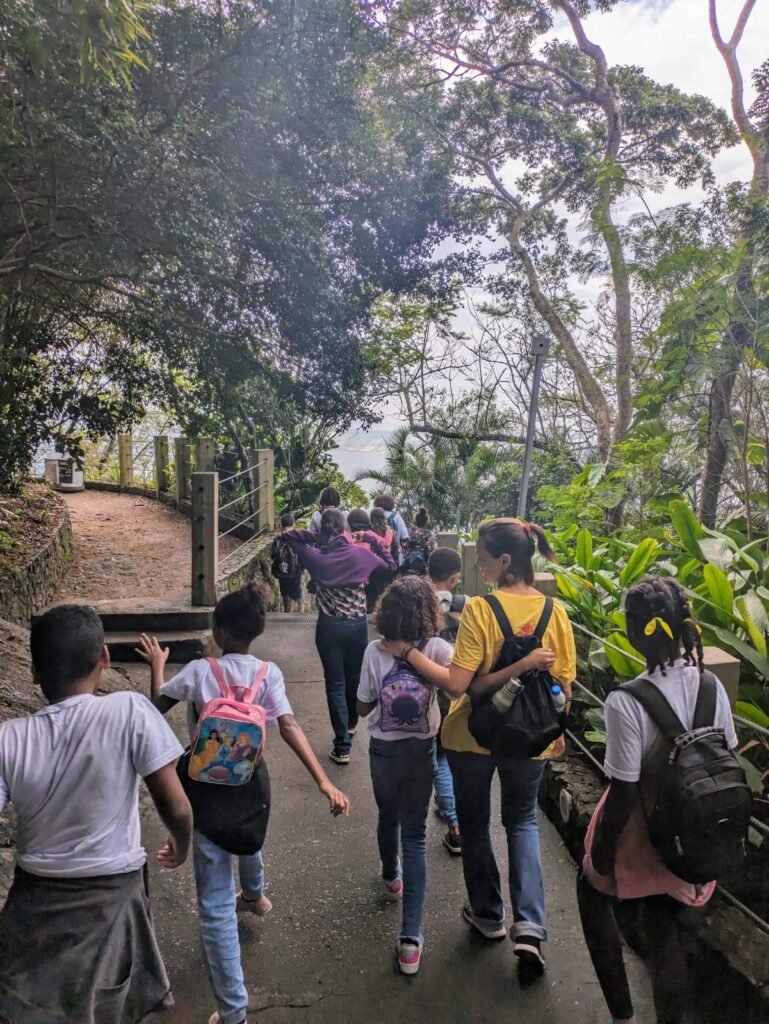
During the experience, the waters and the Sun welcomed us like welcoming loved ones. It wasn't raining and the clouds retreated to another place so that we could contemplate everything that could be seen from the heights. The Sun watched over us as we climbed and descended the hills, and the glow reflected in the waters enchanted the whole group. It was the first time I didn't see fear in the children's eyes. The children hugged each other and walked hand in hand. They smiled wide, long-lasting smiles. There were times when I swore I could see their smiles reflected in the sea. Some cried. Two of them cried a lot and couldn't say exactly why. Unlike the smiles, the cries were short and brief. I'm sure it was just the sea inside their chests that didn't want to be held back.
We were 10 adults on the tour, and as we arrived there I realised that there would be no mediation. Each adult had four children to accompany. We walked very close together, it was party day. I didn't say much, nature doesn't need a mediator. The waters, the Sun, the Plants, the Birds, the Monkeys, the Wind spoke so much, so much, that I was surprised at how receptive they were. Everything caught the children's attention, the aeroplanes that landed right in front of us, the tourists speaking English, the little signs that one friend read to another who couldn't read. "It says the whale will be here until September" "Really! Is it today? Read it properly and see if there's a day." The whale didn't pass by on 5 June.

A lot was healed in us that day. Some people are horrified to hear that education can heal. I learnt from the Quilombola and indigenous elders that everything can be healing: songs, words, food, hugs, advice. While we were on our way down, a helicopter landed on the Sugarloaf helipad.
"Miss V, what does the helicopter want?"
"It doesn't want anything, my son."
"Miss V, is it a shooting?"
"No. It's people out for a ride, they get on the helicopter to go for a ride and see the whole city from above."
The 11-year-old boy only knew about helicopters in the context of urban warfare. The police in Rio de Janeiro have a fleet of helicopters. The armoured aircraft are used in police operations, and the boys know that when there is a helicopter, the situation is worse than usual. They also knew about the news helicopter. But a tour helicopter? Not for travelling. That's because the city separates them. The city has rigid walls to exclude many and guard a few. Capitalism determines the meanings that signs will have within the same city: for my student, helicopter means danger; for tourists, fun.
“But my observation about cities is that they act as a real energy sink." Ailton Krenak
"Miss V, are we in Europe?"
The question hurt my chest, not because of geographical lack of knowledge. But because this boy understood that he wasn't part of that Rio de Janeiro. But it was a day of celebrations and life encounters. Once again, the life present in nature, the same life that sustains the boy, embraced us. Suspended in the air, inside the cable car, we were just people, air, mountains, water, birds, Sun and water. The same boy cried while hugging the school principal. He told me that he won't forget to take care of nature."Miss V, I didn't know it was so beautiful." "You are nature, just like these mountains and the waters of the bay."
This trip inaugurated another round of conversations at the school about people's lives and the life of rivers.

Oh, when we got off the cable car, the clouds covered the sky in that place. I asked the rain to wait for us to come home. It listened to us.
Quando foi transferido o sentido da vida para ter coisas, a gente já começou a se afastar da Mãe Terra. Essa mãe maravilhosa que chama a atenção da gente, inclusive para falar: “Ei, vocês estão vivos”. Quando uma mãe dá uma bronca dentro de casa, ela não está só dando uma bronca para a gente não estragar a casa, ela está dando uma bronca para dizer: “Vocês estão vivos”. Pra gente não se alienar do sentido de estar vivo. (Ailton Krenak)

Photos: Ericka Hoch
__________________
¹ "We traded our humanity for things." https://revistatrip.uol.com.br/trip-fm/ailton-krenak-trocamos-nossa-humanidade-por-coisas
² “WHERE'S THE RIVER THAT WAS HERE?” https://selvagemciclo.org.br/diario-de-aprendizagens/#tab-1717677150043-1