




FROM SUNRISE TO SUNRISE
Veronica Pinheiro
07 de maio de 2024

Photo: Wagner Clayton
Every MUNTU (human being) is the living Sun, perceived as a "power", "a phenomenon of perpetual veneration, from conception to death" and beyond. Once brought into the physical world, a sacred task begins (the most important for African civilisations): to take care of this MUNTU so that it shines like the midday sun.¹
Note: the African cosmology of the Bantu-Kongo, presented by Dr Fu-Kiau, presents caring for children as an art that needs to be honoured.
Pensando no universo escolar, ser professor de crianças é uma atividade considerada de menor prestígio na sociedade brasileira; uma atividade realizada geralmente por mulheres e por pessoas de baixo poder aquisitivo. Existe uma hierarquia estabelecida entre os profissionais de educação e quem leciona na Educação Infantil e Ensino Fundamental são desrespeitados dentro da própria categoria. É comum um professor universitário se ofender ao ser perguntado em que escola ele trabalha. “Escola? Não trabalho em escola. Sou professor da Universidade fulana de tal.”
Curiously, many teachers who publicly present themselves as decolonial (or counter-colonial) are attached to hierarchical European thinking, which sees early childhood and primary education as a place of less intellectual prestige.
Professor Jacqueline Siano was present at my master's qualifying exam and she remarked: "You're researching Afro-Pindoramic confluences and counter-colonial practices in education. You need to go back to school!"
I'm back.
I come back pregnant with paths and possibilities. I carry in my heart some ideas to postpone the end of the world. Some say I'm coming back pluriversalised. I say I'm coming back populated. Populated by beings, narratives, times and spaces. I've been walking with more and more companions. On this return, many memories have been awakened in the body of flesh and in the body of memory. Among these memories, I have met and awakened solar memories.
Who is the Sun? How many stories do we know about its origin, the origin of the world and its role as a vital source of energy?
I carried two solar memories: the one from home, repeated in verse and daily practice, told me that we were like the Sun; the one from school said that the Sun is a star located in the Milky Way, the closest star to planet Earth and the largest in the entire Solar System. The school said that it was impossible for me to be a Sun. Since the school is authorised to say what is right and wrong, I forgot that I was a Sun and stuck with the school's version. This reductionist view of existence erases suns in broad daylight.
Kuaray (Guarani); Abe (Desana); Mãyõn (Maxakali); Kamoi (Baniwa); Sol (Portuguese); Bari (Huni Kuin); Pawa (Ashaninka); Wei (Macuxi) are more than words used to designate the Sun; they are solar epistemologies. Generative words, accompanied by life and worlds. I have a special liking for narratives that begin with "There was no world before". This time before time existed brings profound teachings about caring for and maintaining existence. Origin myths don't exist to feed the ears of the world, but to vibrate life.
Despertando memórias solares, alguns vazios foram preenchidos com escutas e pesquisas; em breve o Ciclo Sol apresentará uma série de falas sobre o Sol². O pensamento lá de casa reapareceu em livros e teses. “Deixa meu Sol aceso”, fala de meu pai, apresenta vestígios de uma filosofia antiga, trazida ao Brasil por pessoas negras durante a travessia do Atlântico entre os séculos XVI ao XIX (tráfico de pessoas promovido por Portugal é a expressão mais precisa). No pensamento Bantu-Kongo, quatro grandes “sóis” regem os processos de formação e mudança. O primeiro (Sol Musoni) é o Sol do “ir para”, todos os começos; o segundo (Sol Kala) é o Sol de todos os nascimentos; o terceiro (Sol Tukula) é o Sol da maturidade, liderança e criatividade; o quarto (Sol Luvèmba) é o Sol da última e maior mudança de todas, a morte¹.
I've never used the word "sun" in the plural as much as I have in recent days. Plural in meanings and existences. Coexistences that are continually forming, changing and expanding. From sun to sun, if we think of the Bantu-Kongo formation solar process, the Ways of Knowing Group is on the second sun. We are being born. Being born and proposing births. To this end, we hold weekly planning and study meetings (with people from the Selvagem team); we meet monthly with the teachers from the partner school and with the group's volunteers.
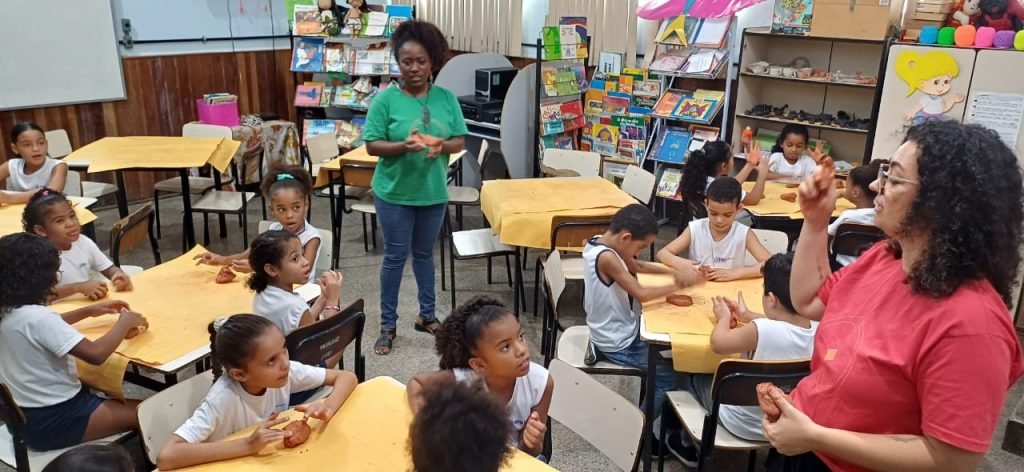
Photo: Wagner Clayton
Our last breakthrough was to receive a visit from ceramicist Angélica Arechavala (a volunteer who accompanied the Children's Group and now supports the Learning Group). It may sound simple, but the school is located in an unfavourable area for visitors. Our idea is to strengthen partnerships and create an organic network between territories, which includes bringing people from outside to meet the school community and taking the school community to visit other places.
In order for another living Sun to be included in the mediation of the ceramics workshops, we had the support of the school, which made people available to pick Angélica up and bring her by using the safest route. When I shared with a scientist the power of that 10-hour meeting, I got the following comment:
"Objects fold space-time, they feel this curve and move accordingly. You are a sun. The arrival of the ceramist brings a new sun in addition to you. It shifts the position of the first sun, and especially of the other little planets who are your pupils, hahaha, who were used to the previous configuration. That's why they were closer together, revolving and orbiting around you."
What was so powerful about this meeting? I was able to sit down and touch children who don't usually allow me to get too close. Children who know horror very closely trusted us at the last meeting. It was an environment of great trust and care: the principal, coordinators and teachers accompanied us at all times, in every space. Angélica's presence folded space-time, generating solar displacements. We are on the way to creating Tukula, the Sun of maturity. May Tukula arrive at a good time.
“O Sol caminha devagar, mas atravessa o mundo” – Provérbio Africano

¹Fu-Kiau, Kia Bunseki e Lukondo-Wamba, A.M. KINDEZI: A Arte Kongo de Cuidar de Crianças. Com introdução de Marimba Ani. Tradução para o brasileiro por Mo Maiê. Rede Africanidades
²O Ciclo é composto por 19 falas pluriversais de Catarina Delfina Tupi-Guarani, Fabio Scarano, Moisés Piyãko (Ashaninka), Catarina Aydar, Carlos Papá (Guarani), Aliny Pires, Dua Busë (Huni Kuin), José Miguel Wisnik, Isael Maxakali, Sueli Maxakali, Júlia de Carvalho Hansen, Francisco Baniwa, Aza Njeri, Anacleto Tukano, Carla Wisu (Dessano), Camila Mota, Marcelo Gleiser, Eduardo Góes Neves e Ailton Krenak.