




A CHILD IS ALMOST A RIVER
Veronica Pinheiro
10 April 2025

WORKSHOP: DRAWINGS TO MAKE VISIBLE
“Worlds inside of worlds”, this phrase from Lua Kali's Notebook Selvagem Drawings to make visiblesparked a deep dialogue with the children about the invisible. We went from talking to looking at maps and tables showing the composition of things. What is this made of? What's inside that? Invisible to whom?
The pursuit of building and reawakening memories is a way of connecting children with their community and the present time.
Through art and kindness, in our workshops we dream of awakening sensitivities and building links with nature and with the memories of the territory. The workshops are often meetings to celebrate and strengthen life.
Among the maps presented to the children was one about the rivers of Rio de Janeiro. Among the composition diagrams, one mentioned that a child's body is between 75 and 65 per cent water. The children observed that, as people get older, they have less water in their bodies. That's when I heard it:
“We are so much water. A child is almost a river.”
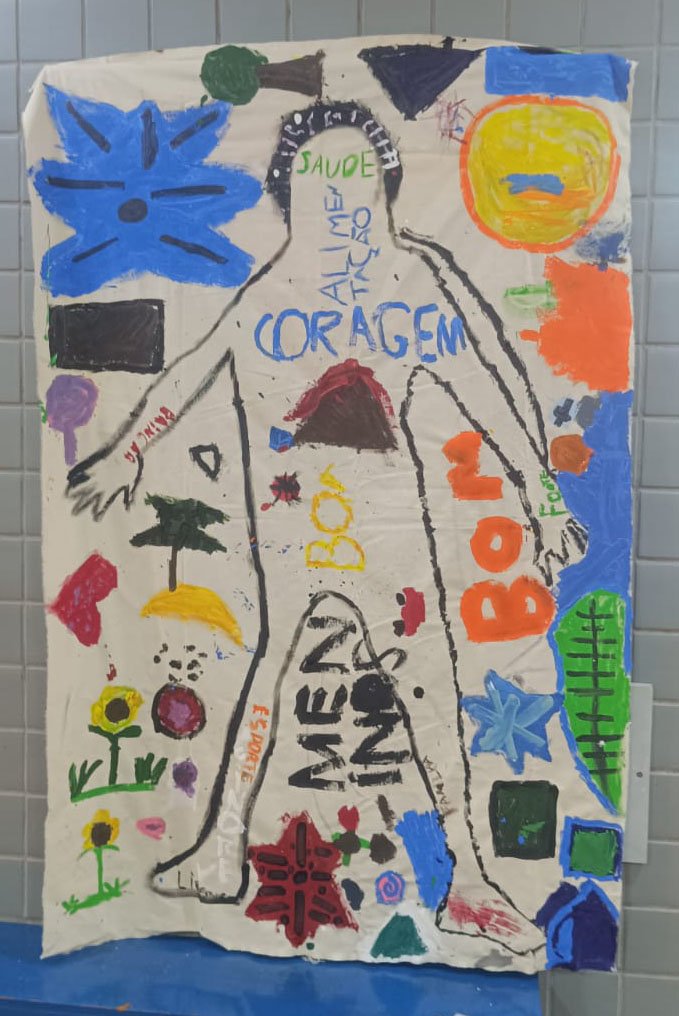
For a while, we wondered what could possibly exist in this river we call a child. At another moment, I asked what could be possibly existent in the other 30 per cent, since 70 per cent was water. Timothy replied without thinking “DREAM”. Pedro agreed and told me:
“A child is made of water and dreams!”

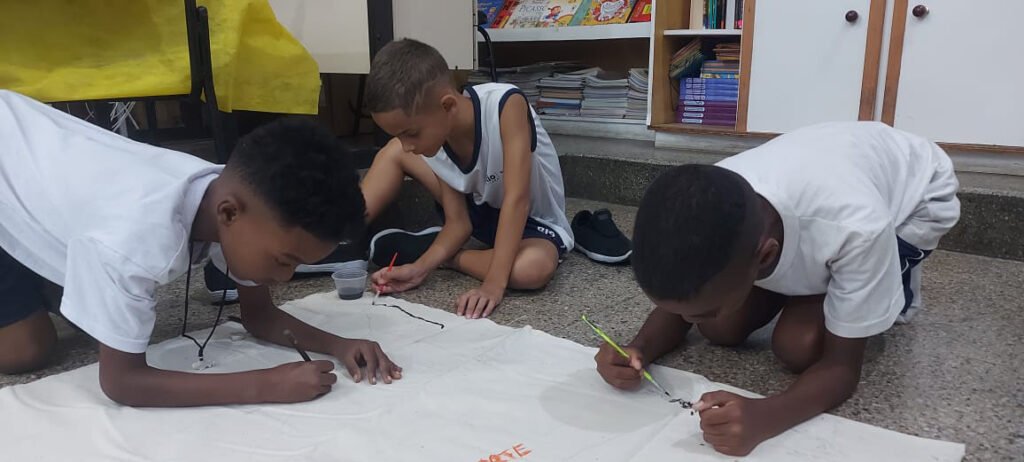
So I discreetly asked Timothy what a teacher was made of, and he told me that a teacher who plays is made of water and courage. And that he knew this because he needs to have courage every time he has to undergo surgery or face a firefight. Once again, Lua Kali was present: worlds within worlds were revealed as spoken words were invited to draw paths on fabric through brush and paint.
The groups responsible for creating the panels were composed of children of various ages. With or without special support needs, they drew to make themselves visible. Have you ever received a drawing made by a child? Drawing in childhood is much more than a graphic manifestation on paper. A child who draws knows themselves, identifies what they feel, appropriates this information and announces what they felt to the world. Art that is not commercialised is communication from the soul.

By drawing, a child is trying to come closer, make contact and establish a bond. The words brincar (Portuguese for ‘playing’) and vínculo (meaning ‘bond’) have the same origin in the Latin vinculum, que significa “laço”. Derivada do verbo vincire, brincar significa “enlaçar”, “encantar”. O desenho na primeira fase da vida é uma brincadeira feita com o corpo inteiro. O processo de escolarização das crianças vai retirando delas os espaços de brincar à medida que vão crescendo. E o momento do desenho vai ganhando regras, hora e lugar determinado.
In their processes, the workshops proposed by the Ways of Knowing group seek to listen to and respect children. Beyond thinking about diversity and inclusion, we want the children to strengthen their sense of belonging. Maya Angelou, reflecting on diversity, inclusion and belonging, says that “diversity” is when you sit at the table; “inclusion” is when you get to speak and “belonging” is when you are heard. Belonging is being able to draw paths of freedom, affirming that we are made of ‘water and dreams’, and knowing that we will be heard.
The answers and reflections presented during the workshop reminded me of Mr Luiz Lana¹, coming from the stars, an indigenous man from the Desana people. Mr Luiz was a Këhíríporã, a son of the drawings of dreams. Dreams are one of the cosmotechnologies that allow us to see what's inside beings. With Mr Luiz I learnt to have the courage to unravel the threads of the memories that linked me to my grandmother. With children, I learn to have the courage to draw the drawings for today and for tomorrow.
The panels ‘A child is made of water and dreams’ were exhibited at the First Meeting on Public Policies for Children in the City of Rio de Janeiro on 5 April 2025. In addition to the paintings on panels, the children kindly donated their drawings, sculptures, flat fabrics and photographic works to compose the art exhibition at the meeting. Like an open letter or a manifesto of life, the children's drawings at the event guided the words that closed the meeting. After the event ended, many educators came to share that their desire to remain in the territories of their schools/projects was activated when they learned that children dream immersed in water. On that day, the drawings revealed some of the worlds contained within the world that is the Pedreira Complex to authorities, politicians, secretaries of education, and educators. The children of Morro da Ventania began to spread their ideas of good living throughout the world. May we have the courage to listen to what the wind and the children say.
_________________________
¹ Luiz Lana. Read more in the text “Luiz Lana e o fio da memória”, a link, and in Antes o mundo não existia [Before, there was no world] – Mitologia Desana-Kehíripõrã narrated by Umusï Pãrõkumu (Firmiano Arantes Lana) and Tõrãmü Kehíri (Luiz Gomes Lana).