




EMBROIDERING MEMORIES FROM PEDREIRA
Embroidery workshop at the Professor Escragnolle Dória Municipal School, Rio de Janeiro
Veronica Pinheiro
14 May 2026
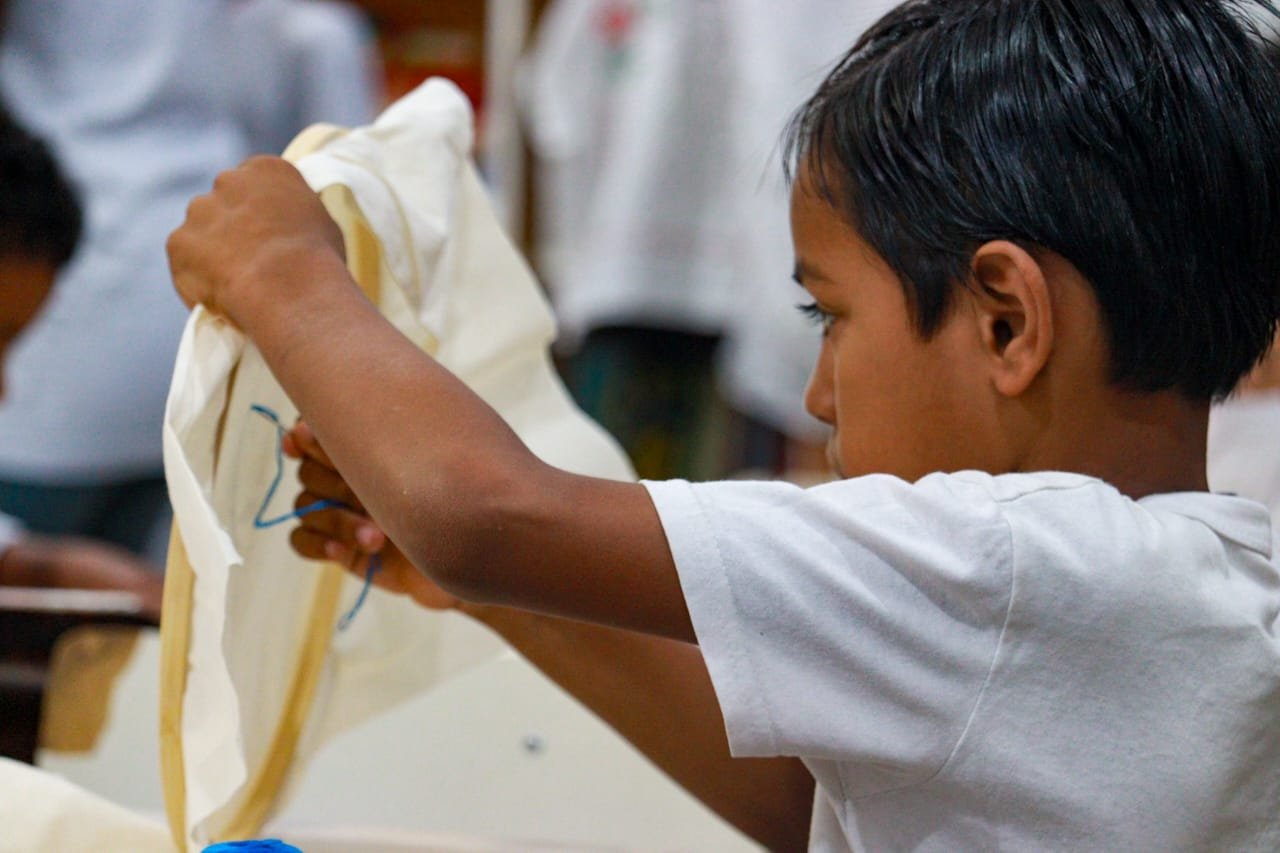
Photo: Rosemberg Auni
We ask for permission to come. And with the blessing of the elders of Pedreira and the kindness of the children who carry the whole hill within their eyes, we returned to the Professor Escragnolle Dória Municipal School to hold the first LAS¹ workshop of 2026. We arrived at the school carrying threads, hoops and embroidery needles. Before the stitches came the stories. Before the embroidery came the children. Before the technique, the shantytown.
Pedreira speaks loudly.
Streets speak loudly. Wires on the power poles speak loudly. Funk parties speak loudly. Dogs bark loudly. Buses, minibuses and motorbikes speed by loudly. There, all of life seems to yell for its existence to continue. But, in those days, silence entered the school. Not a silence out of absence. A silence as the result of deep presence. The same silence that precedes embroidery, when the thread meets the saliva in the mouth before reaching the eye of the needle. The silence of hands thinking. The silence of children learning to listen to their own movements.
“Basting stitch. Backstitch. Lollipop stitch. Full stitch.”
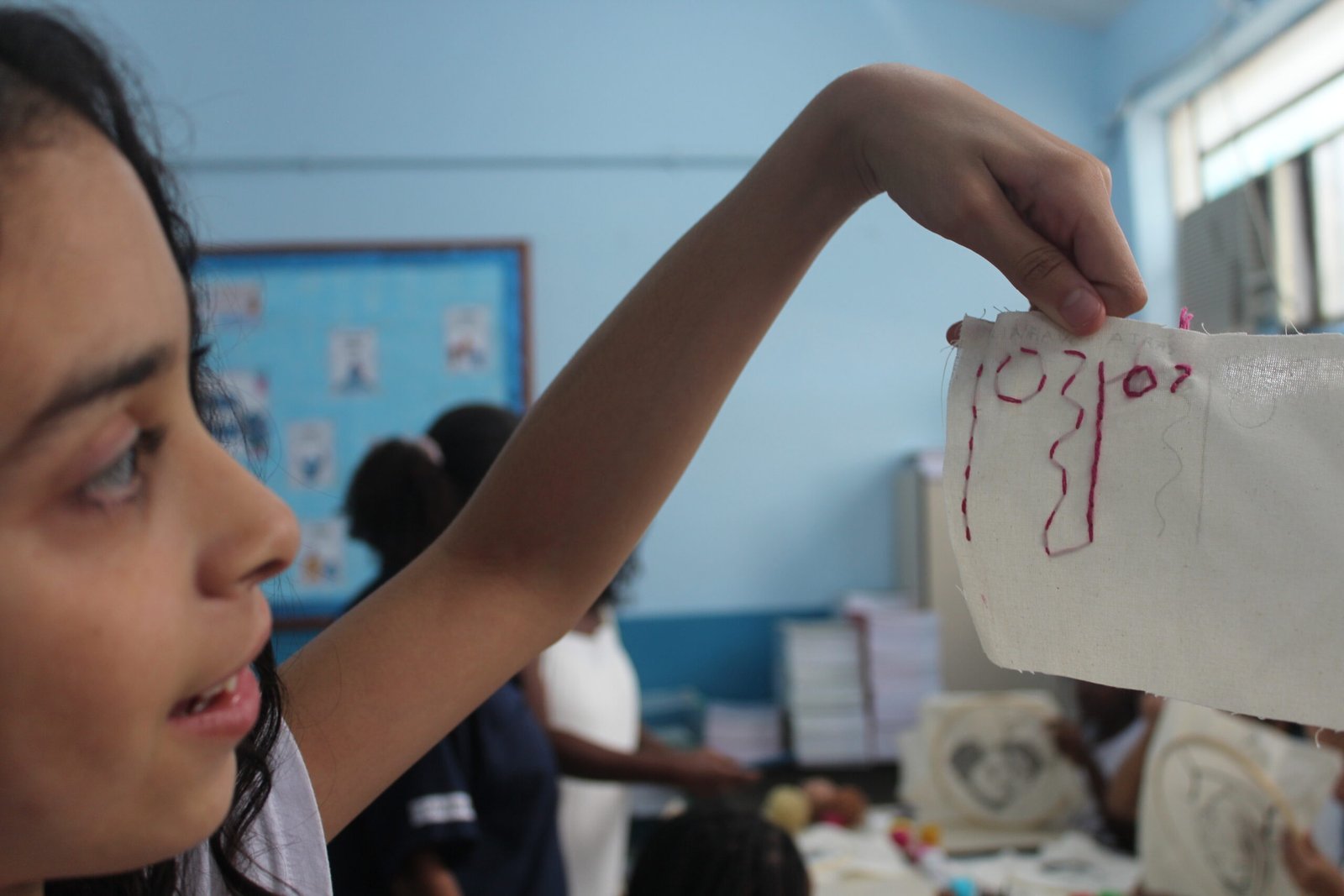
Photo: Carol Delgado
The children began to embroider the shantytown [favela], its people and its memories. First came the kites. Then the concrete slabs. Then the alleyways. Then the skies crossed by wires. Then came the people who wove life in that place. Some children embroidered their own homes. Others embroidered memories. Some didn’t even know exactly what they were embroidering; they simply kept pulling the thread as if trying to reach some memory still hidden away, or a memory yet to be.
The workshop had been conceived as an exploration of textile art, memory, territory and imagination. But the children turned everything into something else. They turned the activity into a circle of belonging. They always transform everything.
As they embroidered, they chatted about mothers, grandmothers, games, gunshots, parties, churches, fears and dreams. The threads began to weave together topics that school rarely manages to touch upon. Some were afraid of the needle. Some learnt the stitch and immediately taught it to the classmate next to them. Some made mistakes happily, for there were no ‘mistakes’.
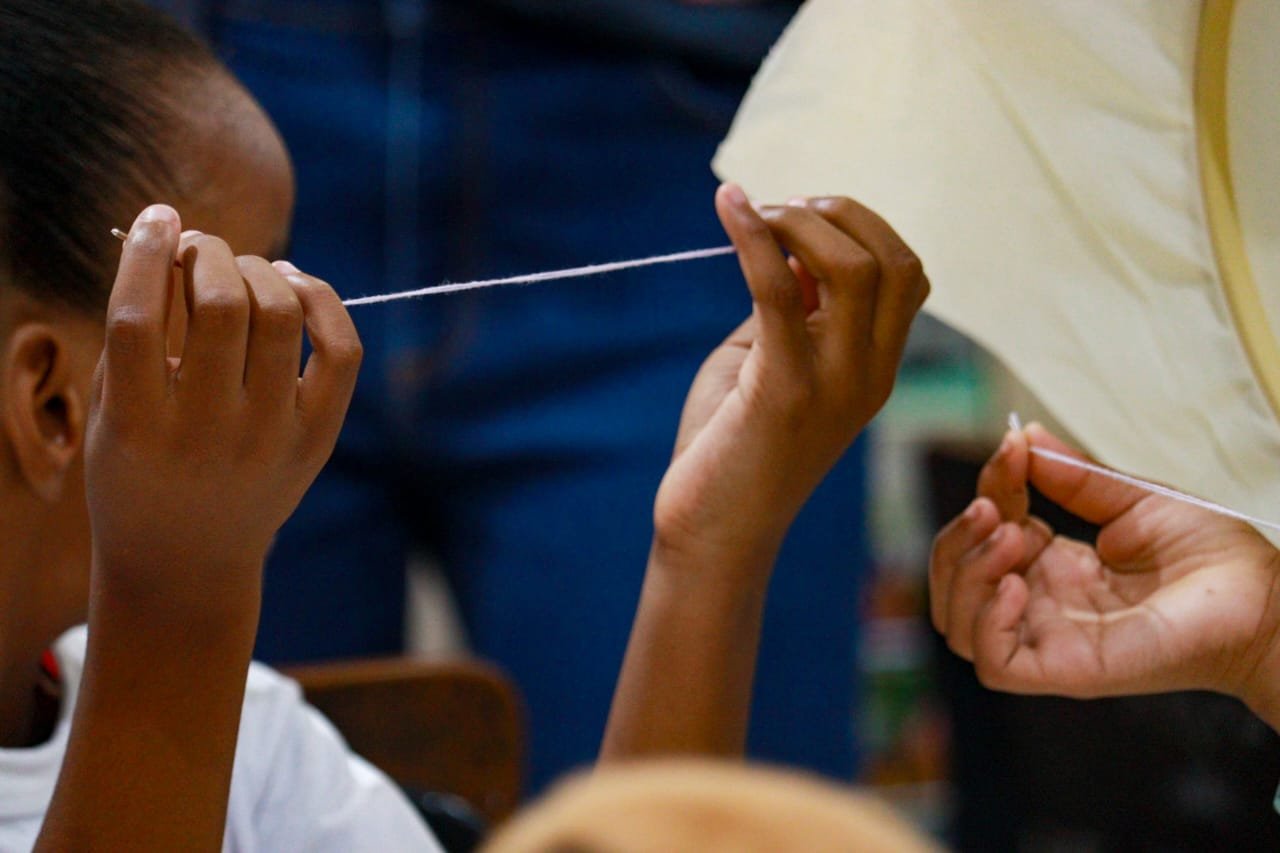
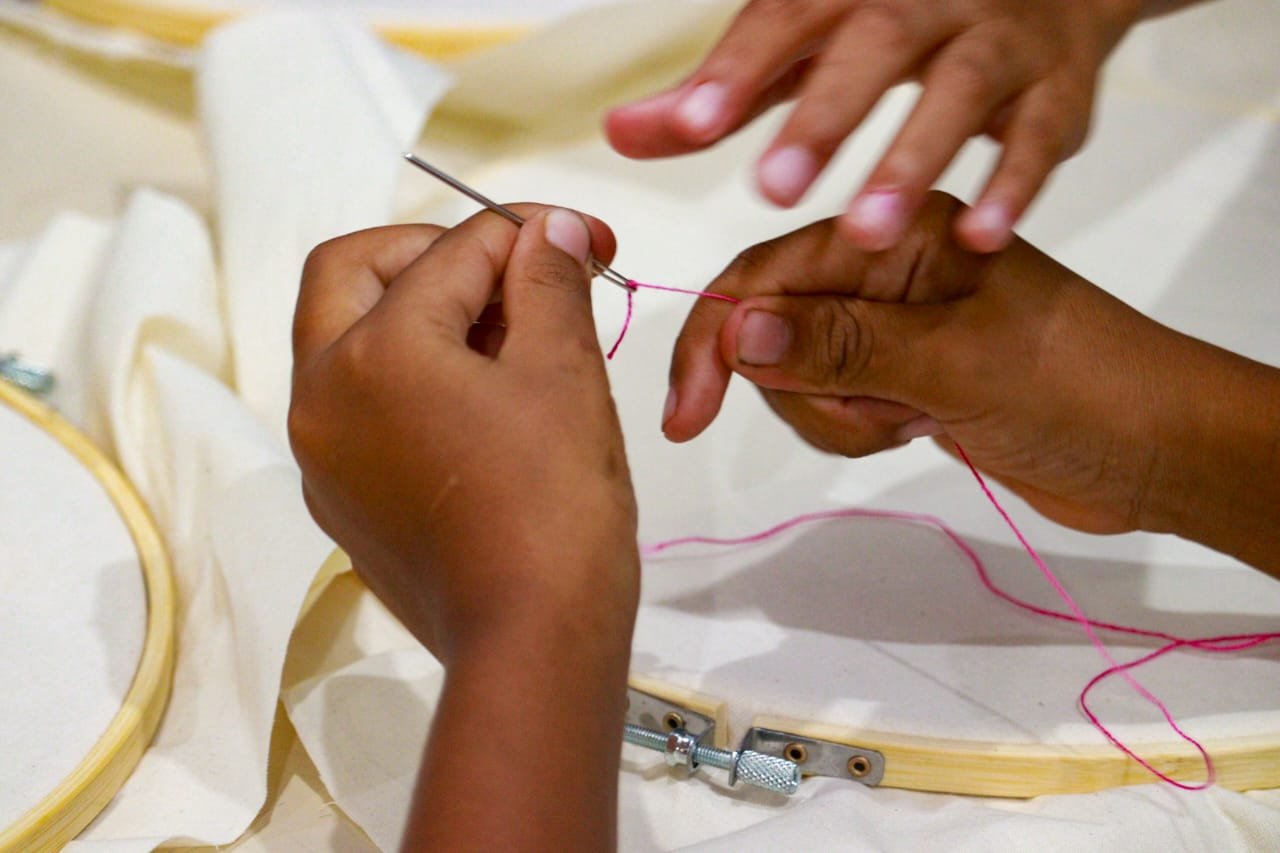
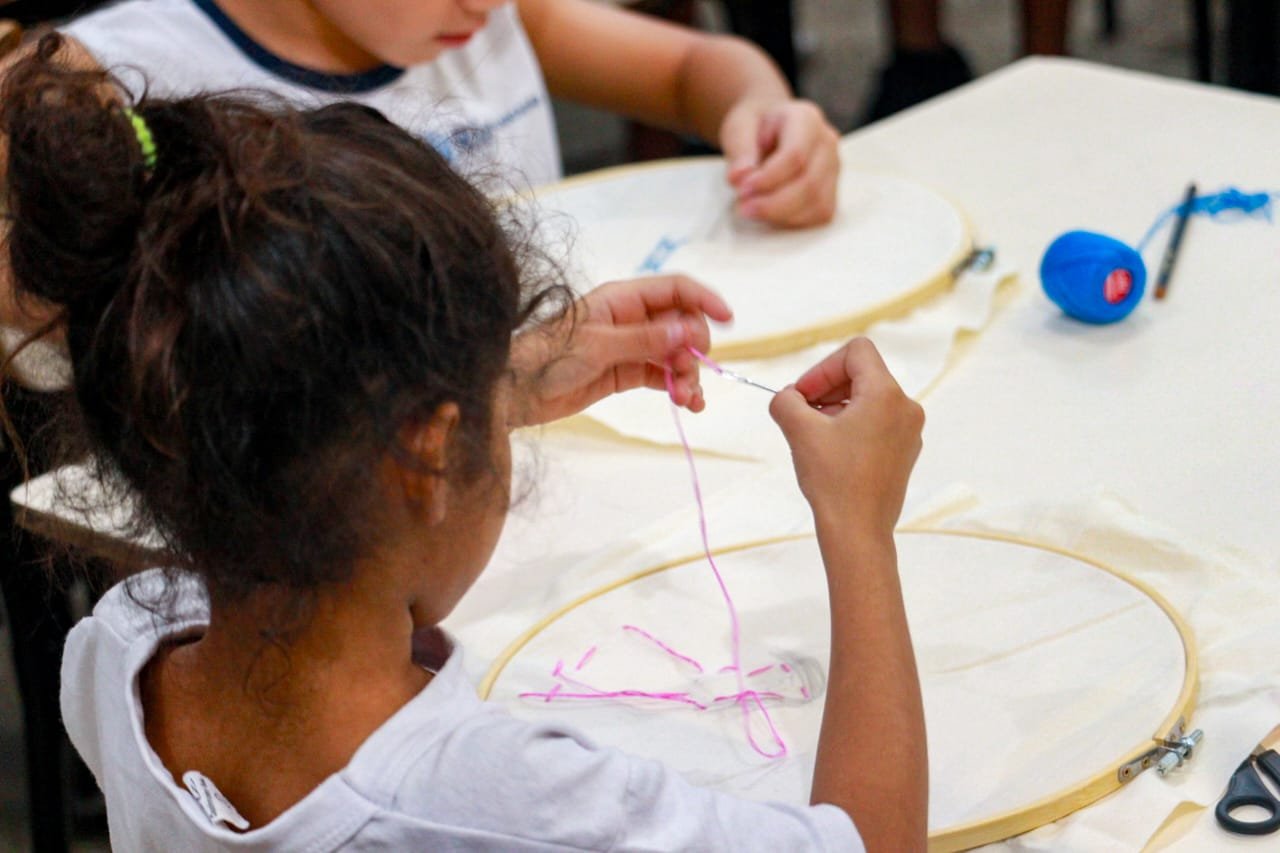
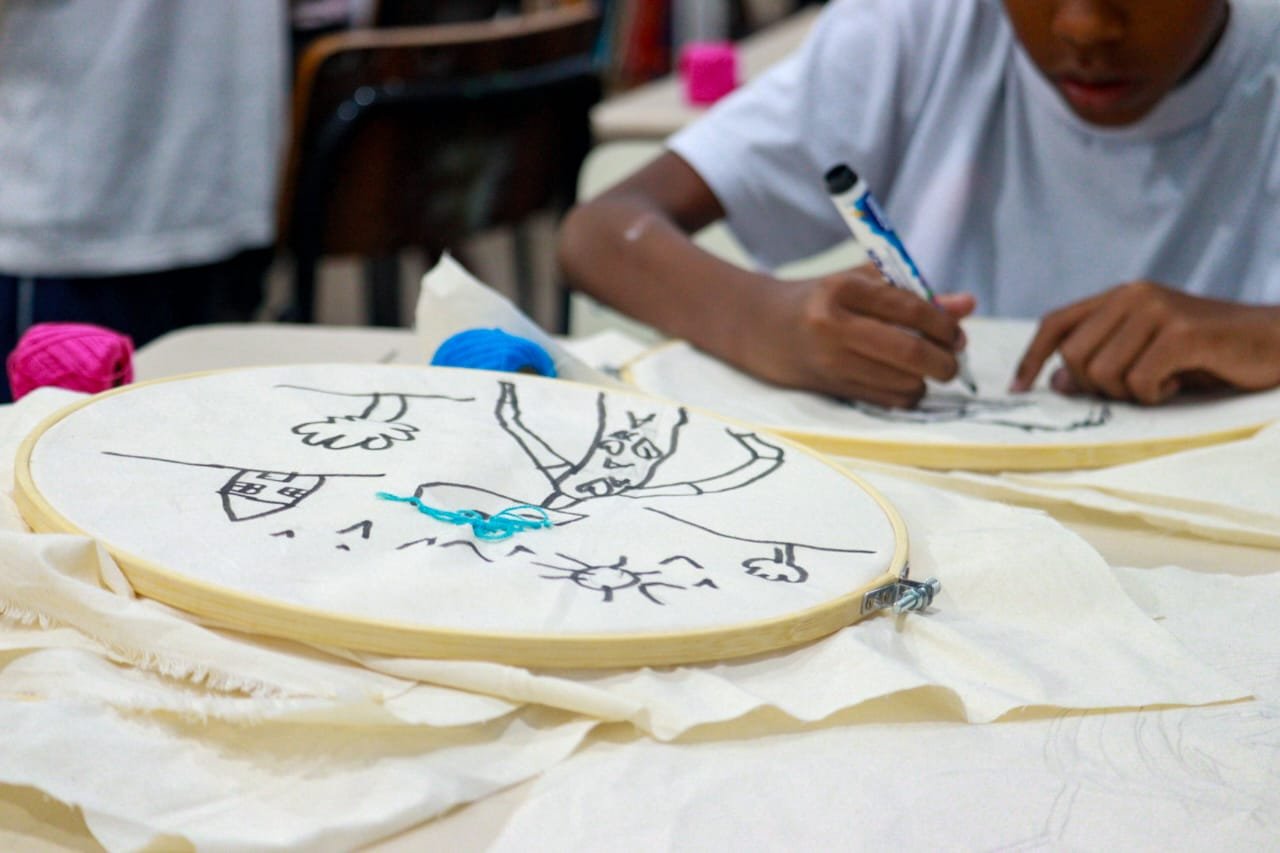
Photos: Rosemberg Auni
The embroideries had no authorship.
One child would begin. Another would carry it on. Another would invent a new detail. One group would inherit the trails left by the previous one. Just as happens in the streets of the shantytown. Just as happens in families. Just as happens in community life. Every movement is continuity. No one lives alone. No memory is born in isolation. Everything is a continuation of what once was.
An activity such as this mobilizes very profound dimensions, because it shifts the child from the individualised logic of production to a collective experience of constructing meaning. When one child begins a piece of embroidery and another continues it, a pedagogy of continuity is created, in which knowledge is no longer understood as individual property but is instead experienced as a crossing.
Children learn that their creation does not end with themselves. This reduces anxiety about individual performance and breaks away, even if only temporarily, from overly competitive and meritocratic school models. Mistakes cease to be a threat, because the work remains open to the gestures of others. This has led to greater emotional security and a willingness to experiment.
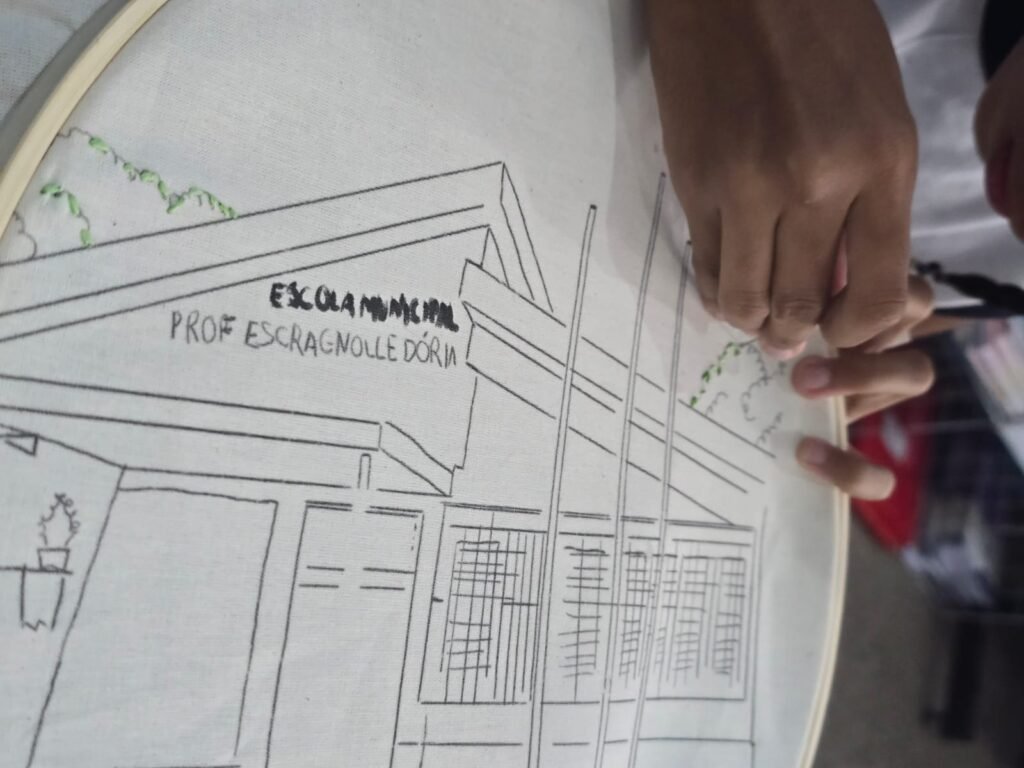
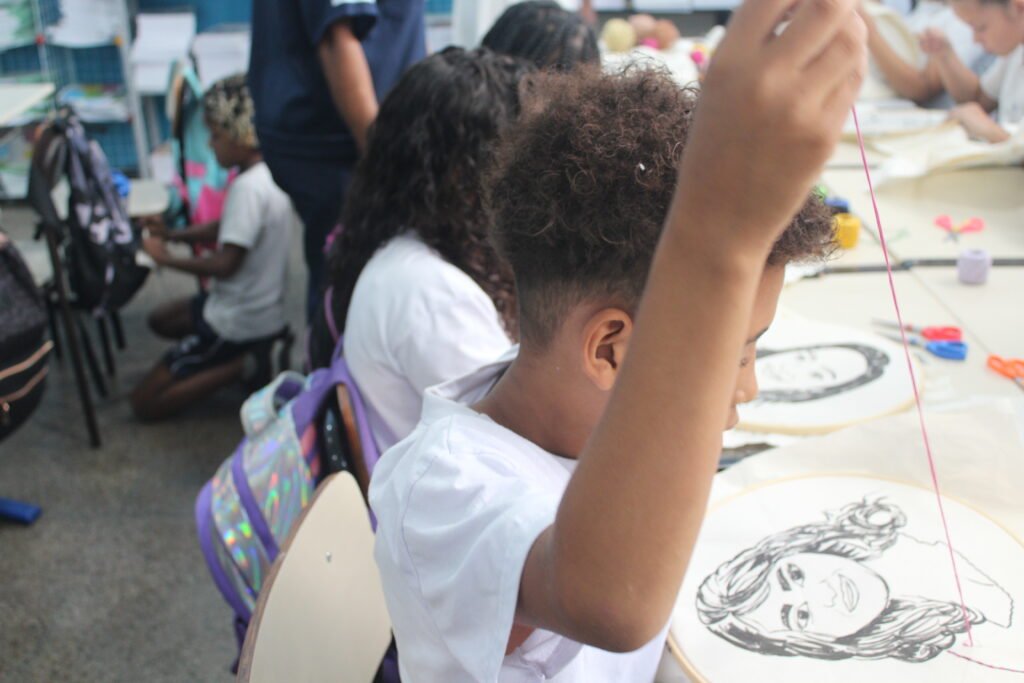
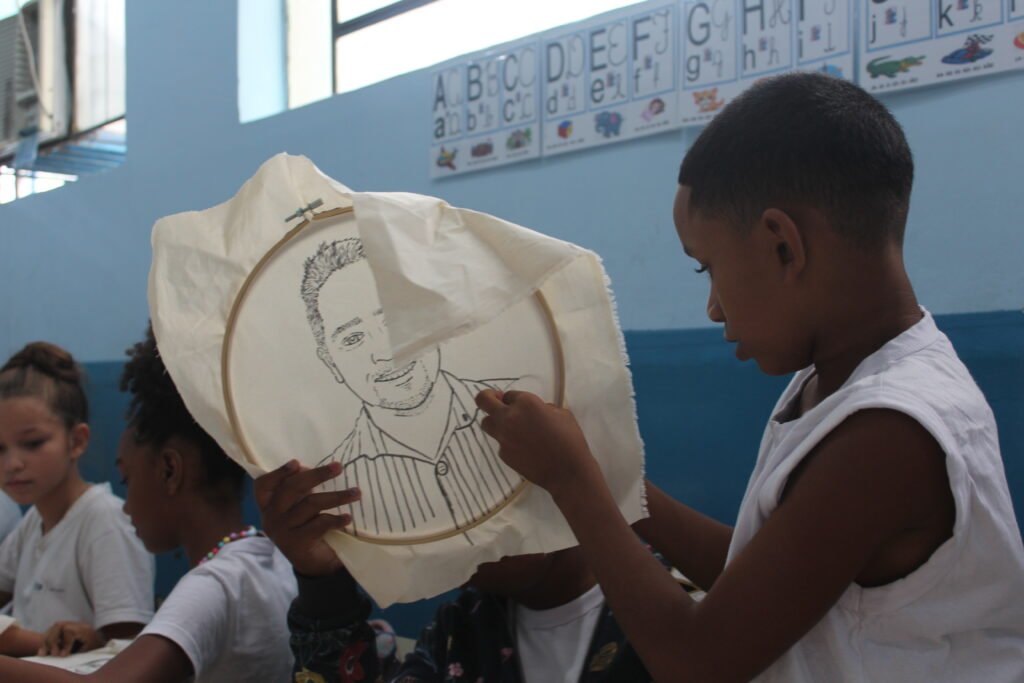
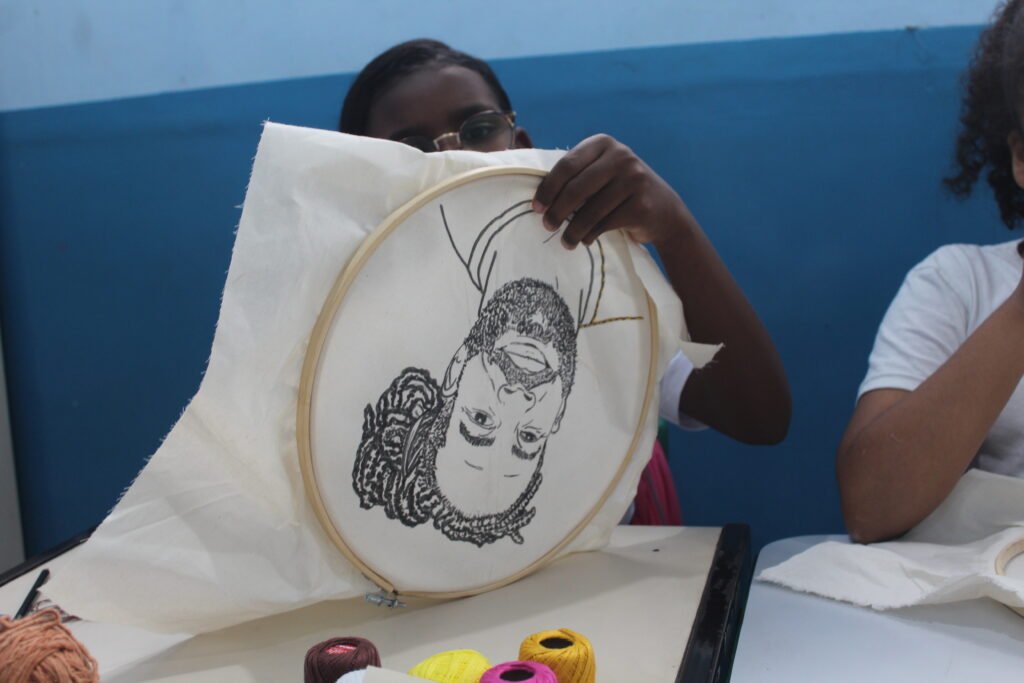
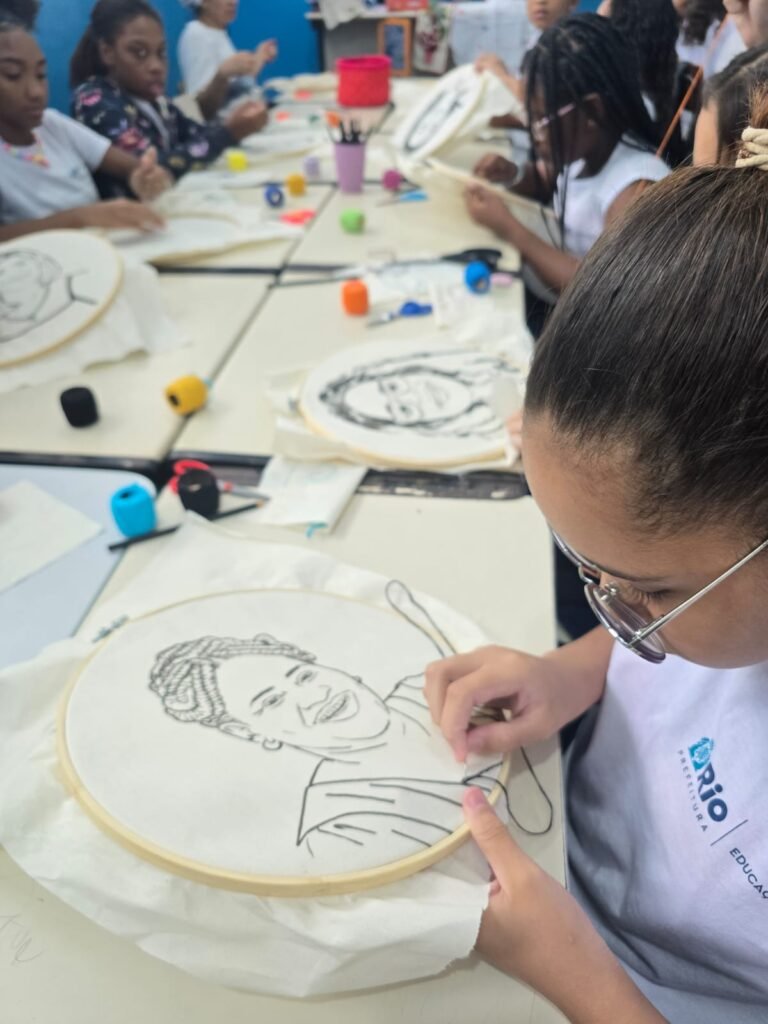
Photos: Carol Delgado and Veronica Pinheiro
Loose ends
We then realised that we were teaching very little about embroidery. In fact, we were relearning collective ways of being. Thais Reis², our embroidery teacher, guided the children with the gentleness of someone who knows the pace of hands. Some teachers watched the little, focused bodies with emotion. The volunteers, Cláudia Daher³ and Eliane Brígida Falcão4, walked from table to table helping with knots, untangling threads, listening to stories. We observed everything, trying to understand at what point the fabric had ceased to be fabric and become a trail. We received photographs of people from the community and these images became drawings. Some of these people showed up at the school to see their own trails embroidered. Others sent messages. Others wanted to tell stories. Suddenly, the workshop no longer fit in the classroom. The longest-standing resident of the Pedreira shantytown will welcome us into her home.
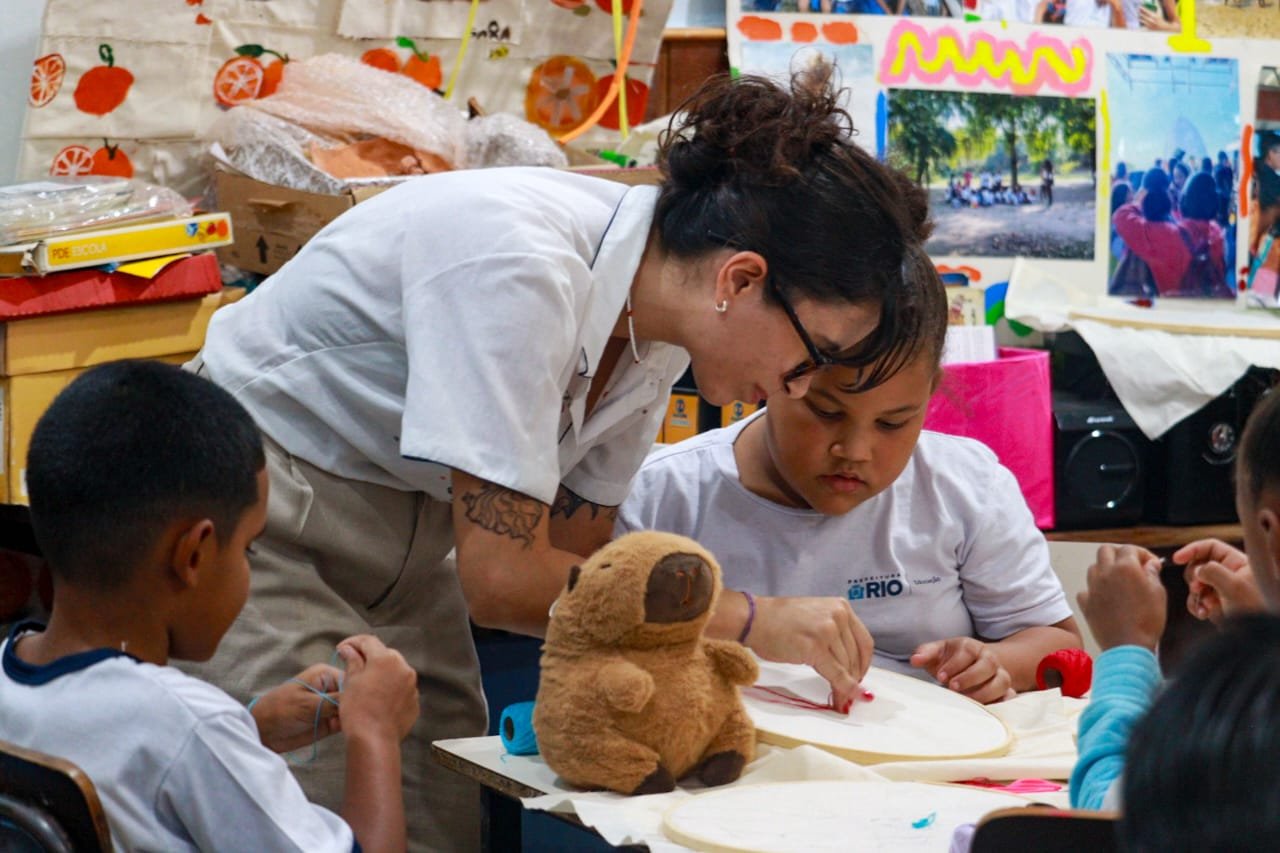
Photo: Rosemberg Auni
Perhaps that's what a living memory is.
A living memory, because it is not a memory frozen in the past, but something that continues to unfold among people. Something that breathes. Something that calls for continuity. Like the threads that keep weaving through the fabric even when the hand that began the embroidery is no longer there.
After the workshop, a teacher wrote to say that the children had discovered they were capable. We kept thinking about this on the way home. How often does school offer children nothing but the experience of failure? How often does a mistake carry more weight than an invention? How often does a child from the suburbs hear ‘no’ more than any other word?
On that day, the children embroidered without fear of making mistakes.
Perhaps because embroidery knows something that school has forgotten: every thread can start afresh somewhere else.
By the end of the meeting, the fabrics were spread out across the school desks like little shantytown emotional maps. There were skies, staircases, wires, playgrounds, houses, trees, names, suns, kites and paths stitched by the children. A fragment of Pedreira appeared embroidered on raw fabric. Perhaps we gathered ‘Shards of myths’, as Alemberg Quindins used to say.5
We went back home with tired hands and lit-up hearts. There’s still one day of workshops left. We think of the children who embroider memories. We think of the headteachers Daniele Oziene, Genicelle Colchone and Vera Lavatori, who continue to gently insist on life. We think that perhaps educating means helping someone realise that their existence deserves to be inscribed in the world.
Onwards we go. Amidst threads, needles, memories and children.
In a state of “Full stitch”.
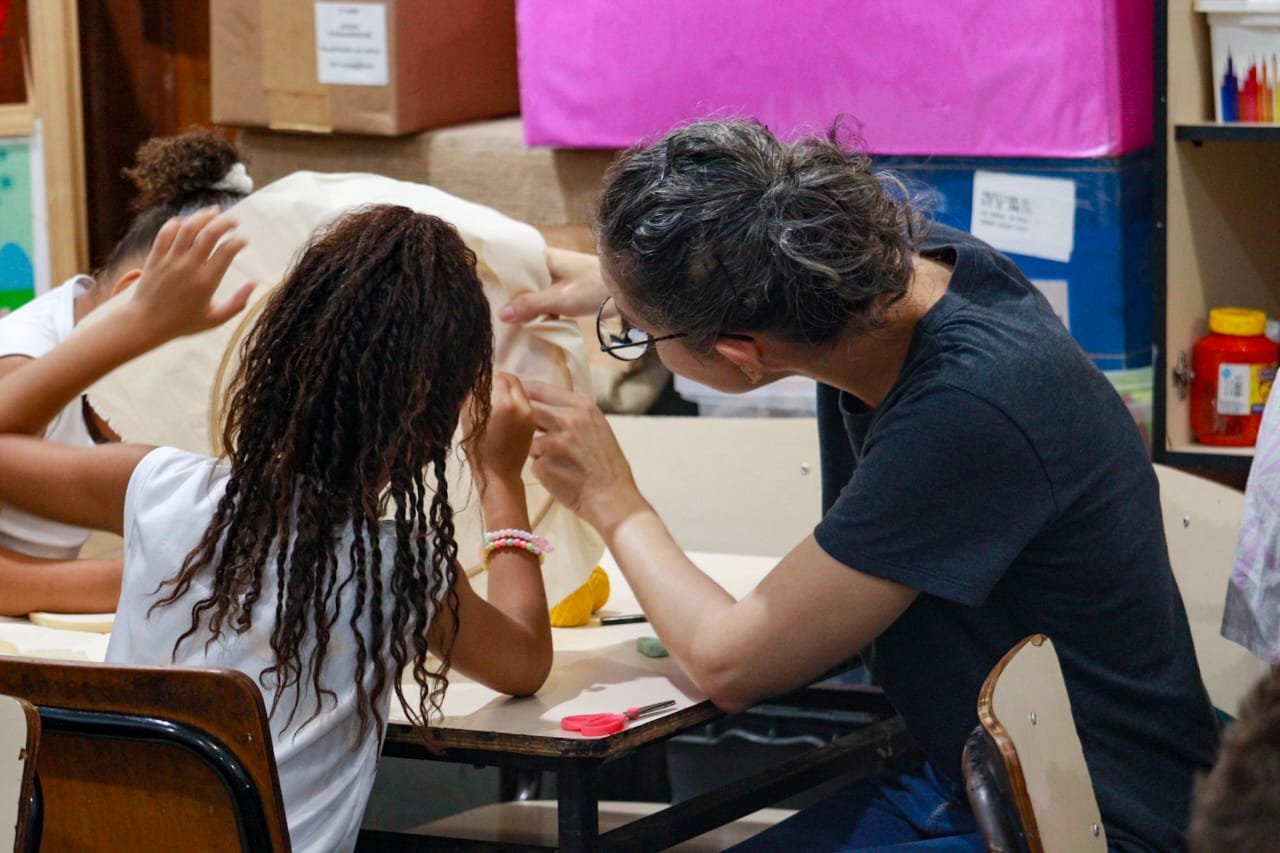
Photo: Rosemberg Auni
1 Selvagem Ways of Knowing Lab [Laboratório de Aprendizagens Selvagem].
2 Thaís Reis is a geographer and craftsperson whose work brings together art, culture and collective practices. She learnt to crochet as a teenager in a women’s group, an experience that shaped her relationship with handicrafts as a space for exchange and affection; she draws inspiration from the embroidery created by her grandmother, Maria Helena. She facilitates workshops on embroidery and other craft techniques, where manual work is used as a tool for creation, listening and expression, valuing processes and encouraging each participant to develop their own language.
3 Claudia Daher is a student of lines and strokes. She holds a degree in Graphic Design from the Universidade Estadual Paulista (Unesp) and is currently a Master’s student on the Postgraduate Programme in Cinema and Audiovisual Studies at the Fluminense Federal University (UFF). She researches image, art and edges, drawing on the insights of Fernand Deligny and his intersections with education, anthropology and clinical practice.
4 Eliane Brígida Falcão is a lecturer at the Federal University of Rio de Janeiro (UFRJ) and serves on the Secular State Working Group of the Brazilian Society for the Advancement of Science (SBPC).