




SUMAUMANOS
Veronica Pinheiro
14 de maio de 2024
“Yuxin dacixunuan punyan daci we tsaua”,
“Todos os yuxin sentaram-se em todos os galhos da samaúma”.

At 7.30am on May 7, 2024, the principal opened the school gate as she did every day. Instead of 'good morning', we heard: ‘I couldn't sleep with so much joy! I wanted it to be morning so I could come to school.'
Once the sentences were pronounced, we heard a sequence of voices, as in a chorus: ‘Me too’. ‘Me too'. ‘Me too’.
I didn't reinforce the chorus, but I couldn't either.
Era o dia da primeira imersão do Grupo Aprendizagens. Nosso destino: Jardim Botânico do Rio de Janeiro. Nesse movimento de despertamento de memórias, provocamos encontros. Alguns são entre espécies, outros não. Para nossa imersão pensamos no encontro das crianças com as árvores. Tínhamos um roteiro alinhavado: receber as crianças na escola; café da manhã; embarque no ônibus; chegada no Jardim Botânico; visita ao museu e à exposição Mbaé Kaá; passeio no jardim; piquenique; meditação e jogos teatrais; retorno à escola; e almoço. Uma linha longa e sensível prespontava de verde nossas expectativas.
If ‘there is only experiencing and the rest doesn't concern us’¹, what happens when we sensitively bring the urban beings we are closer to nature, which we also are? We will probably reach the last diary of the year, in December, without an answer, but this question moves us. Over and over we talk about sowing; about germinating words. In an ideal scenario, those who plant a field know what they're going to harvest and when they're going to harvest it. What about those who plant dreams? Gatherings? Who plants water, trees and forests?
Taking children to the Botanical Gardens so they can find the trees is not a pedagogical strategy. It's much simpler: every child has the right to know what nature is and to have access to the manifestations of the natural world.
‘Miss V, that's not a shot. It's fireworks. Relax.’ ‘Miss V, that noise is from the news helicopter, the police helicopter has another sound.' In the Pedreira favela, many children under the age of 10 can recognise the sounds of horror and war. But they don't know the sounds of the wind meeting the treetops. On May 7, 2024, the day of the tour, the favela dawned quiet and the sun came out early and warm, even though it was autumn. The last Tuesday tasted like a party candy.
We were 42 people in total from the school². 6 from the Ways of Knowing Group³. 1 bright pink bus and 1 very kind driver. The colour of the bus is strategic, we need to get in and out of the favela safely. The pink bus has become a beloved character among children and adults, it has already earned a name and its visit is being awaited by other classes in the school.

A visita ao jardim começou e terminou diante da Sumaúma (Ceiba pentandra). No começo, “Sumaúma: Copa, Casa, Cosmos”, obra de Estevão Ciavatta com narração de Regina Casé, nos imergiu virtualmente na Sumaúma. Fomos recebidos pela equipe do educativo do Museu; Daiani Araújo e Thalyta Sousa receberam as crianças com muita delicadeza e conduziram todo o grupo até a obra Sumaúma. Na sala de projeção, todos, sem exceção, ouviram com o coração as palavras da árvore. Pela primeira vez, muitos dos presentes se deram conta que uma árvore tem muito a dizer sobre si e sobre a vida. Alguns quase não piscavam, outros ouviam de olhos fechados. Todos sorriam com lábios e olhos.

‘Miss V, draw us the map of how to get from school to here. I want to bring my family here to listen to the tree.’
‘I'll make a map from the Pavuna metro station to here. It'll be very easy to get here.’
Subimos as escadas de madeira em pequenos grupos de 7 pessoas e no segundo andar, dentro da exposição Mbaé Kaá aprofundamos algumas conversas sobre plantas e a relação dos povos indígenas com elas, ao redor da instalação Jardim Viva Viva. Arte Guarani, natureza, ciência, Barbosa Rodrigues e as janelas do prédio. Após a conversa sobre a exposição, as crianças correram para janela. Ali me toquei que as janelas das salas de aula da escola não têm vista. O gesto coletivo de olhar para fora trouxe uma inquietação ao grupo. Muitos encontros estavam por acontecer. Abraços entre crianças e educadores do museu encerraram a primeira parte do passeio.

In the Garden, the children looked in every possible direction. They saw with their eyes, ears, feet, skin and hearts. They paused to admire the fresh water flowing down from the rocks. Pause to feel the freshness of the water. For a minute or more I didn't hear any voices; hearts and mouths fell silent so that the eye could see properly. After the silence that greeted the waters, euphoria gradually overtook the group again. ‘I'm not going to wash this hand any more. I touched the water from the waterfall with it.’ I didn't say anything. The boy believed he had touched the water, little did he know that the water had touched him. Now he carries fresh water within, whether he washes his hand or not is a detail.
‘Miss V, the bamboo just spoke!' Before I could comment...
‘Why are there no pandas up there?
Before I could say anything... a giant fish, the Black Pacu that lives in the Frei Leandro Lake became more interesting than the answer. We walked for a few minutes, crossed the small bridge and went through the gate to the children's playground. There we had a snack and meditation break. We sang to the Earth. With our eyes closed, we were trees. Roots. Trunk. Branches. Leaves. Our tour was coming to an end, it was time to return to the bus. We took a different route inside the garden, as we couldn't leave without finding the Sumauma tree planted in the Garden.
Com raízes muito profundas que trazem água para a superfície mesmo na época seca, a Sumaúma é considerada a mãe da floresta e pode chegar a 70 metros, o que equivale a um edifício de 24 andares. De onde eu venho, na sumaúma vive Iroko, (do iorubá Íròkò) que é guardião da ancestralidade e dos antepassados, seio da natureza e morada de todos os Orixás; primeira árvore que se fez plantar na Terra. Muitos povos indígenas afirmam que as grandes sapopemas da sumaúma representam um portal para outro mundo. Uma árvore sagrada para diversos povos da floresta, uma grande mãe, que protege todos. Os Huni Kuï dizem “Yuxin dacixunuan punyan daci we tsaua”, “todos os yuxin sentaram-se em todos os galhos da samaúma”. Num espaço pluriversal de diálogos, a sumaúma é tudo isso e mais um pouco.
I read an EMBRAPA document on the Sumauma tree and thought that the team who wrote the text for the Ministry of Agriculture, Livestock and Supply should have visited Rio's Botanical Garden together with the children, because the government technicians were only able to present multiple uses and economic alternatives of the tree. However, just like the babas and shamans, the children connected with the tree. Dreams and sap mixed together. As our circle formed around the buttress roots, green memories were awakened. In the time of dreams, my little companions dreamt of being a tree and living in a garden. Dreams are sap, a liquid that circulates and keeps circular time. In the time of saps, 10-year-old Angélica came to the following conclusion: ‘We found the tree, we went inside it and now we are SUMAHUMANS’.
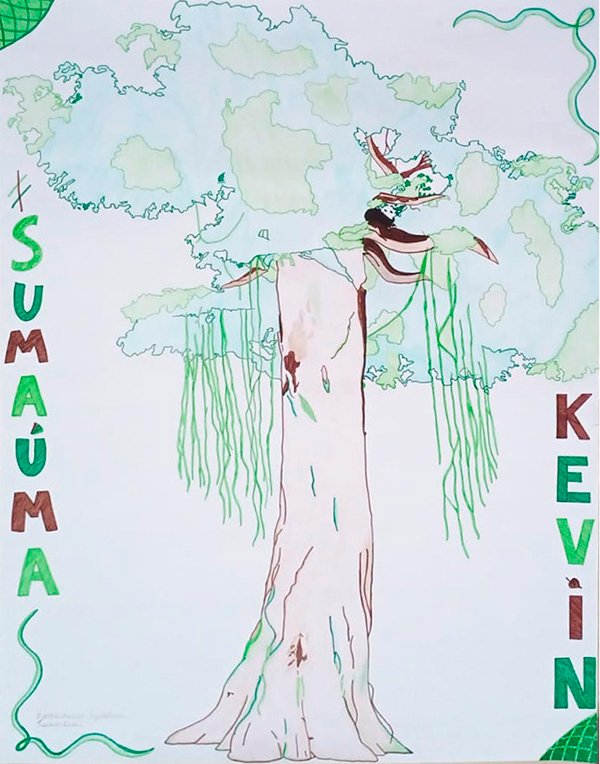
Returning to the question that moves us: what happens when we sensitively bring the urban beings we are closer to the nature we also are? According to Angélica, we can become a bit of a tree.
¹in Mbaé Kaá o que tem na mata: A Botânica Nomenclatura Indígena, de João Barbosa Rodrigues. Dantes Editora, 2018.
² 37 4th grade students, 3 teachers, the pedagogical coordinator and the assistant principal.
³ Luany da mediação de visita ao Jardim; Paula Novaes da mediação de atividade de respiração e jogos teatrais; Tania Grillo da mediação durante a exposição Mbaé Kaá, e 3 integrantes da equipe de voluntários, Bia Jabor, Eliane Brígida, Evellyn.
Photography: Éricka Hoch;
Coordenação e medicação nas atividades de Veronica Pinheiro.