




O SENHOR DO QUINTAL
Veronica Pinheiro
27 de agosto de 2024

The backyards I knew were run by ladies. Backyard ladies. I grew up without a backyard to call my own. I did, however, immerse myself in my grandmother Dona Irene's backyard every week. A yard full of plants, trees and water. Plants to eat, to bathe with, to make tea with, to bless and to delight the eyes with. Backyards are suspended places where you play at being until it's time to be. Like me, most of my little companions on this journey of awakening memories in Favela da Pedreira don't have a backyard at home.
Walking through quilombos and indigenous villages I keep thinking about backyards, terreiros and the absence of communal places in peripheral urban spaces. The absence of these spaces to play influences the sense of community, because when people play, they act out the world around them and the worlds they carry in their memories. By playing, the past and the present are reinvented. Playing is not exclusive to childhood: where I come from, women, men, stars, plants and animals play. Incarnate and enchanted beings also play. It was common to look up at the sky and say that the sun was hiding; to say that the trees were dancing... that the wind was singing. It was also common to play with the entities at home.
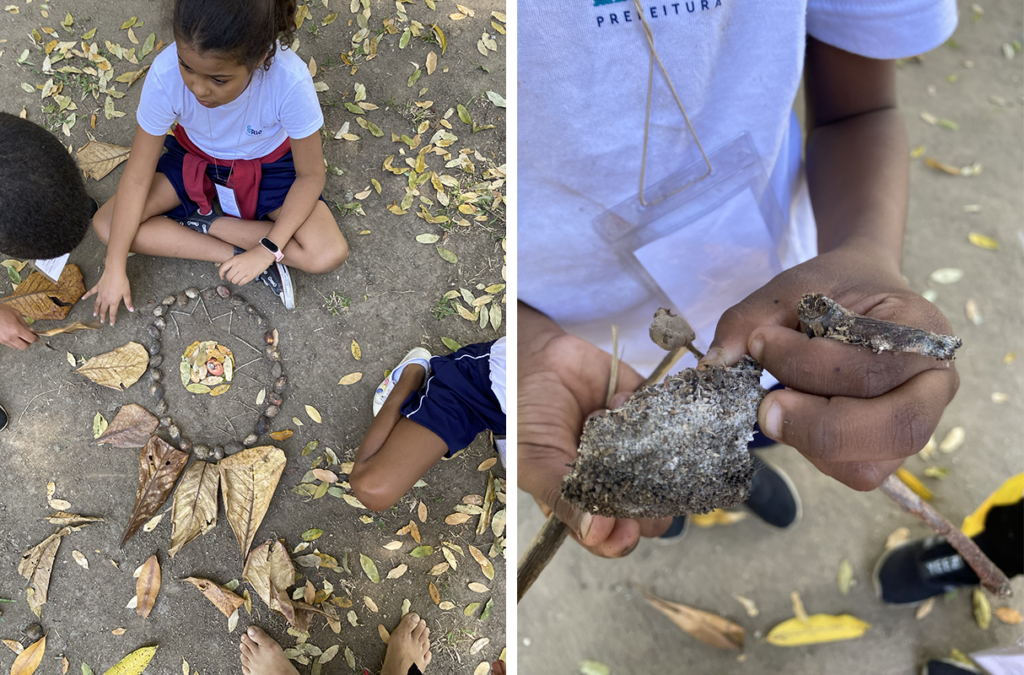
The Professor Escragnolle Dória Municipal School has a large yard that is poorly used due to security reasons. The backyard is the school's most vulnerable space, exposed to the weather and 'stray bullets'. If children from the outskirts don't have a yard at home and don't have communal spaces, where can they play? I turn the reading room into a backyard, a wild backyard with a bonfire and moonlight. We understood that the outings organised by the Learning Group in conjunction with the school also needed to be moments for playing. When walking with the children around the city of Rio de Janeiro, we realised that there were profound movements among them to broaden their view of themselves and their territory, to self-regulate their emotions and impulses, and to foster a sense of community. Organically, when they leave school, we see ‘rowdy’ students becoming leaders, taking on the care of their peers who need support. One child takes another by the hand and offers to spend the whole day by the side of the classmate who is scared or anxious.
The backyard is the outside, the place of encounters and affective, sacred, communal and festive constructions. Our outings are an invitation to go outwards. And some people have very kindly collaborated so that we can go out safely and with a proper structure. We went to Quinta da Boa Vista with the financial support of a former pupil of the school. Mr Altair studied at Escragnolle in the 1980s and, when he heard that we were taking the children on nature outings, he readily offered to pay for the bus and snacks. Mr Altair and his wife were the backyard hosts, just like at the quilombo festivities. Many backyards were opened that morning.
Taiana Simões¹ opened the door to the Quintais Brincantes, bringing Bia Jabor and Rafael Cruz to play. Bia is already part of the Selvagem community and Rafael is inviting us to play in UNIRIO's backyards. Quinta da Boa Vista would just be our location on earth.
Taiana, after the picnic and the walk, said:
‘The story tells us that a long, long time ago, in this very same land, there lived a gentleman called Quintas. Mr Quintas loved his backyard and took great care of everything that grew there. He loved it so much and cared for it so much that it was the most beautiful thing one could ever see. And that yard wasn't just about beauty. All the fruit that grew there was somehow very different from anywhere else. They were huge and very, very sweet indeed! They were so big that the oranges were as big as the heads of the children running around, and the watermelons were the size of truck wheels.
There was so much fruit, so big and delicious, that Mr Quintas' backyard provided food for the whole community around him. Whether it was people or birds, monkeys or skunks, everyone who passed by had something to eat and a good chat to have with Mr Quintas.’
I was surprised! I've known Quinta since I was a child and had never heard of Mr Quintas.
I followed the narrative attentively! Where was I, how have I never known of this incredible gentleman? I realised that what Taiana was telling was a created truth, a literary truth that happens in the imagination.

‘The news about this lovely yard, with its giant, delicious fruits, went from mouth to mouth. And it brought a whole host of curious people who just wanted to get something for themselves. And so, day after day, the whole yard became sad, nothing was the same as before, nothing was so vibrant anymore. And as time went by, Mr Quintas watched his yard die little by little, plant by plant. Until, not knowing what else to do to save his beloved yard, Mr Quintas began to feel so sad, but so sad, that he began to dig a hole in the ground, right in the middle of his yard. He dug a deep hole and put his two feet in it, covered the hole with soil and waited, waited, waited until the rain came. When the rain hit the ground, Mr Quintas's feet began to take root, going deeper and deeper into the earth. His legs became rigid, turning into a hard and very firm trunk. His arms and hair turned towards the sky, grew into branches and leaves that were very tall and eye-catching. Thus, every part of Mr Quintas‘ body was transformed into a large, beautiful tree, except for one part that continued to beat inside Mr Quintas’ chest, marking the rhythm of his new life. He thus became the Grove Man, the guardian tree of this backyard.'
'Miss V., does Mr Quintas exist?’
I replied: ‘I think so’. Angélica, aged 08, had already explained to me at the beginning of the year on a visit to the Botanical Garden that we are a bit like trees.
Realising the doubt in the eyes of those listening, Taiana handed out stethoscopes for the children to listen to the hearts of the trees. Doubt ceased to exist: every tree in that yard had a beating heart. The lord of the backyard was there.
The children, more attentive than me, could hear the baby jackfruit's heart. ’We've got to look after the trees, right, Miss V.? Everything's alive.'

Everything is alive. After telling me this, Bia ran off into the arms of her grandmother Lúcia. Until I arrived at the Escragnolle School, Lúcia was the teacher in charge of the unit's reading room. She retired a few weeks after my arrival, but she is present at all the outings as a volunteer. Lúcia is somehow planted, bringing life to the school in other ways. For a long time I wanted to be the wind. However... together with the children, I have longed to be a planted tree.
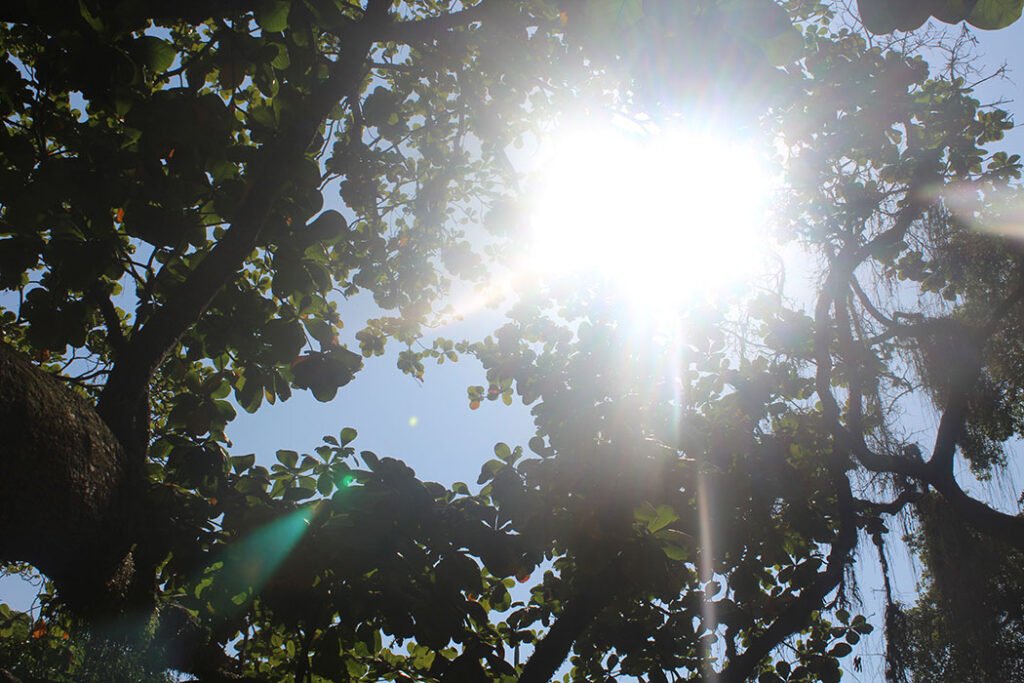
Fotos das crianças da Escola Municipal Professor Escragnolle Dória
_________________________________________
¹Taiana Simões is an anti-racist educator with a sensitive eye for nature and childhood. Her work integrates different areas of knowledge such as ecoliteracy, science teaching, storytelling, racial literacy and agroecology.
The story of Mr Quintas, by Henrique Santiago, the creator of Ecobé