
NAVIGATING THE TEACHING FOREST. A DIVE INTO LIVING SCHOOLS
Cristine Takuá
29 May 2025

In the forest, there are no laws, there are responsibilities…
– Kauê Karai Tataendy
As I walk with my children, I learn to pay more attention to the subtleties that surround us and also to broaden my perceptions of this modern world in which we all have been placed, a world full of rules, norms, schedules, restrictions, etiquette, discipline, and obedience. When we look into the forest, we perceive another way of being and interacting with time and territory.
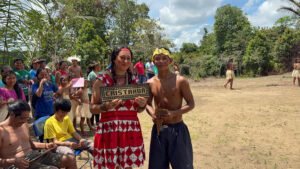
Together with the Selvagem group, we sailed to visit the Living Schools that inhabit the Amazon Rainforest: Bahserikowi, in Manaus, run by the Tukano, Dessano and Tuyuka peoples, and Baniwa Living School, located in Assunção do Içana, in the upper Rio Negro.

Meeting the kumuã and visiting the coordinators of the Living Schools filled me with enthusiasm and the desire to continue weaving this tapestry of dreams and profound intentions. In Manaus, at Bahserikowi, we were welcomed with açaí and quinhanpira, a traditional dish of the Rio Negro peoples, which is a fish broth with pepper, a lot of pepper. We participated in a graphism workshop and discussed the work that has been done, as well as future plans. We also talked about the constellations and the times that govern life in Tukano and Dessano cosmology.

As we sailed further up the Rio Negro and went deeper into the forest, we felt the power of nature in its essence, but we also saw, in the communities, historical marks left by colonisation and schooling.
But even amid challenges, upon arriving in the Assunção do Içana community, we found a happy collective, living and practising their knowledge in harmony. The Baniwa Living School and farms are pure truth, profound joy, and complex knowledge experienced by many in dialogue with the river, the ants, the peppers, and the carurus. I remembered Ailton Krenak when he says in his little book Um rio um pássaro [A River a bird]:
…...if they learn to balance utility with nature, perhaps life can be better. Just as river waters flood or recede according to the rainy season, they must learn to respect the rhythm of nature, learn that there are times of abundance and times of scarcity.

This is how the Baniwa, Koripako, Tukano, Dessano, Tuyuka and other peoples live, coexisting in harmony with time on the rivers of the Amazon and practising their ancestral knowledge, which comes from ancient traditions.
During the days we spent together at the Baniwa Living School, we felt a very strong sense of collective power among the women, and Francy talks about this in her article ‘My writing, lived experiences and dialogue with indigenous women from Rio Negro – Amazonas/Brazil’, which can be found the speech.
We take care of life, we take care of the home, we take care of the environment outside the house, we take care of the community with other women. We show solidarity in crop work, when we are invited, everyone participates. We show solidarity when someone is in need. Just as I learned from my mother and grandmother, and in my travels I see that in many difficult moments the last word is female.
All these depths we have experienced have placed us in close contact with the codes that hold together all human interaction with the usefulness of life. For some time now, I have been reflecting on the usefulness of school in our lives and the flood of theories that are poured into children and young people without the slightest concern for preparing them to live in harmony with nature.
This distance between school curricula and nature, and what really makes sense to be learned and practised in teaching and learning processes, concerns me deeply.
Human societies are losing the sensitive and delicate perception of reading, deciphering, understanding, and practising the knowledge and skills that reside in the ancestral memories of their grandmas.
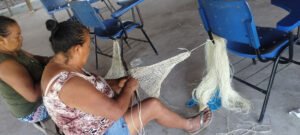
Connecting with ancient narratives, learning about fishing techniques, cultivating crops, weaving fibres, or playing a sacred instrument—all of these are precious skills that the Living Schools have prioritised on the path we have been weaving together. We are rowing our little canoe of transformation.
By doing so, we continue dreaming and believing that Living Schools can be like colourful parachutes to postpone the end of childhood and strengthen the true process of transmitting knowledge that is very sacred and important to our lives.