




LER A TERRA
Veronica Pinheiro
28 de maio de 2024
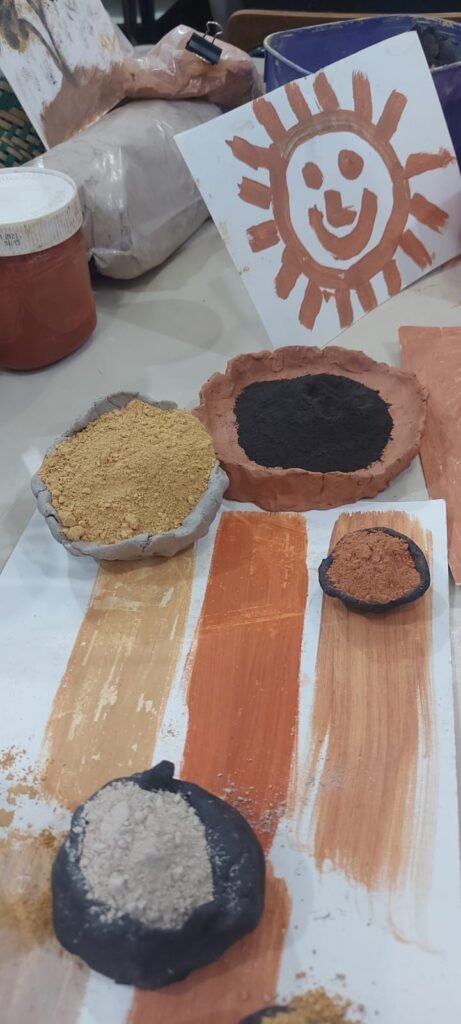
I remember the conversation we had with clay at the Cosmovisions from the Forest, no dia 13 de maio de 2023, no Museu de Arte Moderna do Rio de Janeiro (MAM-Rio). O encontro entrelaçou os projetos Ore ypy rã – Tempo de Origem e o Selvagem em um dia de exposição e atividades com cantos, danças, conversas. Diante de um vaso de cerâmica marajoara, Francy Baniwa começou a falar sobre como as mulheres Baniwa conversam com a argila, que é um ser muito antigo e sagrado. De onde eu venho, o barro também é sagrado. Lembro do barro vermelho que cobria toda a comunidade e de como tocávamos com a mão no chão e no coração antes de dançar ou jogar capoeira. Lá em casa, o barro era nossa avó; berço originário e colo derradeiro. O barro só era colhido mediante as necessidades. Levei isso para as oficinas com argila.
Walking through the Costa Barros neighbourhood, where the school is located, between gullies and shacks, the cracking of the ground caused by rain, landslides or the action of man reveals the colours that lie in the earth. Textures and shades of brown and reddish hues colour and reveal the soil's physical, chemical and mineralogical properties. While planning the workshops on planting fruit species at Nhe'ëry with Gerrie Schrik, I was asked the following question: What is the soil like at the school? Not having the technical answers, I was able to talk in detail about what I saw. And I could see the colours of the earth in the excavations and gullies. Looking at the soil is a practice I try to pass on to the children.

"Nobody analysed the soil, we knew the soil just by looking at it. Just by looking at the soil we knew what to plant. We knew the vegetation. On a soil that produces a lot of native legumes, we planted beans; on a soil that produces a lot of native grasses, we planted maize and rice. It's a cosmic language. It's simple. You don't need to analyse the soil, because soil already tells you what it is willing to offer." Nego Bispo
The soil speaks. We spent a week at school looking at the ground. Children and I. Tracks of dirt around the school that hadn't been covered by cement were the texts of the week. In class, the children and I read and talked about the ‘Earth Letter’. Interestingly, the children don't even know what a letter is anymore. They write little notes to me on pieces of paper, but they call the note a message. I explained what a letter was, what it was for and how it was composed. ‘Can the Earth write a letter?’, ‘No! It doesn't have arms or hands. She must have dictated it and someone wrote it down: like God with Moses".
After a lot of chatting, we went out into the yard. It looked like an expedition: notebooks, pens, a branch to support us on the way up. The book was outside the reading room. We read the oldest book of all: we read the earth. For a while, we only observed the colours of the soil; in other moments, only the little insects and animals that lived there without anyone noticing. ‘Auntie, a lot of people live here!’, ‘I know, did you think the school only had furniture and books? The school is inhabited by living beings even when we're not there." Ants, lizards, spiders, plants, lots of birds. The first graders were amazed. They didn't know that so many different birds used to visit that yard in the late afternoon. We sat in silence in the middle of the court after the story had been told. I told them that they would be receiving visitors. Winged, colourful, singing visitors. I had the feeling they were the same birds that usually wake me up at home. They're certainly not the same birds, but it's nice to think that they accompany me to Pedreira.

I tried to talk to the old gentleman who is always planting on a piece of land at the top of the hill. He's certainly the best person to talk to about the planting and earth pigment workshops. He has a daily relationship with the soil: I see it when I walk past his yard at 7am. In a region with the second lowest human development index, there is a man who is full of green. Man-plant-soil suspended and hidden in the green on the edge of the asphalt. While food insecurity circulates daily among the local population, this man, who has not disconnected from the land, cares for and is cared for. We've arranged to visit him, we intend to arrive with a basket of delicacies, and in some way be kind to those who gently tread on the earth.
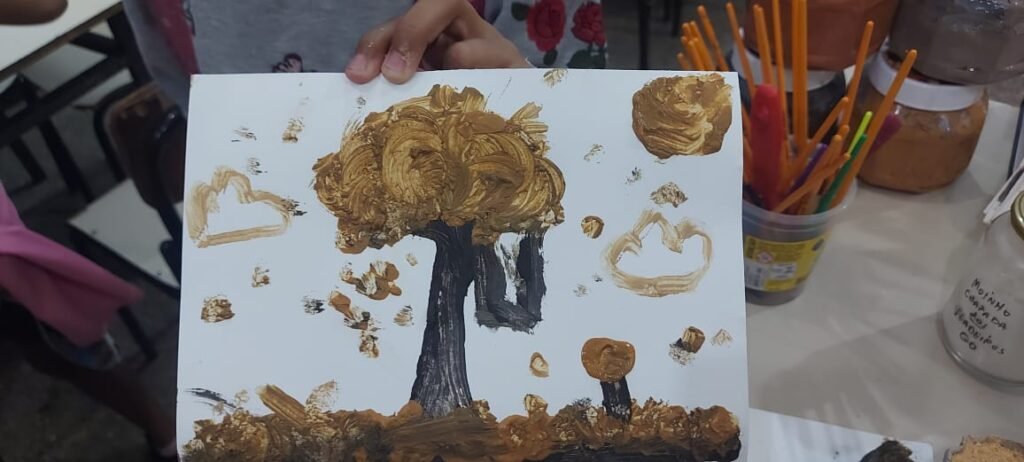
We also intend to bring him a picture painted with pigments prepared using soil from the territory and the school, and somehow establish a dialogue based on our common cradle: our relationship with the land. The workshops are initial movements, they are seeds. By germinating the seeds, some memories of life are awakened. The awakened life is in the territory, in the memories stored in the earth and dormant in the bodies. By establishing a partnership with a regular school, we dreamed up the idea of living schools in urban and peripheral environments. Our proposal is to strengthen the territory, the knowledge and life practices that exist there. In this movement, we try to identify who are the guardians of good living; who are the beings who, in the midst of so many imposed difficulties, maintain practices that sustain ancestral cosmologies.
There is no single model of workshop that can be applied to every school and territory. We have shared natural paint workshops in other moments. For the children at the Escragnolle school, we started with the ‘Earth Letter’ and worked our way up to pigments and paints. When I invited them to learn more about the place where they live, I repeatedly heard stories of violence and fear. I asked them if they knew where the paints in the workshop came from. Some children suspected that the paint was clay. ‘It looks like paint, but it smells like earth’. I asked them if they knew that the soil in the area around the school was a soil full of colours. I asked them if they knew the kind man who managed to have a different way of being and living in the favela. Children, like birds, know a lot. The little ones gave me his name and a possible time for visiting him.
The children said they hadn't realised how important it was to know about soil, plants and the backyard. During the week the children gave me gifts of soil, annatto and pigmented flowers. Gifts from the children of Pedreira. Perhaps the most beautiful I've ever received.
Now we're mapping the favela's green paths. The colours of the earth in the school yard paint in yellow and in shades of red the maps of life in Pedreira.
Photos: Wagner Clayton