




KUNHANGUE REKO | THE WOMEN'S WAY OF BEING
Cristine Takuá
June 26, 2025
 Feminine energy, Ara’ i Gennis, 2020
“Generally, during the menstrual period it is the time to listen to our own body, they say it is the time of solitude, to enjoy your body, listen to your body, move away from people, because at that moment you are also in a period of conflict, anguish sometimes, so that’s why this moment is very important for us — it’s called the moment of solitude, of enjoying the solitude. Your own body, your spirit, your own breath. It’s a dangerous moment for our blood to go down and then we take care of ourselves, strengthening ourselves.”
Somos aquele chão que carrega e leva tudo – Corpo-Território 2 – Sandra Benites
At the beginning of June, I hosted a group of girls and young women from the state secondary and primary schools of my community for a dialogue about women's way of being. We talked about the times, the challenges, the dreams, and the struggles. I gathered with Carlos Papá at Guarani Living School , who brought the firts words by talking about territory and then expanding this to the notion of the body as part of the territory. My sister-in-law Clementina Ara and my niece Milena Jaxuka also participated, sharing their knowledge and thoughts about the world of Women.
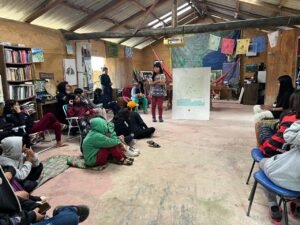
I always like to talk about the grandmother, the grandmother's grandmother, the grandmother's grandmother of our grandmother, and mention how wise they were and how they were guardians of so much knowledge and skills. Their lives were totally different from ours. I like to talk about how much we need to focus in order to activate and awaken practices that lie dormant.
During the conversation with the girls, I remembered a text I read some time ago: ‘Kunhangue arandu rekó, ta 'ánga re a 'egui nhembopara: wisdom of the life cycles of Guarani women in paintings and words,’ by Gennis Martins Timóteo. In this text, Ara'i Genni shows some paintings she made and reflects on what happens during menarche, the first menstruation, a very sacred moment for Guarani women. It is a moment that is like a blessing from Nhandexy, our true mother who protects and cares for all women.
““The hummingbird is the great sacred spirit sent by Nhandetchy to bring fertility. The flower it carries in its beak refers to the first blood of menstruation that spills over the uterus in the form of a plant with leaves and flowers that will still bloom inside the uterus. The first menstruation is the most important in the lives of Guarani girls. From then on, a new cycle of life will begin, childhood ends and adulthood begins to emerge. Little by little, life changes in a way that we women leave a world of fantasy and enter a real world where facts happen and experiences accumulate with each passing year. Djatchy is a term used by the Guarani of Biguaçu to refer to when a woman is menstruating. When she is about to menstruate, we say she is on the moon. The moon is a sacred being that represents the Guarani feminine symbol that influences the life and way of being of a Guarani woman.”
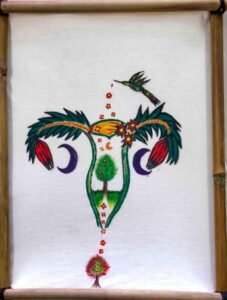 Memby ryru (uterus), Ara’’i Gennis, 2019
It was very special to talk to the girls about life, childbirth, body care, and the importance of listening to their elders, the older women who are guardians of ancient secrets. I spoke about the importance of cotton in women's lives, for caring for and affection towards the baby that is arriving. I shared cotton seeds with each of the girls who came to talk and we walked to the cotton tree that I have planted near my house.
Ara Clementina spoke of the importance of protecting and respecting the body during each cycle and warned that if we do not follow these rules, we become ill. We discussed natural contraceptive methods and the danger posed by injections that sterilise women, causing them to go months without menstruating. These bad practices have been causing cervix cancer in some indigenous women, so we need to have the courage to weave networks of resistance and dialogue that clarify the good ways of living for young girls.

Durante as falas das meninas, que ficaram fazendo perguntas, me recordei e compartilhei com a professora para depois mostrar às alunas, a série de Cadernos Selvagem Corpo-território.
In another text, Sandra Benites comments:
“Girls must be careful during oguapyare – menstruation, and we Guarani women must always take care of our bodies throughout our lives. The tchedjaryi say that headaches come with the wind. That is why we cannot expose ourselves to the cold during this period. You cannot have a headache during seclusion, because you will always feel pain and, over time, the pain will become stronger. Girls also cannot handle fire, heat, or go out in the hot sun. Excessive heat causes dizziness and headaches. When we are menstruating, we do not cook. During menstruation, we are very exposed, fragile, and sensitive. We have to stay calm, stress-free, and peaceful. Disregarding these rules leads to problems in the py’a – heart” (BENITES, Nhe’ẽ, reko porã rã: nhemboea oexakarẽ Fundamento da pessoa guarani, nosso bem-estar futuro (educação tradicional): o olhar distorcido da escola, [Foundation of the Guarani people, our future well-being (traditional education): the distorted view of school], 2015, p. 21)
The girls were very curious to hear stories about women and their relationship with nature and sacred spirits. Papá told the story of Kuaray and Jaxy (Sun and Moon), and I followed up by talking about the importance of Ka'a and Takua to the Guarani world.
Takua is the oldest goddess, she created our universe, especially our solar system. Grandmother of all gods and the pulse of a heart, the only way to communicate with her is through the takuapu, a sacred instrument used by women in the house of prayer. When a woman hits the takuapu against the ground, the sound of this instrument reaches the goddess, who then receives your call. (MOREIRA ANTUNES YVYDJÚ TAKUA, 2019, page 3).
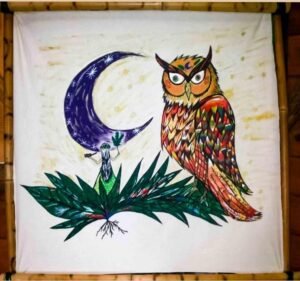 Takua, Ara’’i Gennis, 2019
This meeting with the young women brought back many memories of when I used to teach and talk about childbirth, healing plants, the importance of rest as a profound science of the forest, the sensitivity of dreams as a guide and compass for life, and all the critical and political connections I have been making over the course of several years of journeying. I told them about my work coordinating the Guarani Yvyrupa Commission and what that meant to me, since, until that moment in 2016, only men had been coordinators. Since my arrival, I have encouraged many women to become leaders, and today I see many women speaking out and fighting to defend their rights. I also spoke about the dream of Living Schools movement and the coordination work I do today, sowing seeds that awaken memories and strengthen our bodies and territories.
A salute to all the elders who came before us!