




I WILL MISS THE WIND
Veronica Pinheiro
26 June 2025
“I was born to live in a neighbourhood like this, full of nature,
in fact, everyone was born for this, right?”
Catarina, 9 years old
 Lake of Victoria amazonicas at the Botanical Garden
One year after the children's encounter with the trees¹, we returned to the Rio de Janeiro Botanical Garden with a group of 40 students from the Professor Escragnolle Dória Municipal School. For the first time, the group took part in activities over two shifts. We wrote a long itinerary, full of twists and turns, and reserved some time between activities for the children to play. Schools have so many rules and are committed to so many goals that, with each passing year, playing is no longer part of everyday life. I am alarmed when I think that a school-age child spends an average of 25 hours a week sitting down. That is 5,000 hours a year sitting in a chair, getting up only to eat and go to the bathroom. From a lack of safe spaces to a lack of staff, every school has an excuse to justify the need to keep bodies immobile.
The group that went to the Botanical Garden on May 30, 2025, consisted of children aged 9 to 11. Boys and girls in the phase of self-discovery, reading through the bus window the entire route from Costa Barros to Jardim Botânico neighborhood. According to data measuring the HDI of the city of Rio de Janeiro, those born in Costa Barros have a life expectancy of almost 20 years less than those born in Jardim Botânico. The Escragnolle students do not yet know what the Human Development Index means, but they understood on that last trip that, in the city of Rio de Janeiro, the distance from nature was directly related to territorial issues and that this had a direct impact on their lives.

According to Leonardo Boff, every point of view is the view of a point. For him, everyone reads with the eyes they have and interprets things from where their feet step. Catarina, 9 years old, from where she stepped, exclaimed that she was born to live in a neighbourhood full of nature like the Botanical Garden. And, with the eye of someone who sees collectively, she concluded that everyone was born to live in contact with nature. Children in urban environments experience a sickening separation from nature. The negative consequences of this disconnection are profound and affect children's physical and emotional development.
Os Huni Kuin dizem que “Todos os yuxin sentaram-se em todos os galhos da samaúma”. Para as Casas de Keto, no início do mundo, Iroko habitava a primeira árvore plantada na Terra e através dela os outros orixás desceram do céu. Se afastar das árvores e da natureza é também andar desencantado; é encarar a dureza de um mundo cosmofóbico sem yuxin e sem orixás. Richard Louv cunhou o termo “Transtorno de Déficit de Natureza” ao observar uma mudança profunda no comportamento das crianças em relação à vida por conta da desconexão da natureza². Na Escola Escragnolle, por exemplo, as crianças temem ao rio pelo histórico de violências que fizeram do rio uma grande cova para desafetos e pelas enchentes vividas pela comunidade a cada verão.

Our conversation and walk in the Botanical Garden bypassed the lakes, streams, and irrigation system of the place. This time we did not look at the treetops, but walked with attentive ears to hear the path of the waters. On that day, the waters carried leaves bearing dreams and secrets. The waters also sheltered the spectacle of giant Victoria amazonicas and flowering water lilies that hid large fish and a small submerged forest. There was more silence than usual among the children. It was the moist voice of the waters that reigned over a day of Ways of Knowing.
Entre conversas, escutas e caminhadas chegamos à Coleção de Plantas Medicinais do Jardim Botânico. Ali folhas, flores, cascas e raízes mediavam a chegança das crianças. Diálogos sensíveis, repletos de saberes tradicionais e científicos, fluíram durante todo o dia. À tarde, sob a regência dos Fitoimaginários, Viviane Fonseca-Kruel e Brígida Campell assumiram o encontro, a oficina ministrada por elas integrava arte e etnobotânica criando com as crianças Aprendizagens Vivas cheias de beleza e significações. Rafaelly, 9 anos, observa a professora Viviane com olhos de alegria, olhos de quem vê o amanhã. A menina mora na Pedreira, antigo Morro da Ventania, mas foi no Jardim Botânico da Cidade do Rio de Janeiro, sentada sob um arbusto de Justicia Gendarussa que ela brincou de observar o vento nas copas das árvores.
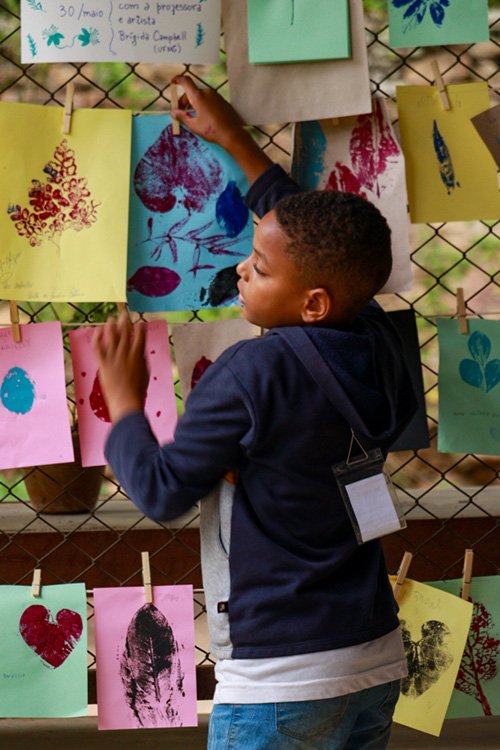
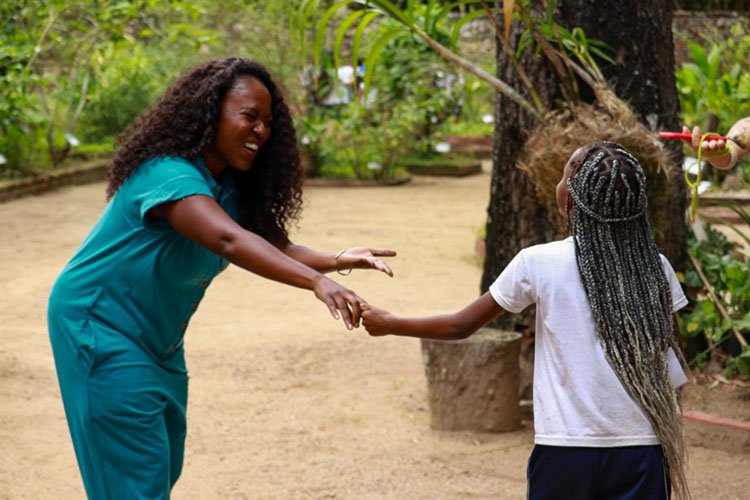
Popularly known as Path Opener, the shade of the bush was Rafaely's favourite place. Among everything she saw and experienced, Rafa said she would miss the wind. I remembered José, 7, who taught me last year that we carry the forest inside our hearts. I told her that she had wind inside her and that good winds would accompany her. Rafa asked to leave last. ‘The last child in nature,’ said Lucas.
We went back to Pedreira stronger and more spirited, writing diaries collectively, taking care of the tree seedlings we planted, and hoping that the wind would start blowing again on Morro da Ventania. When Hugo, 10, got to school, he concluded:
“If everyone goes to live in the Garden, they will cut down the trees and there will be no more Garden. We have to keep planting here, so that we can have trees and monkeys here too. It will take a good bit of time, but it will be beautiful.”
I believe that rivers and winds, beings that have always inhabited the worlds, are delicately drawing possible futures in Escragnolle. The children's words show me this. It may take a good bit of time, but in the meantime we will continue to sow seeds and connect worlds.
Photos: Rosemberg Auni
________________
¹ Diário de Aprendizagens, SUMAUMANOS, by Veronica Pinheiro – 14/05/2024
² Richard Louv. A Última Criança na Natureza [The Last Child in Nature]. Editora Aquariana, 2016.