




APAGA QUE TÁ FEIO!
Veronica Pinheiro
19 de março de 2024
Reading room, book 3
Read the following extracts aloud:
‘And he wasn't too bright, either. He had built his whole house out of straw. Can you believe it? Who in his right mind would build a house of straw?’
‘That whole darn straw house fell down.’
‘He was a little smarter, but not much. He had built his house of sticks.’
‘So the wolf went to the next house. This guy was the First and Second Little Pigs' brother. He must have been the brains of the family. He had built his house of bricks.’
Did the story of the three little pigs really happen that way? What if the wolf decided to tell the whole thing from his point of view?
The wolf told it and it got worse. Published by Companhia das Letrinhas, A verdadeira história dos três porquinhos[The true story of the 3 little pigs], by Jon Scieszka, is a children's book that is part of the reading room collection of Rio de Janeiro's municipal public schools. In the school where I work there are 32 copies. A primary school class has an average of 32 children, so it's a book recommended for class reading. In addition, in 2013 and 2014, the text was included in the pedagogical notebooks of the Rio de Janeiro Municipal Department of Education, with some sections – the ones that classify people who build houses out of straw or wood as ignorant – being removed. However, in the two editions of the teaching material for children in the 4th year of primary school, the passage ‘That whole darn straw house fell down’ appears.
The book A verdadeira história dos três porquinhos is supposed to be a text to prove that the Big Bad Wolf is innocent. The book's intention is to make the reader aware that the wolf was the victim of a frame-up. In the format of a diary, the wolf tells his version of the story; and I'm sad that no one has flagged it up: delete that passage, it's shameful. On the contrary, the wolf's outburst was written, revised, published and distributed to primary school children.
I would like to bring up again a piece of information that appeared in the diary of the first week: Pedreira, the favela where the school I teach at is located, has the lowest Human Development Index in the city and the state of Rio de Janeiro. As we walk along the neighbourhood's main road, we see many houses made of sticks.

Photo of Botafogo Road. Personal Collection Lenon Suhett, who researches Geography and the School Community
(Lenon and Veronica were school headmasters together from 2019 to 2021)
A verdadeira história dos três porquinhos hurts the children directly, as well as the community and traditional populations who, demonstrating abundance, ancestral knowledge and a relationship with the land, build their houses out of straw, wood and earth.
Carter G. Woodson says that the Eurocentric educational system is at the service of the diseducation of black Americans and calls on the black population to develop and implement a programme of their own. Reading the diary of a wolf made me remember Professor Woodson and think that we need effective decolonial educational practices and not instagrammable ones.
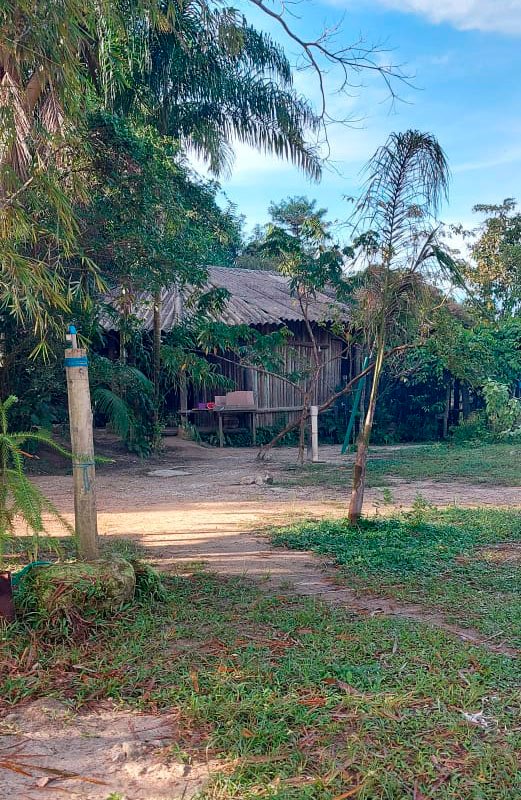
Photo of a house in the Rio Silveira Guarani Village. Personal collection of Veronica Pinheiro
Over the course of the trimester, we will build our little house out of bamboo, straw and clay. The children need to know that what the wolf calls ‘unintelligent’ we call traditional knowledge, bioconstruction, and that it takes a lot of knowledge to build a house without buying anything. Indigenous peoples and quilombolas know a lot about soil, plants, where the sun rises and where the moon is in relation to the house they build; and this is all about relationships. We will retell stories, activate practices, knowledge and memories.
May the Sun help us through this journey.
The wolf has already written what he thinks. Let's not expect anything from him.
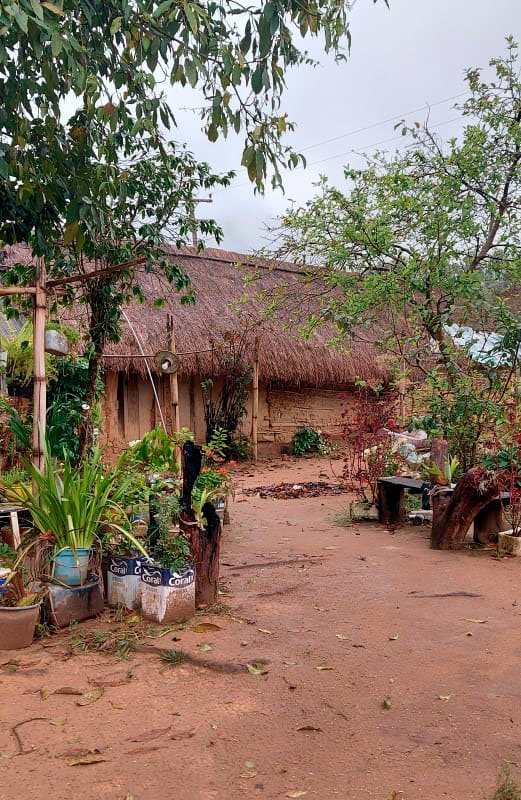
House in the São José quilombo. The São José quilombo has existed for around 150 years and is located in the city of Valença (RJ).
It is a community of descendants of enslaved people who came from Angola and the Congo. Currently, around 200 quilombolas
live there and their houses are made of adobe, wattle and daub and have straw roofs.
Photo: Personal collection of Veronica Pinheiro
¹SCIESZKA, Jon. A verdadeira história dos três porquinhos(New York: Penguin Books, 1996)