
NOW I KNOW WHAT NATURE IS
Veronica Pinheiro
29 May 2025
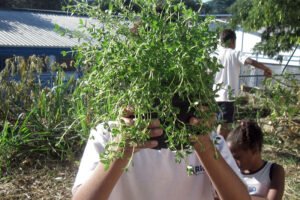
‘Now I know what nature is!’ – said Giovanna, 9. The girl spends her days in silence. She always has a slight smile in the corner of her mouth. She usually breaks the silence to complain about the noise the other children make. She is hardly ever seen in the company of other children. Most of the time, Giovanna is looking inward. When she looks outward, she smiles slightly with the corner of her mouth. Her voice is firm, slightly hoarse; her words are assertive, slightly harsh. But the smile on the corner of her mouth is like a flower. Giovanna does not write, but she says a lot in her drawings. She draws, and boy does she draw! One day she was sad because she couldn't write a poem about friendship. ‘I don't know how to write. Can I draw?’
Last Wednesday Giovanna's class, a 3rd grade elementary school class, participated in the Life on Earth. “Vamos plantar floresta!” Essa era a chamada inicial. Vida na Terra também é o nome de uma seção no Caderno PINGO – O Sol atravessa tudo. A oficina é um desdobramento dos diálogos estabelecidos com as crianças a partir do Pingo, na Escola Municipal Professor Escragnolle Dória. “Uma escola verde, tia?” “Pode ter flores, pra ser colorida também?” “Pode ter planta que come e faz chá também?” “E se o caramujo comer tudo de novo?” Os caramujos comeram toda a horta que plantamos em 2024. A partir disso, pudemos conversar sobre equilíbrio, sobre alimento, sobre as vidas que habitam e coexistem no espaço escolar.
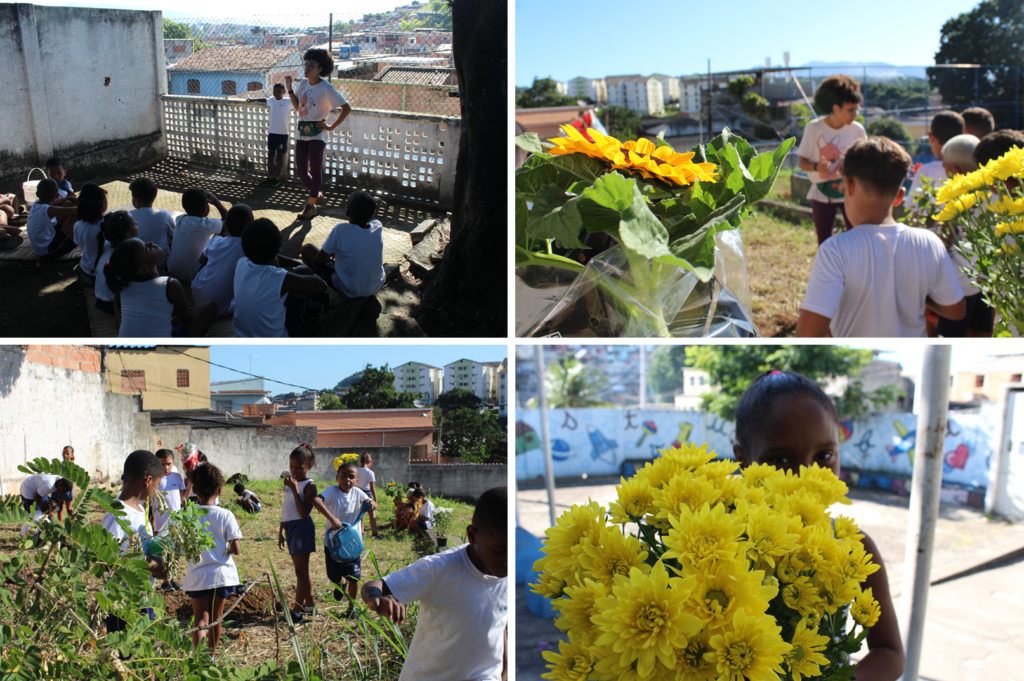
Once the children were heard, the workshop was organised so that the first day of planting at the school in 2025 would have leaves, flowers and fruits. The agreement was to ‘plant circles’, forming circular beds around a Nhe'ëry fruit tree. A mandala garden. The mandala garden blooms in circles, where each plant finds its place in sync with the earth. This model is quite common in permaculture projects, which seek agriculture that is more integrated with natural cycles, with less environmental impact and greater efficiency.
Dreaming volunteers who plant seedlings and worlds were present on the day of the workshop. Among them were Amilton Pinheiro, Otávio Ferreira, Taiana Simões, and Carol Delgado. Amilton had never planted a tree, but he had cut down a few, and he was learning alongside the children. Otávio is a man of the land, who plants to feed the stomachs and dreams of his community. Taiana is a skilled planter, a biologist by training, with extensive experience in planting and schools. Carol plants smiles, dreams and worlds. She also plants photographic records. What the four have in common is the smile and gaze of a child who loves life.
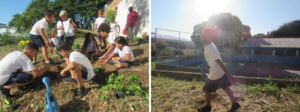
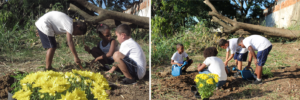
The day started with Amilton picking up the seedlings before the sun came up. At school, he met Otávio; together, they were responsible for making the circular beds that would receive the seedlings and the compost bin. Taiana arrived with the kids, telling them about Odu Obará, who did his best when he was given a task. The conversation with the little ones was short because it was time to plant seedlings. The little ones were divided into groups, and in each group everyone had a role: some took care of the tools, some took care of the seedlings, and some took care of the water for the plants and the people. Everyone took care of everyone else, and they also cared for the worms that were exposed while digging the holes, keeping them alive. Giovanna walked among the groups and did not stay with any of them. She watched the planting of the beds while holding a vase of thyme.
At the end of the planting, the girl, who spends her days in silence, said: ‘Now I know what nature is.’ Most of her classmates had already returned to the classroom. ‘Yes, now I know what nature is!’ Realising that she was being watched, without letting go of the thyme, she spoke again:
'Nature is everyone together, treading carefully so as not to kill those who live on the soil. Nature is touching things gently so as not to hurt the plants or hurt our hands with tools. Nature is staying calm in the hot Sun. Nature is caring so that everything keeps on living.'
Many other things were said by Giovanna at that moment when she broke her silence. Part of what was said was recorded in a short video.
Giovanna's words watered the eyes and hearts of those present. Hugging a pot of thyme, she learned to calm herself in the warm Sun. She learned with her body and created memories with the body of the Earth. “Now I know.” In the relationship, observing other bodies, she finds words. While the children planted in a circle, Giovanna watched the round dance of bodies. The body of the Earth, open and partially exposed. The delicate body of the earthworm, easily broken by contact with the body of the tool. The bodies of people crouching without avoiding contact with the ground. The body of the plant giving off aromas, colouring the day. Sun, a celestial body, traversing everything and everyone. Without traversing, there is no life.
Life happens through traversings.