




THE SUN DREAMED OF RISING
Veronica Pinheiro
30 de abril de 2024
There are thousands and thousands in the middle of the dark
[A God] created the Sun
There are thousands and thousands in the middle of the dark
Created the water, the wind, the life on the planet
That’s why you can not be afraid of darkness.
Darkness is the mother of the whole universe, including God.
Darkness does not choose anyone.”
Guarani poetics narrated by Carlos Papá.1
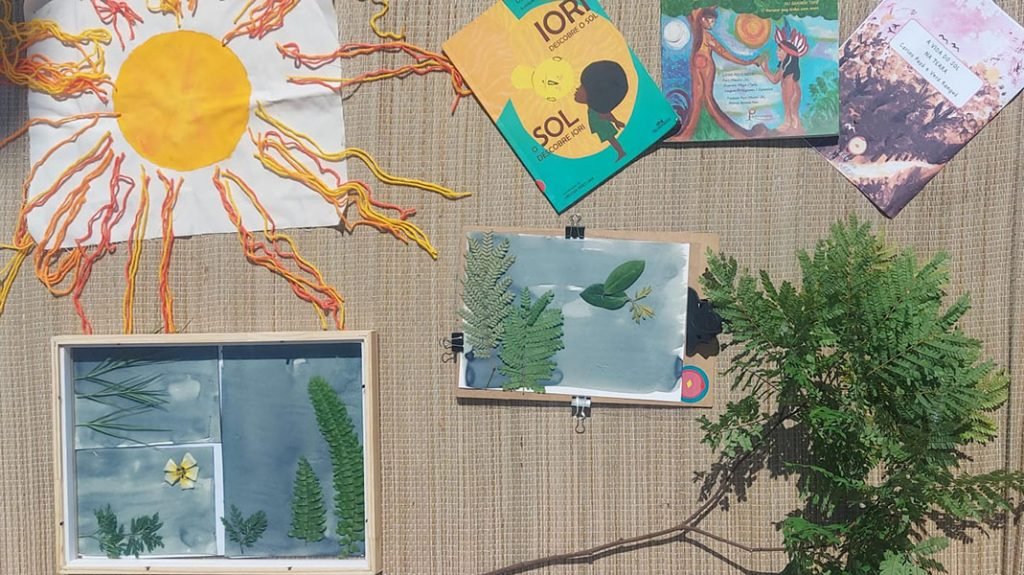
Photo: Veronica Pinheiro
The following dialogue opens the way to the second Ways of Knowing Workshop, tought by Selvagem for the House of the Children:
- I need a dark classroom.
- We don't have a dark classroom. Can't you use the Reading Room with the lights off?
- Yes I can. But it is not dark enough. And, if by chance someone turns on the room's light, we will lose this stage of the work.
- Kids are afraid of the dark.
- Kids are afraid of the relationship with the dark that has been created for them. It will work, they will be carrying the Sun inside their chest. We will build a good relationship with darkness.
- There is the former doctor's office. I don't know if it is dark enough, but I'll take you there.
The doctor's office was covered in layers of black fabric, kindly installed by teacher Wagner, making it our laboratory for images and sounds. The workshop was about the Sun and the relationship of life it establishes with the Earth. The word "relationship" will appear written or implied in all the diary entries, and it won't be by carelessness. The workshop, more specifically, was on cyanotype, a handmade photographic process created in the 19th century that uses iron salts to produce blue photographic prints. The room provided was initially for preparing the chemicals, sensitising and drying the paper in the first stage. And the sunlight was needed to print the images. The room then becomes a place to think about the things we feel when we are away from the light. For the children, light means good, a good thing; and darkness means bad, a bad thing. Between light and darkness, Euro-Christian-monotheistic thinking has created fixed distances filled with fears.
A escolha das oficinas é um grande apanhado de inquietações. Buscamos atividades em que a natureza seja protagonista. E nos concentramos para que o protagonismo não se confunda com utilidade ou recurso. Cuidamos para que ninguém pense que usamos a luz do sol para revelar fotografias. Não usamos a natureza, somos seres compartilhantes. Diante do sol os corpos dançam – o corpo da água, dos humanos, das plantas, dos sais. De que nos adiantam atividades onde há uma ebulição sinestésica, que, no final, só gera prazer aos humanos e ofende às árvores, às águas, à terra?

Photo: Wagner Clayton
Antes da oficina de fotografia artesanal, conversamos sobre os textos que a luz do Sol escreve na terra. Falamos sobre escuridão (de onde saímos todos), sobre fotossíntese, foto e sínteses. Três textos foram compartilhados com os alunos da escola: A vida do sol na Terra¹, Iori descobre o Sol and Taynôh, Ho Shamêh Tahe. Um vídeo sobre o Sol foi exibido. Pintamos o Sol em tecidos de algodão; tecemos raios solares para pulseiras; fizemos registros fotográficos; sensibilizamos papéis no laboratório escuro. Com qual objetivo? Despertar memórias solares.
School builds forgetfulness. For years, I woke up before the sun, arrived at school very early and returned home just as the sun was setting. I worked at school and taught about the things of life. At that time, I was so far away from the sun that my body forgot a lot. I hadn't learnt how to sweat or produce vitamin D. My body lacked sun.
If school builds forgetfulness, we tell stories to awaken the senses and the memories.
"If you struggle to find the way, ask my son Kuaray, the little Sun, and he will know how to guide you."1
In dialogue with the Guarani myth, we learned a little about Kuaray, son of Nhanderu'i. We talked about walking and listening.
The mother of the Sun stopped listening to the Sun at some point because she became furious when she was stung on the finger by a huge bumblebee.

Photo: Wagner Clayton
The little suns in front of me wanted to speak. I paused to listen to them. Those were silenced narratives. At that moment, I understood a little about their relationship with me and with the school. Some children without a mother, many without a father, having to be a Sun shining alone on Earth. Children aged between 5 and 7 talking about the guardianship council, abandonment and their desire to be a Sun.
Na leitura de Iori descobre o sol, de Oswaldo Faustino, na verdade é o Sol que descobre Iori. Em Iorubá, Iori quer dizer “cabeça que voa alto”. Exercitamos imaginar quem era o Sol e o que ele fazia na Terra. No final dessa atividade, recebi vários sóis pintados e nomeados com nomes femininos. Sorri e falei alto: “Vocês aprenderam isso com os Macuxi?”. “Wei” significa “Sol”. Sony Ferseck me disse que, para a cultura do povo Macuxi, o Sol é uma entidade feminina². As crianças entenderam o exercício de pensar em outras formas de ser e estar no mundo. Pensaram no Sol como quem alimenta as plantas todas as manhãs e disseram: “O Sol é mãe”. Eu sorri. Nunca tinha pensado nessa possibilidade. Confluímos. Meus pequenos companheiros de jornada iluminaram mais uma vez meu caminho na Pedreira³.
From this book comes the sweetest sentence I've read all week: "The sun dreamed of dawning".
I dreamt of the sun and we headed to the last reading and workshop.
Taynôh, Ho Shamên Tahe, o menino que tinha cem anos, é um livro polilíngue (Puri, Guarani Mbya, português e espanhol) de Aline Rochedo Pachamama (Churiah Puri). A leitura foi rápida e generosa. Fomos guiados por uma água doce e profunda, conversamos sobre não plantar esquecimentos.
During this meeting, we systematised all the stages of cyanotyping. After explaining everything that was going to happen and the results we were going to get, I skipped stages and broke agreements. The class followed the teacher in the dark room, and later in the Sun. But the impressions didn't come out on paper. Letícia, aged 10, remarked: "For things to happen on earth, all the elements need to be present. You sensitised the papers with water. You didn't use salts. 'Everything happens in presence', right?". "Yes. Everything needs to be present, Leticia."
Vitor, aged 10, concludes: "So let's go back to the dark and start all over again";
We started again. And when we put the papers in the sun, without skipping steps or absences, the sun wrote in blue on the papers. There were our blue photographs, depicting the leaves we had picked in the backyard.

Photos: Wagner Clayton
¹https://selvagemciclo.org.br/wp-content/uploads/2023/11/CADERNO79_PAPA_KANGUA.pdf
²Ferseck, Sony. Weiyamî: mulheres que fazem Sol. Boa Vista, RR: Wei Editora, 2022.
³Pedreira [Quarry] is the name of the complex of favelas where the school is located.