




WHERE IS THE FOREST? INSIDE THE CHEST
Veronica Pinheiro
18 de junho de 2024

The school reading room resembles a library in terms of organisation and functionality. Books on shelves, divided by subject; large tables and chairs. A planned space that takes into account storage areas, activity areas and circulation areas. A few general rules are common in reading environments: enter only with the material you need to study; enter in a "disciplined" manner; keep your voice and gestures discreet so as not to disturb other readers.
The first stories I learnt weren't from books kept on shelves. The first narratives and lessons I learnt came from Ms Cassiana's mouth, an elderly woman who used to sit on a wooden bench under a pepper tree, late in the afternoon, on the hill where I was born. To find out the end of a story, we sometimes had to wait until the next day or go after Ms Cassiana while she took care of the plants. She would bless the children and hold them in her lap while she prayed. It was a story-prayer, sung and choreographed with leaves. I remember looking for her one day and not finding her. I never saw her again. Shortly after Ms Cassiana's vanishing, the bench and the pepper tree disappeared. But the words told, sung and prayed are still with me today.
Today, I'm the old lady who sings verses to children. This week, I went into the reading room and removed all the chairs. I also removed the tables and turned off the lights. And I lit my campfire in the middle of the room. On the floor there were mattresses, 15 copies of the same book and I was sitting there just like old Cassiana used to wait for me.
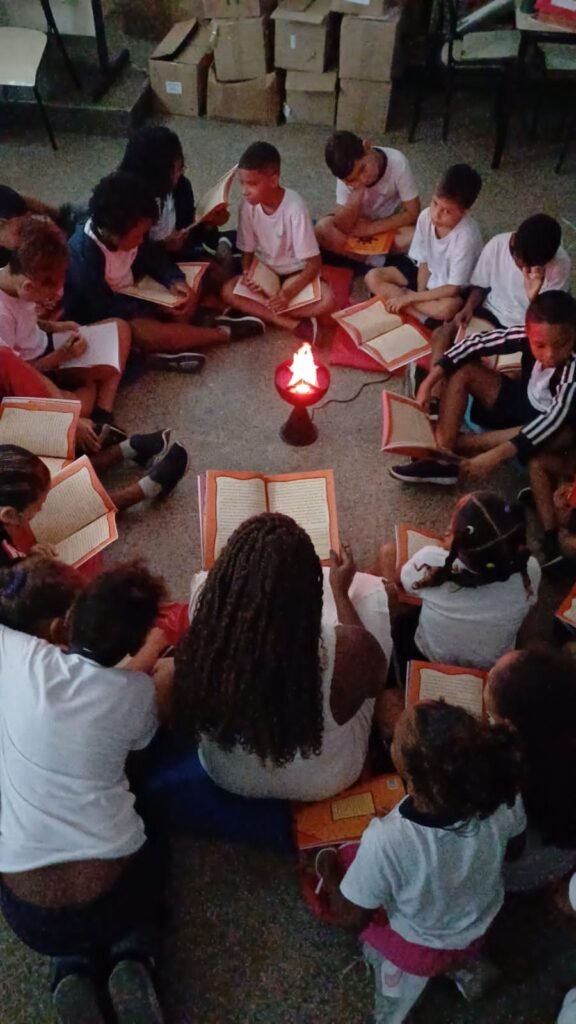
I learnt from Carlos Papá that the darkness welcomes everyone, making no difference between people. And it was in the dark of the room that we met grandparents' stories and shared care and kindness. "What is this?" "A camp, don't you see?" I followed their entrance with just my eyes and ears, and said nothing. "Yes, it's a camp. Check out the fire." "Let's sit down because it's dark and cold." It was 8am and it was 31°C outside the room. Inside the room, time and place were moving with no conventions.
They sat in a circle. The first class I welcomed that day had 28 children present, most of them aged 8, and they were curious to find out what was going to happen. For the first action, they would form pairs of readers. I asked a student who already knew how to read to team up with a classmate who didn't yet know how to read. Once they were in pairs, they had to choose a corner in the reading room to read the story. Each pair cuddled up and hid in any way they could and wanted. They set up little huts and created burrows to read in. I told them that learning is a process in which everyone collaborates in whatever way they can. They took it upon themselves to look after their classmates. I watched as the listeners slowly slid down the mat until they were lying down to listen attentively to the words read by their friend. And unintentionally, at that moment we established another relationship with that floor. Every time we had laid down on the floor of the reading room, it had been to protect ourselves from shooting. For the first time, it wasn't fear that drove us to the ground. It was the earth teaching us to strengthen bonds. The class teacher entered thinking the room was empty and was surprised by the scene and the gestures. Sensitively, she left without being noticed.

Our second action was to sit round the campfire again. Now the story would be read by me and followed by everyone, each with a copy of the book in their hands. It was a solemnity, the flames of the LED fire warmed our circle. I began like this:
"Sônia Rosa, the book's author, dedicates this book to her two great-nephews: Phelipe de Oliveira Nunes and Vitória Oliveira Silva. I, Veronica, dedicate this reading to my students, who are sitting round the campfire with me."
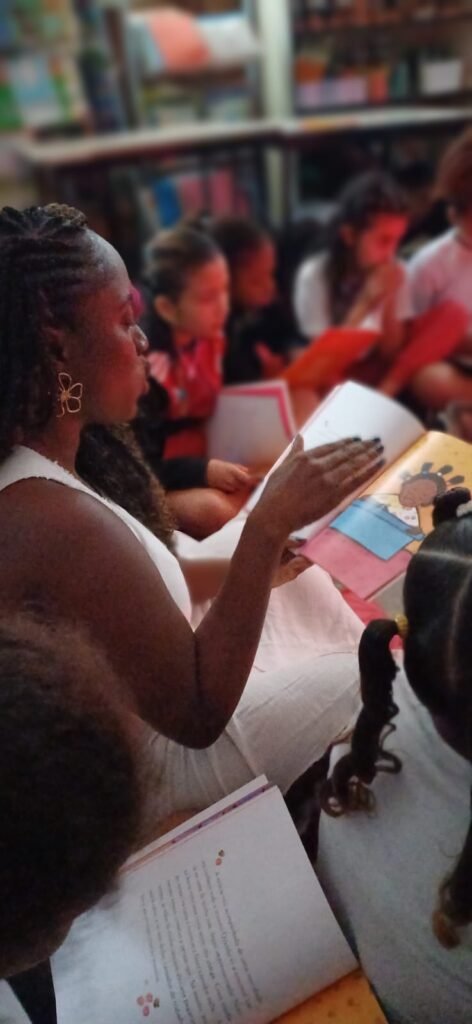
Os tesouros de Monifa é a história de uma menina que, no dia de seu aniversário, foi escolhida para ficar com o “tesouro” de sua família. Monifa era o nome da bisavó da avó da menina. Monifa chega ao Brasil num navio negreiro e escreve muitos diários cheios de sonhos, rezas e canções. Minha voz tentou acompanhar a solenidade do momento, mas meus olhos decidiram por si só regar a terra. Não só os meus, mas muitos olhos regaram a terra naquele dia. À medida que líamos, mais perto ficávamos um dos outros. A roda logo se tornou um ninho. Uma mão pequena e macia colhia as lágrimas que me saiam dos olhos para não molhar o livro. Outras mãos me amparam os ombros e as costas. Mais um par de mãos percorriam minhas tranças.
I don't remember ever crying in front of a class. At the beginning of the year, I was "the auntie who comforted" the children who cried during the adaptation week. In the middle of reading camp, I was looked after by the children who understood that, in the learning process, everyone co-operates as they can. So I started to receive care. I read the story and they read Monifa's notes.
Around the campfire, sitting on the ground, we hugged each other at the end of the reading.
Alguém falou que no nosso acampamento só faltou uma coisa: “marshmallow”. Outro acrescentou que faltaram duas coisas: “marshmallow” e a mata. Antes que eu conseguisse formular resposta, Enzo, que parece nunca estar ouvindo o que falamos, disse: “Faltou só ‘marshmallow’ mesmo, a mata tá dentro da cabeça.”
Monifa means "I'm lucky". Full of forest inside, I was the luckiest person in the world.
Photos: Wagner Clayton