




THE GRANDMOTHER, THE CHILDREN, AND THE WATERS
Veronica Pinheiro
06 de agosto de 2024
"Waters are like our relatives. In the old days, my grandparents used to say that one should not throw dirty things in the water, because it's the same as throwing dirty things in one's grandmother's or mother's eye", kujá1 Iracema Gah Teh
 Photo: Tania Grillo
Uma conversa líquida e circular. Confluências entre uma avó Kaingang, as crianças do Rio e as águas da Baía de Guanabara. Ela, do Rio Grande do Sul. Elas, do Rio de Janeiro, nascidas nas proximidades do Rio Acari. A Baía, um estuário de inúmeros rios, um corpo d’água parcialmente encerrado, formado pelo encontro das águas doces que se misturam com a água salgada do mar. A avó, as crianças e as águas se encontraram na cidade do Rio de Janeiro, no Morro do Pão de Açúcar. Na agenda escolar das crianças, a atividade consta como passeio escolar; chamo, porém, de Encontro. Um movimento de conexão e ampliação de olhar. Pois, se cada um enxerga com o olho que tem e entende apenas o que os pés reconhecem como caminho, quando seres com olhares diferentes, cujos pés reconhecem outros caminhos, se encontram, novas tramas de vida são estabelecidas. No encontro, os diversos se conectam de forma tão natural que um indivíduo pode começar a desejar outras possibilidades de se relacionar com a vida, com o cosmos e com ele mesmo. O encontro é o evento natural que mantém a vida. É assim na floresta, nas cordilheiras, nos quilombos… nas favelas.
This diary page is a brief and superficial account of a Kaingang grandmother's meeting with the children on top of a hill surrounded by water. On July 3rd 2024, we received the children at school at 7.30am for breakfast. The pink bus was already waiting for us. Every day, more people join together to dream up new ways of life for the Pedreira favela. Even the driver, who also owns the bus, has become a partner in the activities of the Ways of Knowing Group with the school. Mr Jonas said that the journey on July 3rd was on him and he didn't charge us anything that day. From the school, we took a 5th grade2 class, teachers and our dear headmaster Daniele Oziene. The routine of a 40-hour working week plus the bureaucracy and many responsibilities of being a school headmaster in a school in the municipality of Rio de Janeiro make moments like this very special; Dani was with us. Six volunteers from the Selvagem Community³, Rafael Cruz and Dona Iracema, with her Kaingang family, were waiting for us in Urca, at the starting point for the cable car ride.
The number of adults is planned so that the children don't have to walk in line. It's also so that the teachers can stay out of the role of conductors. In very small groups, without a voice telling them all the time what they need to watch, children and adults can pay attention to everything, to a single point or to nothing at all. I don't understand the Western need to fill in all the gaps all the time. Allowing the eyes to find their way, the ears to find their way, the skin to find its way is allowing memories – dormant due to routines and the plastering of the school process – to awaken. Western education anaesthetises. Life, however, is synaesthetic. To wake up is to reconnect with what keeps us alive. Despite being urbanised, we are nature. Our urbanity is recent, artificial, supplementary and imposed. Every child has the right to know that they are nature. When we understand ourselves as nature, we don't feel alone. Cities are full of people, and yet people feel alone. Being disconnected makes an individual feel lonely in a house full of beings. I say beings because the city and its ways of being, reproduced at school, create models of connection only between equals. In a zoo, animals live only with their equals, as if nature is like that. In a housing estate too, the equals share that space. This is also the case in most schools.
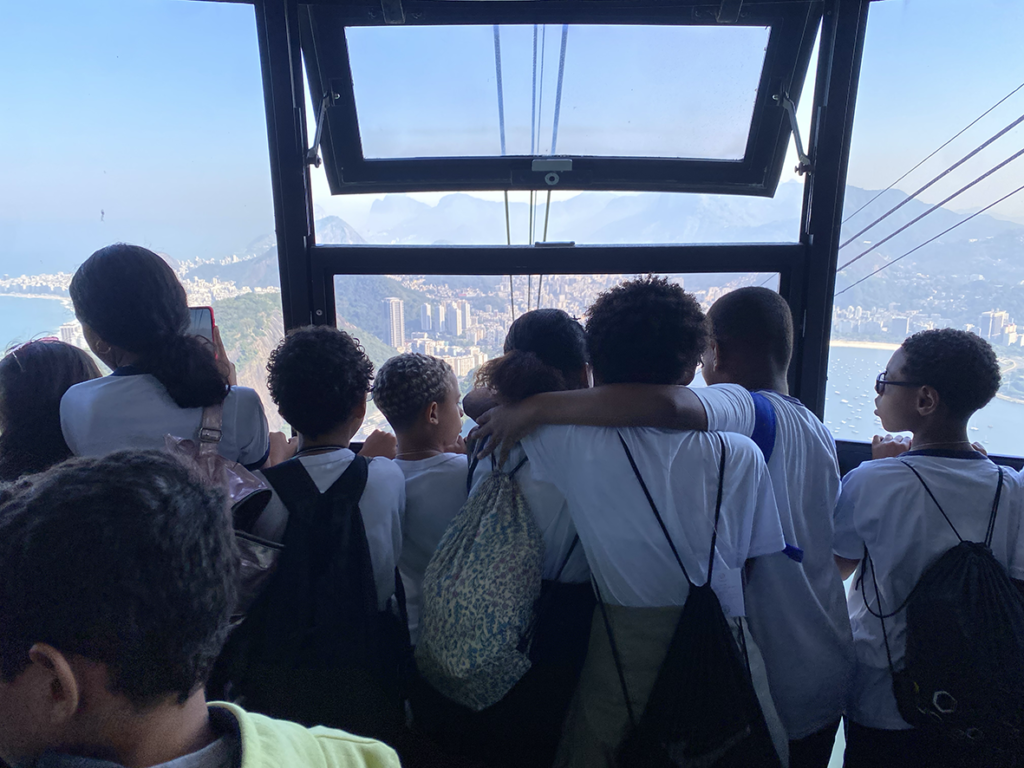 Photo: Carol Delgado
At Morro da Urca we were welcomed by the waters. An immense cloud crossed the massif and hid us. We stayed inside the cloud for a few minutes. Surrounded by water that moistened our skin and hair without getting us wet. We were generously kept in the waters of the rivers from above. The scene reminded me of a prayer house full of smoke.
Freshwater embrace. For a few minutes I thought we wouldn't be able to see the waters of the bay or the horizon, but that was not a bad thing. The beauty of the water from above was so enchanting that the embrace was worth the journey.
 Photo: Carol Delgado
O encontro era com a avó, as crianças e as águas – as águas da baía e as águas que se movem dentro dos seres. A avó Iracema é kujá (liderança espiritual) do povo Kaingang, natural da Terra Indígena de Nonoai. Conhecedora das ervas medicinais e dos poderes da mata. É também Cacica da Retomada Gah Reh, que fica localizada no Morro Santana. Sempre há em nosso roteiro de visitação um momento para conversas. Sábia e muito atenta a tudo, Iracema entende que cada um vê com o olho que tem e compreende a partir das próprias perspectivas. Iracema trazia sobre sua cabeça seu cocar de penas, certamente as crianças da Pedreira nunca tinham visto, até aquele momento, alguém de cocar. Iracema, no entanto, partiu do lugar comum, e disse: “Eu sou Iracema, avó Kaingang”. Pronto! Uma avó, toda criança sabe o que é uma avó. Essa informação bastava para nos tornar uma família, ainda que temporária.
 Photo: Carol Delgado
Rafael Cruz, an actor and researcher of childhoods, was the one who started the conversation. He kindly accepted the invitation to the meeting and presented the waters of Guanabara Bay with data and words enchanted with kindness. It was up to me to provoke the group: Anyone here doubts we are nature? I heard reflections full of wisdom from the children. Seeing the doubt in some of their eyes, I asked Chief Iracema: did you ever doubt you were nature? She replied, bringing the waters into the conversation in an unusual way: I never doubted it, because I'm round water. We all stopped to listen with eyes and ears. Even the visitors to the cable car park and the park staff stopped to listen to the waters that were flowing and confluencing in Grandma Iracema. A liquid, circular grandmother. I still find myself thinking about it.
The Kaingang people consider there to be two types of water in the world: Goj tej (long water, from the rivers) and Goj ror (round water, from the springs, the lakes). These waters are complementary, just as the whole Kaingang cosmology is. The brothers Kame and Kainru are the ones responsible for the origin of the world, according to the Kaingang. They were the ones who created and gave marks to all plants, animals and to the Kaingang people. Everything that exists on Earth has a Kame or Kainru creator half. And each half has different powers and energies that are opposite and complementary.
Kame – gêmeo ancestral da marca comprida – o Sol e os rios pertencem à metade Kame
Kainru – gêmeo ancestral da marca redonda – a Lua e as nascentes pertencem à metade Kainru
 Photo: Carol Delgado
A conversa transitava entre conselho e cura, história e ciências, sorrisos e olhares. No colo da montanha, nossa avó ancestral, ouvimos a avó cacica falar sobre amar. Ao final de suas palavras, nos abraçamos todos com águas, em águas, sob o Sol. Os currículos pensam em relações étnico-raciais, por aqui, porém, pensamos em relações de vida. Para continuar pensando, deixo aqui transcrito parte do que ouvimos:
"Water is sacred, it is life for us
Through water, we live on as well.
Water is our sustenance, part of us.
Water is part of every living being.
We will never survive without water,
both salt and fresh.
Salt water is also good for skin diseases.
Fresh water is also very good for the body. For any living being.
When I say living being, I also mean our mother Earth, who survives on water.
The tree. Us. All that lives on Earth.
All that lives in the water.
So water is very sacred.
Why didn't we dirty it in the old days?
I say, we don't dirty it, we don't put dirty things in it.
My grandmother and grandfather used to say to me:
"When you put something dirty in the water, either in the eye of the water or in the freshwater, it's the same thing as you putting something dirty in the eye of your grandmother or your mother.
They have marks.
There are waters we call Goj ror, Goj ror.
For us – you might know that, right? – that's when the water springs.
This one is called Goj ror.
Guaíba, for us, is ti ninó goj mag (an arm of great water).
And why do I say ti ninó goj mag (the arm of great water)? Is this arm fresh or salty?
Ti ninó … como que é o nome?
Guaíba is ti ninó of the sea (the arm of the sea)
It's fresh. Yes, Guaíba is fresh.
So where does Guaíba come from?
From all these goj ror that flow down.
So Guaíba is goj tej.
And there is also goj ror flowing down to Guaíba, for supplementation.
So they have marks, they supplement each other. As we, Kaingang, have our marks, Kamē e Kainhru.
If there were no goj ror, we could not survive.
So they are sacred, part of us, and we are part of them."
Transcrição fala Gah Teh durante espetáculo de dança contemporânea Água redonda e comprida. O mesmo foi compartilhado por Iracema no encontro com as crianças.
__________
¹ kujá – pajé e líder indígena Iracema Gah Teh
² nosso desejo é levar todas 3 turmas de 5º ano da escola ao Pão de Açúcar. Até o momento, já levamos duas turmas.
³ Ana Paula Santos, Carol Delgado, Geórgia Macedo, Tania Grillo and Camille Santos
Acknowledgements:
Georgia Macedo who made it possible for Iracema to come. Georgia has a master's degree in Social Anthropology from UFRGS and is a dancer. She works in cultural production, in partnership with indigenous artists and as a dance educator in the city of Porto Alegre.
Rafael Cruz ator e pesquisador das Infâncias, membro do GITAKA, Grupo de pesquisa GITAKA: “Infâncias, Tradições Ancestrais e Cultura Ambiental”
Carol Delgado is an anthropologist as a professional and a curious person by nature. Mother, researcher, writer and founder of Puxadinho, a network laboratory of anthropological experimentation for plural futures.
Iracema Kaingang's family:
Angélica Kaingang, a native of the Votouro Indigenous Land, has a bachelor's and master's degree in Social Work and a PhD in Education from UFRGS
Nyane, 13, has accompanied her mother Angélica Domingos through the cities and indigenous territories since the womb, in the struggles of the indigenous peoples.