




A FORÇA E SABEDORIA DO FOGO
Cristine Takuá
30 de agosto de 2024
 Photo: Carlos Papá
On the origins of fire
"In the old days, when the Guarani didn't yet know how to use fire, they ended up eating all the things the ancients hunted, and the fruit they picked and had to be roasted, raw. They had a hard time as they didn't know about the fire.
Then, one day, a Guarani Mbya saw a vulture flying high in the sky and thought: "I think I need to talk to someone. How can I cook things or even warm myself when it gets cold? How can I work it out? Someone in this world must know. Well, I'll start with the vulture".
The vulture was flying high in the sky and the Guarani was just waiting for his chance. One day, the vulture was sunbathing on the ground, so the Guarani Mbya approached very slowly. Slowly, he asked:
"Getting some Sun? Getting Sun?"
The vulture said: "And what are you doing? Are you going to warm up too?" He replied: "Yes, I'm going to warm myself up too".
Then he sat down next to the bird. The vulture started to get curious and asked him:
"What have you been up to?"
Then he said: "Oh, I'm trying to find out how to make fire, because the Sun heats up. When the sun is hot, we all get warm, but when there's no Sun, when it's cold, we suffer a lot. So I want to find out how to make fire. And I want to know: who is the guardian of the fire? I also want to know which animal in this world, which bird in this world, is the guardian of fire".
Then the vulture looked right at him and said: "Oh, the guardian of the fire is me".
The Guarani said: "Is that so?"
"Yes, when there's no Sun, when the Sun doesn't come into the world, we warm ourselves with fire", said the vulture.
"Is that so?", asked the Guarani.
"Our creator said that if I gave this fire to someone one day, I would fly higher than everyone, I would be able to fly higher than the clouds," said the vulture. "I never thought I'd give the fire to someone, because I fly low up until today. I can't fly up there."
The Guarani Mbya replied: "Oh, so you've spoken to the right person! I want to make fire, I want to handle fire, I want to master fire, I want to be able to cook food".
Then the vulture said: "Oh yes, we can make a deal then. I want to fly higher, I want to get to know the clouds up there a bit more. And I'd also really like to eat the tobacco leaves, the planted tobacco leaves".
The Guarani Mbya replied: "Oh, so you've spoken to the right person, I'm going to plant tobacco. When it's ready, you come and eat the leaves. That's a deal".
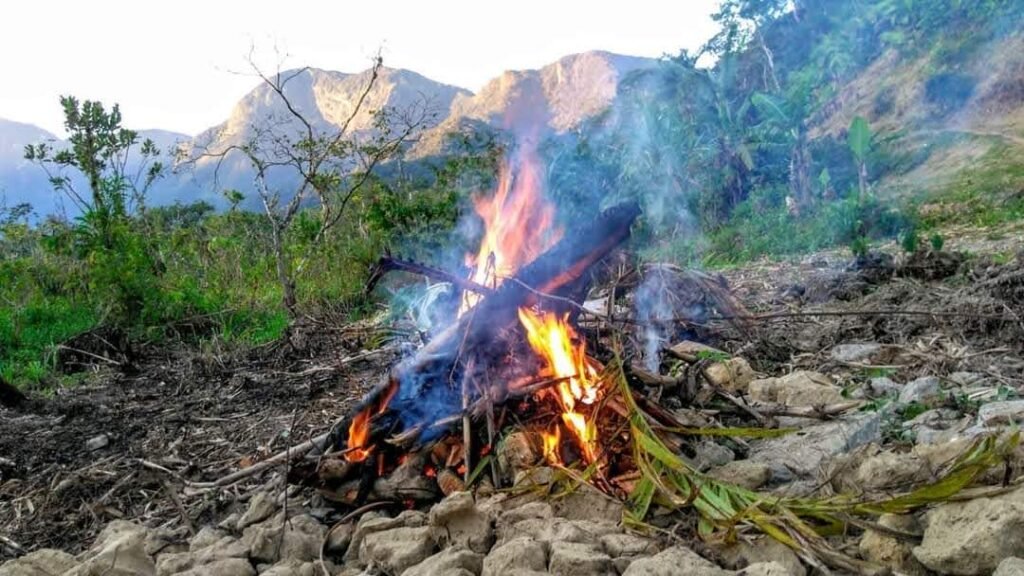 Photo: Cris Takuá
The next day, the Guarani Mbya took the tobacco seeds and began to plant his crops. He planted tobacco, a great deal of it indeed. He looked after it with the utmost care and, when the leaf became beautiful, all showy and ready to be harvested, the Guarani Mbya called out from afar: "It's ready! Now you can come!"
Then the vulture arrived and said: "Thank you very much! So let's make our deal. Tomorrow I'll come with the others and the next day, after we've left, you'll take over the fire. That's our agreement. And we'll leave a tool for you too. Whenever you need to make your fire, you'll have to build this instrument. It's like your bow: you will take a sturdy stick and make a hole in another piece of wood. With this bow, you'll find it easier to spin the wood. Because of the high temperature at the tip of the wood, it catches fire. That's how you'll learn, by practising".
The Guarani Mbya saw many vultures in his fields, eating the leaves. Some vultures even took the tobacco leaves. There were even chicks, lots of vultures indeed. They ate all the leaves and in the afternoon they all started to fly away.
He looked at the field and there was nothing. The next day he came back and everything was dry. At the edge of the field, he saw a wood on fire. He was so happy that he stayed there, tending the fire. He made a hut over it and looked after the fire for a long time, until the wood burned out. He didn't know what else to do and remembered the tool the vulture had left behind. He searched around and suddenly found it: a bow, a piece of wood and a stick, there, a little stick, and another piece of wood with a hole in it. He began to make tests and practised for a long time. One day, when he had almost given up, he tried again and realised that smoke was coming out of the hole. He started blowing, put the sticks in, and they started to catch fire. He was so happy!
He realised that the vulture had passed on the fire and the secret of the fire. The vulture could no longer be the guardian of the fire.
Today, the vulture lives above the clouds. The vulture is the bird that flies the highest, but is no longer the dominant one of the fire. The Guarani Mbya became the guardian of the fire."
(Carlos Papa Mirim Poty, Guarani Mbya)
 Photo: Cris Takuá
Assim como os Guarani, muitos povos indígenas têm suas narrativas ancestrais sobre a origem do fogo e sua significância para a cosmologia de suas tradições. Ao longo da história, modos de fazer roça e práticas de manejo integrado ao fogo foram ferramentas de uso muito importante para conservação da biodiversidade, tendo aspectos ecológicos, sociais e culturais de muitos povos. Porém, de forma inadequada empregaram essa técnica para desmatamentos criminosos, causando o desequilíbrio das florestas e de nossas vidas. Essas violências relacionados ao mau uso do fogo, ou o seu uso abusivo e descuidado, estão totalmente ligadas a políticas da monoculturas de exportação, ao café, ao gado, ao agronegócio, à mineração, à urbanização e ao capitalismo de um modo geral, que não respeitam as vidas vegetais, animais e minerais, nem mesmo as vidas humanas.
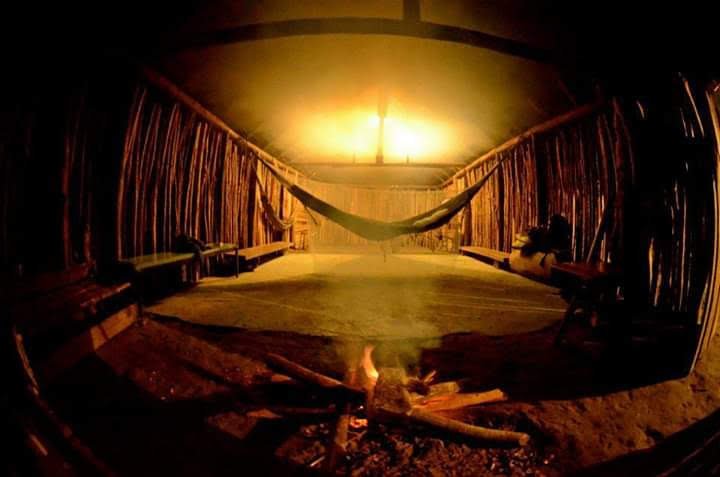
Fire is also a very ancient element connected to spirituality. Rituals and healing ceremonies use fire as the basis for transformation, which can be to protect a person who has passed away and guarantee their spirit a peaceful return. It is also traditionally used to scare away evil spirits and, for this reason, fire usually accompanies the nights, lit just after sunset and kept burning until dawn. In many cultures, when someone dies, it is customary to burn the house where the person lived and all their belongings, so that the spirit departs from the earth and leaves no memories.
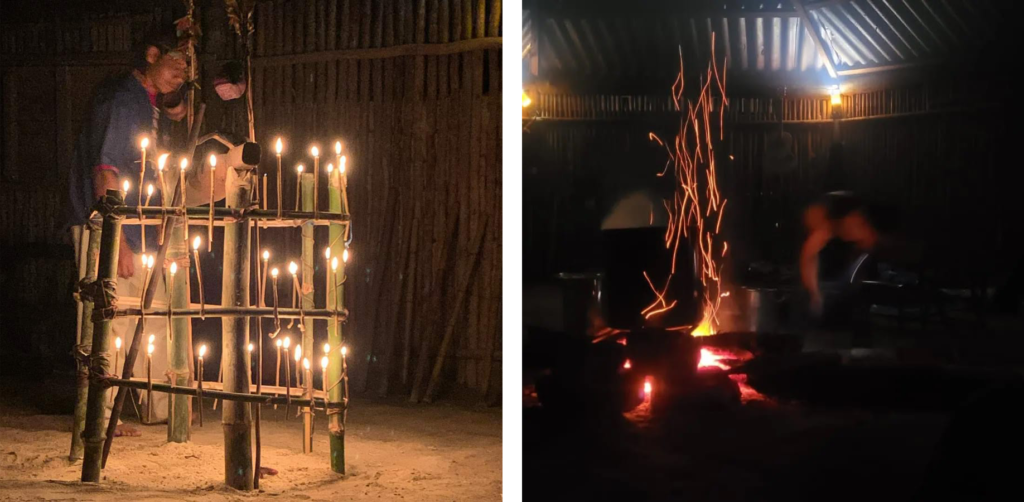 Photo: Cris Takuá
There is a lot of knowledge and lore related to fire. It is sacred and has existed for thousands and thousands of ages. A great teaching from an elder who is more than a hundred years old is that indigenous technology allows regeneration. Fire is not used in whatever way, it is prayed over, permission is first sought and its use is controlled.
When it's used in communal agriculture, it tends to overtake vines and small plants that are expected to be burnt. The women then plant the fast-cycling plants first, such as maize, beans and watermelons. Then comes the capoeira (secondary vegetation) and, with it, the animals and small creatures. The animals bring seeds, who gradually germinate. The second burning, the coivara, is a finer selection of fertile spots. From this point on, sweet potatoes, who take particular advantage of the potassium in the ashes, are planted. Many peoples go so far as to prepare food on the sites of the swiddens in order to take advantage of the ashes as a nutrient. The plants introduced in the first planting are the most fire-tolerant, followed by fruit trees, destined for the game. Today, many people use agroforestry techniques to recover soils that have been excessively degraded by human activity.
In general, what indigenous agriculture teaches us is what colonial arrogance refused to learn from it. Arrogance ended up destroying the vegetation, which hardens the land, decreases its permeability, increasing nutrient run-off and accentuating erosion, making it impossible for humus to accumulate and causing water to be lost.
Saber caminhar de forma respeitosa e suave na Terra e saber como se relacionar com os elementos sagrados – água, fogo, terra e ar – é fundamental para que possamos entender os limites dessa nossa humanidade.
These teachings are alive in many cultures. And the practice of this knowledge is a form of resistance in a world where money intends to buy even souls.
We need to break through the barriers of arrogance and see that there are many possible worlds. The most important sowing today is the mental one!
We must expand consciousness so that the respect for all forms of life can exist again!
Fire is sacred!
 Photos: Carlos Papá