
PROFOUND ENCOUNTERS
Cristine Takuá
11 November 2024
Over the last few days I've been hiking around Huaraz in Peru, the highest tropical mountain range in the world. I was invited to take part in a conference on Climate and Epistemic Justice, organised by WikiAcción Peru. This meeting brought together several youngsters and some indigenous leaders from various peoples and countries.
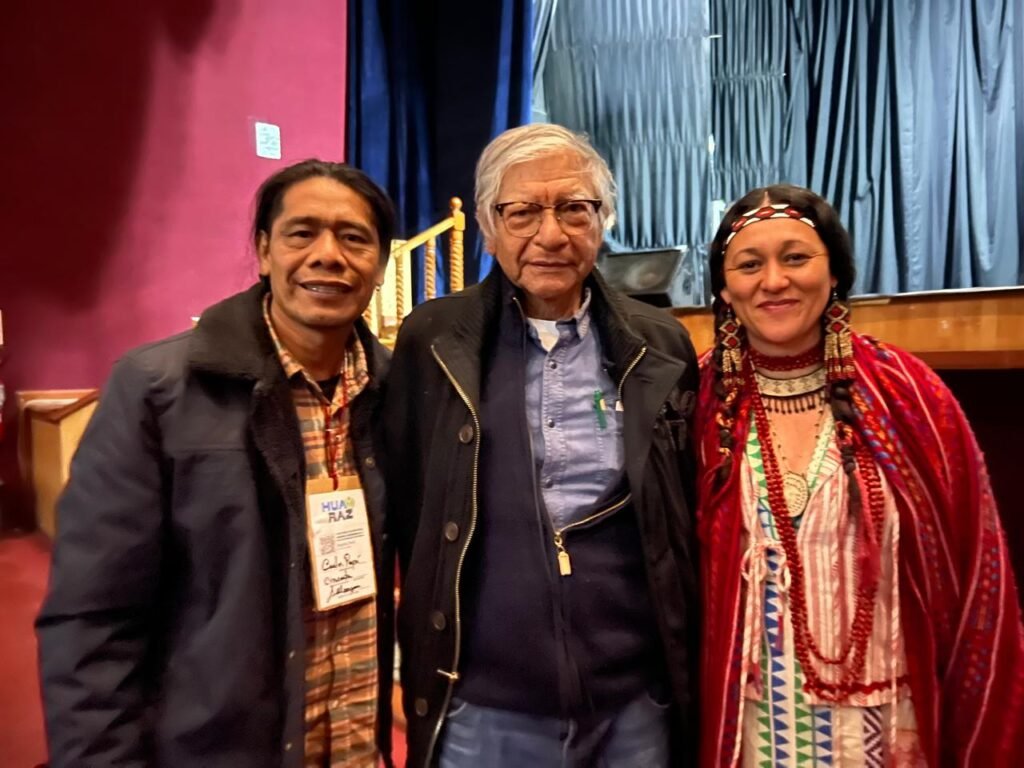
During the conference, there was a round of dialogues with two teachers, Carlos Papá and Grimaldo Rengifo, who is a Peruvian educator, writer, thinker and researcher in intercultural education. These were moments of very profound exchanges and of sowing reflections for transformation in life.
The next morning I woke up thinking about the complexity of indigenous philosophies, whose epistemologies are hidden by universities. Throughout history, humanity has violently distanced itself from nature and used nature for its own benefit, aiming only for profit, which is very clear in the ‘Order and Progress’ message written on our flag. Although Western society has very well structured pillars based on Eurocentric reason, today everyone is facing an unprecedented crisis in which the survival of thinking beings is in jeopardy. Agribusiness, mining and, to a certain extent, mental monoculture – which is present in universities and doesn't allow people to get to know other philosophies – are possibly responsible for this difficult reality in which we are all living.
During the conference, Carlos Papá spoke about the importance of feeling part of nature and reconnecting with our bodies and our breathing.
"The pure truth of life is that you have to live in a place, step on the ground, smell it, feel the sun, bird, wind, rain, cold, this body. That's the real life to which you're integrated. Our life has everything, it has water, it has iron, it has glass, it has smell, it has water. We say that nature is there and our body is here. Our body is nature itself. Why do I say that? When you speak, the water sings, screams, our saliva comes out wet. Our vocal cord is always in tune so that it can speak the messages. And it plays like a flute, so that you can touch the person and they can hear and understand. And this flute, when you speak, this breath comes out of the hot water... That's where this wisdom of understanding life comes from, this is life, life is beautiful, life is marvellous from the moment you have the support of life."
Within the reflections we made and shared with each other, I felt strongly the need to talk about my concerns and my insistence with children and young people, whom I invite to learn to dialogue with plants, because they are great teachers, mentors and guides. They not only heal, but they show us the direction, the way to where we need to go.
I feel that our humanity has failed a lot with regard to the principle of what respect is. There is a very deep contradiction within humans, within all of us, and I believe that this is the great challenge that we need to learn to overcome, first by learning to walk more slowly, to listen and speak less so that we can understand and listen to what the spirits are saying. The spirits of everything: the mountains, the rocks, the wind, the rivers, which sometimes pass under our feet in cities that have been robbed. And many people don't stop to listen.
During the profound exchanges we had, Professor Grimaldo's talk also left a mark on my heart and memory. He raised very serious questions about the many ways of thinking about the use of technology among children and young people and how this reflects on educational processes.
“It's rare to hear concepts like decolonisation and epistemic justice applied to creativity within education systems.’
Through his long experience, Professor Grimaldo weaved his speech very much based on everything he had experienced, including his experience with master plants. Listening to Papá and Grimaldo, I realised that there is an urgent need to listen more and understand the relationship with all forms of life.