




THE FUTURE IS COLLECTIVE
Selvagem Ways of Knowing Lab
Veronica Pinheiro
19 March 2026
I ask permission to come once again, for these are times of new arrivals. Love has brought our paths together and the Ways of Knowing journey has expanded: we are now five schools in confluence. Some might call this ‘methodology’; we call it a traversed life. After being traversed by child-beings, tree-people, grandparent-rivers and infinite existences, we arrive in 2026 with many arms, legs, heads and hearts. What was once a journey is now a body. We are now the Selvagem Ways of Knowing Lab.
Between 2024 and 2025, the Selvagem Ways of Knowing Group established its presence at the Professor Escragnolle Dória Municipal School, in the Pedreira favela in Rio de Janeiro. There, where tarmac coexists with structural deficiencies, we learnt that imagination is a survival technology, and that children are beings who inhabit different times simultaneously: present-future-past, rhythmic time, enchanted time and playful time.
With the children of Pedreira, we learnt to sow little seeds of longing and to linger in the sun without haste. We learnt to weave good memories and to see with eyes that see small things. These seed-children have blossomed so much that today their experiences spark conversations across five regions of Brazil. The children showed us the way. They, who have never left Rio de Janeiro, have taken part in class councils, conferences on childhood and university lectures in Brazil and abroad. Far from theories, alongside the children, we have built a path, and today the Selvagem Association brings joy to five public schools, while also fostering tenderness in two federal universities.

Based on the Selvagem Ways of Knowing group, LAS will coordinate dialogues between two universities and five public schools (one in each region of Brazil). LAS aims to bring together research, creative work and teaching practices that promote interculturalism, local knowledge and care-based ecologies. The project will directly support 100 teachers and community educators (through the Intercultural Ways of Knowing courses); it will also benefit approximately 1,000 children enrolled in primary and secondary education, thereby strengthening local learning networks.
What you will see below is not a map of borders — it is a map of bonds. There is an etymological theory suggesting that the word ‘vínculo’ (bond) in Portuguese is linked to the word ‘brincar’ (to play). It was through play, without haste, moving at the pace of children, that the Ways of Knowing group found not answers, but questions. And we begin 2026 by asking:
What happens when schools listen to the territory? What happens when universities decide to return to elementary education?
Throughout 2026, you will read pages from a diary made up of maps that don’t appear on Google. Maps made of clay, red dust, Southern winds, Northern water, the heat of the Caatinga, and the hot concrete of the favela.
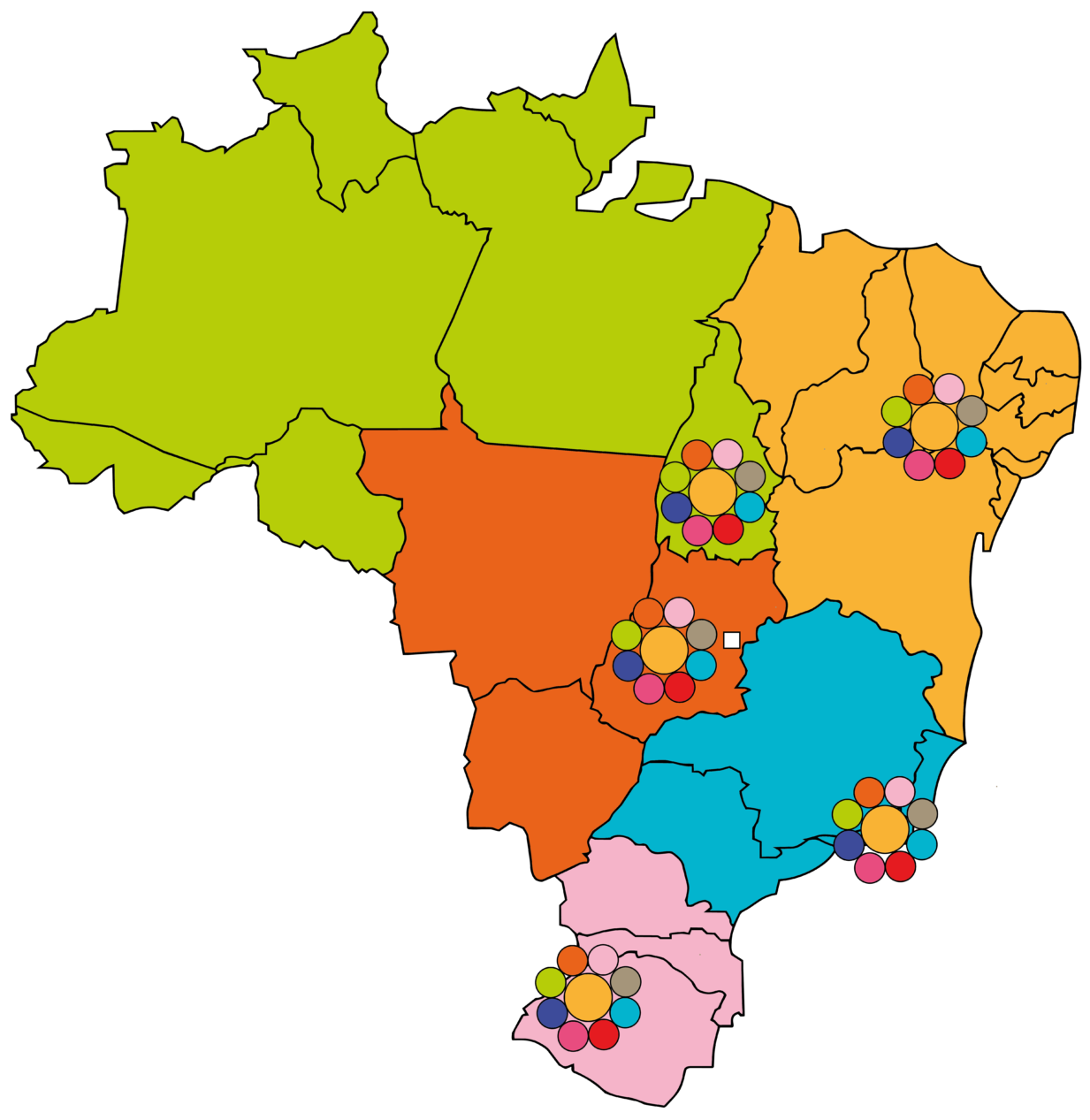
Where to find us in 2026:
Southeast Region
Professor Escragnolle Dória Municipal School
(Favela da Pedreira, Costa Barros, Rio de Janeiro)
South Region
Instituto Estadual de Educação Indígena Ângelo Manhká Miguel [Ângelo Manhká Miguel State Institute for Indigenous Education]
(Inhacorá Kaingang Indigenous Land, São Valério do Sul, Rio Grande do Sul)
Midwest Region
Colégio de Aplicação Centro de Ensino e Pesquisa Aplicada à Educação [Model School Teaching Center for Research Applied on Education]
(University campus, Goiânia)
Northern Region
Horácio José Rodrigues Municipal School
(Barra de Aroeira quilombola community, Santa Tereza do Tocantins)
Northeast Region
E.M.T.I. Governador Adalto Bezerra School
(Cariri Region, Ceará)
In just two months of engagement, we’ve learned that if schools listen to the territory, they’ll know that:
“Land is not property, but family.” — Teacher Sebastião Luis Kaingang (Southern Region)
“Freedom is not a concept. It is a practice passed down through generations.” — Teacher Salviana (Northern Region)
“The Cerrado keeps teaching us that what appears dry is alive on the inside.” — Teacher Cássia (Midwest Region)
“The bond is an invisible infrastructure. That doesn’t fit in a book.” — Teacher Genicelle Colchone (Southeast Region)
“Suddenly I hear the call of the cattle ranchers and look up at the sky. A world of poetry and memories comes and embraces the morning.” — Teacher Franklin Lacerda (Northeast Region)
“The songs that emerge carry within them memories of times gone by, of nature, and of events from the local rural reality.” — Teacher Diego Brito (Northern Region)
The Selvagem Ways of Knowing Lab walks in company. Its steps are not taken alone: they intersect with other paths where thought also seeks to breathe freely beyond the rigid fences of knowledge schooling. It is in this encounter that partnerships with universities emerge.
Through its partnership with the Federal University of the Pampa, LAS is opening up new horizons: UNIPAMPA’s “Intercultural Learning” extension course, in collaboration with Selvagem, will offer free online classes for teachers and educators over a ten-month period, featuring Indigenous and Quilombola experts and masters.
Through its partnership with the Federal University of Rio de Janeiro (UFRRJ), surrounded by forests, rivers, and farmland, the gathering unfolds like the act of planting. The university will connect with the ground where LAS’s educational practices take root, and from this connection research, dialogue, and experimentation in the biological sciences will flourish.

LAS understands territory as a living tapestry of memories, worldviews, history, science, social indicators, local cultures, and community ecologies. Based on this understanding, we aim to collaboratively chart expanded pathways. We will map rivers of memory that flow across generations, where knowledge is passed down from mouth to mouth, song to song, and gesture to gesture.
Mapping bodies that learn together: children, teachers, trees, rivers, animals, and enchanted beings, to weave a narrative woven from presence, listening, and creation.
We hope we can tell the stories of these learning territoriesresponsibly and with the necessary permissions. We recognize that schools, forests, backyards, courtyards, and paths are no longer separate places, but components of one single landscape of knowledge.
By mapping the knowledge that springs from the earth, we hope to learn to listen to the buriti palms as they grow, to follow the rhythms of the waters, and, with the flight of the birds, to learn to chart new horizons. More than simply documenting places, LAS seeks to chart constellations of ways of knowing, revealing how each territory holds its own methods of teaching, recalling, and imagining the continuity of worlds.
TEAM OF LAS COLLABORATORS AT SCHOOLS AND UNIVERSITIES
Adriana Colling
Cassia Oliveira
Daniele Oziene Silva
Diego Brito
Franklin Lacerda
Genicelle Colchone
Lana Fonseca
Maria Cristina Graef
Onorio Isais de Moura Kaingang
Salviana Rodrigues
Sebastião Luis Kaingang